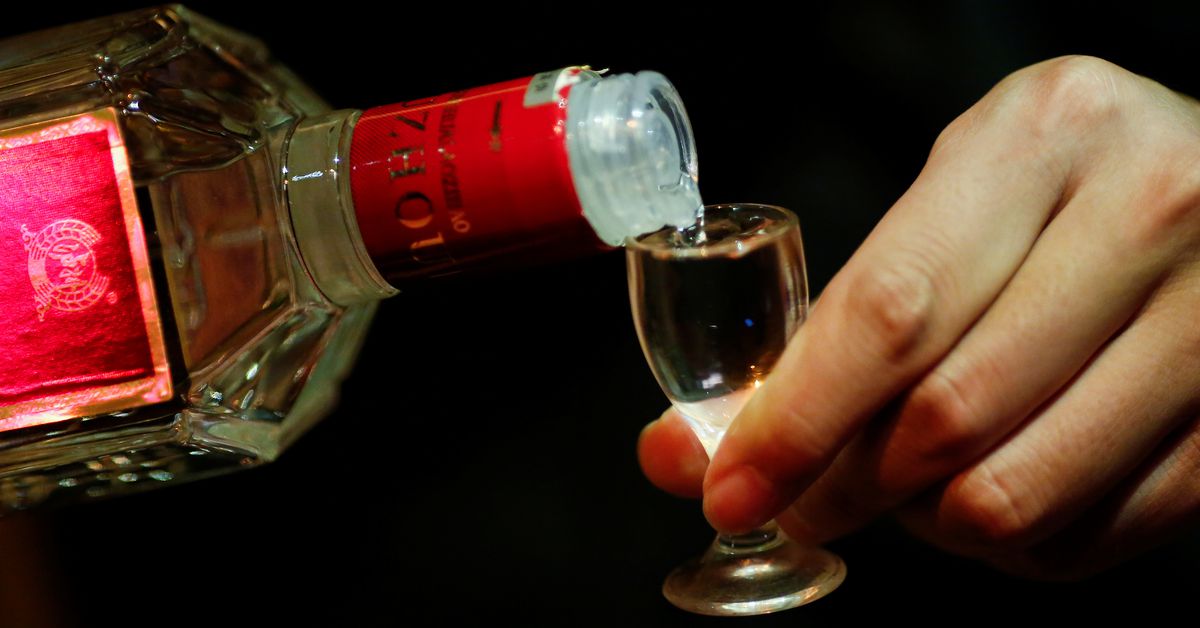
HONG KONG, April 17 (Reuters Breakingviews) – Hong Kong could use a shot of something. Initial public offerings in the financial centre are in short supply, but a KKR-backed (KKR.N) Chinese liquor maker’s up to $811 million listing will be the city’s largest so far this year. Beijing is channelling funding onshore to strategic industries, and that will send more consumer companies to the Asian hub. The result could be appetising.
Baijiu, a potent colourless spirit, accounts for over two thirds of China’s alcoholic beverage market – surpassing the roughly 50% share of wine in France and beer in the United States. Yet compared to the $313 billion Shanghai-listed behemoth Kweichow Moutai (600519.SS), debutante ZJLD is a drop in the near-$100 billion baijiu industry: it logs less than 1% market share.
Still, the deal is set to invigorate valuations in the city dragged down by a global technology rout. At the top of the marketed price range, ZJLD could be worth $5.4 billion, or almost 24 times this year’s forecast earnings, IFR reports. That’s a discount to Moutai’s 29 times, per Refinitiv, but higher than one-time investor darlings Alibaba (9988.HK) and Tencent (0700.HK).
Compared to the sobering new reality of slower growth and increased government oversight for China tech, alcohol makers, particularly smaller ones like ZJLD, have it easier. Revenue at the company, which will be the first baijiu distiller to list in Hong Kong, was up a healthy 15% last year, while its adjusted net profit margin topped 20%. Over the past three years, an index for mainland liquor stocks has surged 96%, trouncing the broader benchmark CSI 300’s 7% gain.
For Hong Kong, consumer stocks will put the focus back onto classic risks. As part of President Xi Jinping’s campaign to achieve self-sufficiency in areas like semiconductors and artificial intelligence, authorities want to ban certain food and beverage, home appliances and education companies from equity financing on mainland stock exchanges, the Financial Times reported earlier this year.
The track record has been patchy, though. Years of Covid-19 lockdowns and debt-fuelled expansion, for instance, have hurt restaurant chains like hotpot-specialist Haidilao (6862.HK); China’s consumption recovery is weaker than expected. Apparel brands like Anta Sports (2020.HK) and Bosideng (3998.HK) have fared well. ZJLD could also be hit by corruption crackdowns and by policies from cash-strapped local governments – as Moutai has been. Either way, Hong Kong’s biggest IPO this year is a sign of what’s to come.
Follow @mak_robyn on Twitter
CONTEXT NEWS
Chinese liquor maker ZJLD will raise up to HK$6.37 billion ($811 million) in what will be Hong Kong’s largest initial public offering in 2023, according to filings dated April 17.
ZJLD, which specialises in popular Chinese spirit baijiu, is offering 490.7 million shares in a price range of HK$10.78 to HK$12.88 each. At the top of the range, ZJLD would be valued at $5.4 billion.
There is also an option to sell another 73 million shares that could raise an extra $122 million, according to the filings.
U.S. private equity firm KKR owns a 16.2% stake in the company, which will fall to 13.8% after the IPO.
Our Standards: The Thomson Reuters Trust Principles.