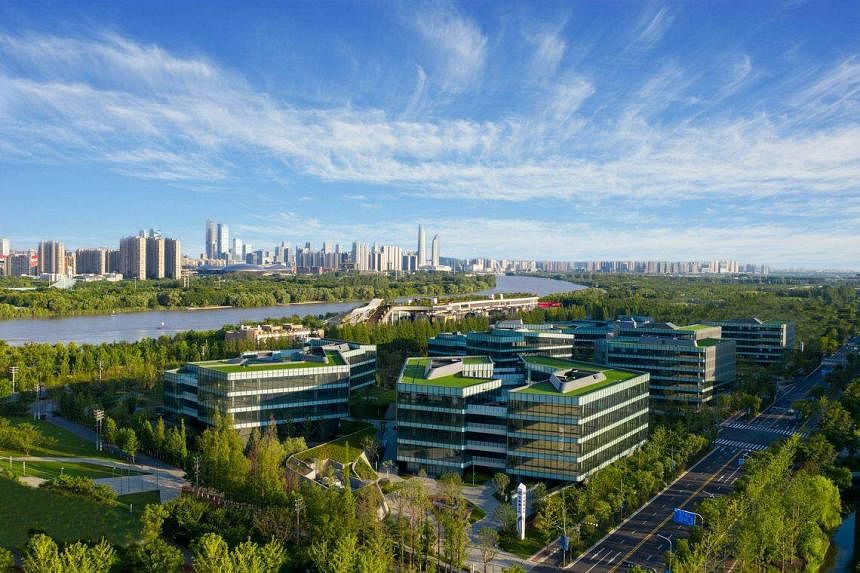
NANJING – Right in the middle of the Yangtze River is an island the size of Pasir Ris, previously best known for its annual grape festival.
But the vines and guest houses that used to dot Jiangxin Island – an islet 6.5km from downtown Nanjing that used to cater to day-trippers from central Nanjing – have largely been replaced by acres of manicured greenery and a clutch of buildings housing the artificial intelligence (AI) units of Chinese tech firms like Huawei, Tencent and iFlytek.
Elsewhere across the island are incubators offering work spaces and collaborative opportunities for companies linked to low-carbon businesses.
As Jiangsu – one of China’s richest provinces – moves towards embracing the green economy, it has tapped Singapore’s expertise in sustainable urban planning, which is evident in the solar-powered office and residential blocks and electric buses that ply the streets of the island.
It is the eastern province’s answer to the bigger, more high-profile Tianjin Eco-City, a project between the Singapore and Chinese governments that will mark its 15th year in September.
Much like the planned city up north, Jiangxin Island, whose name has been changed to the Singapore Nanjing Eco Hi-Tech Island, aims to provide a blueprint of an ecologically friendly smart city.
It is one-part high-tech business park, one-part residential district and one-part waterfront park. There is even a local school for residents.
But the Jiangsu government has its eyes on the island and other science parks in the province to churn out cutting-edge technology as China makes a major push to develop tech self-reliance in the face of growing pushback from the United States and Europe.
Mr Lu Hong, deputy director of the Nanjing Eco Hi-tech Island Economic Development Zone Management Committee, told The Straits Times he has managed to woo at least 12 companies to set up operations on the island since 2019.
A flagship project under the Singapore-Jiangsu Cooperation Council, it is a collaboration between Yanlord Land Group and Sembcorp Development on the Singapore side and the Jianye District State-owned Asset Management Group and Nanjing Hexi New Town State-owned Assets Management Group on the Chinese side.
Construction on the project began in 2009, when residents on the island were relocated. It took nearly 10 years of infrastructure construction, reshaping the landscape of the island, before it was ready for companies and residents to move in.
Most of these companies work on water treatment, environmental protection, AI and smart transportation. Autonomous driving technology company WeRide has been operating driverless shuttle buses on the island.
Mr Lu said there are plans to build another integrated development that will be carbon-neutral, while more water treatment companies are looking to move into the International Water Hub on the island.