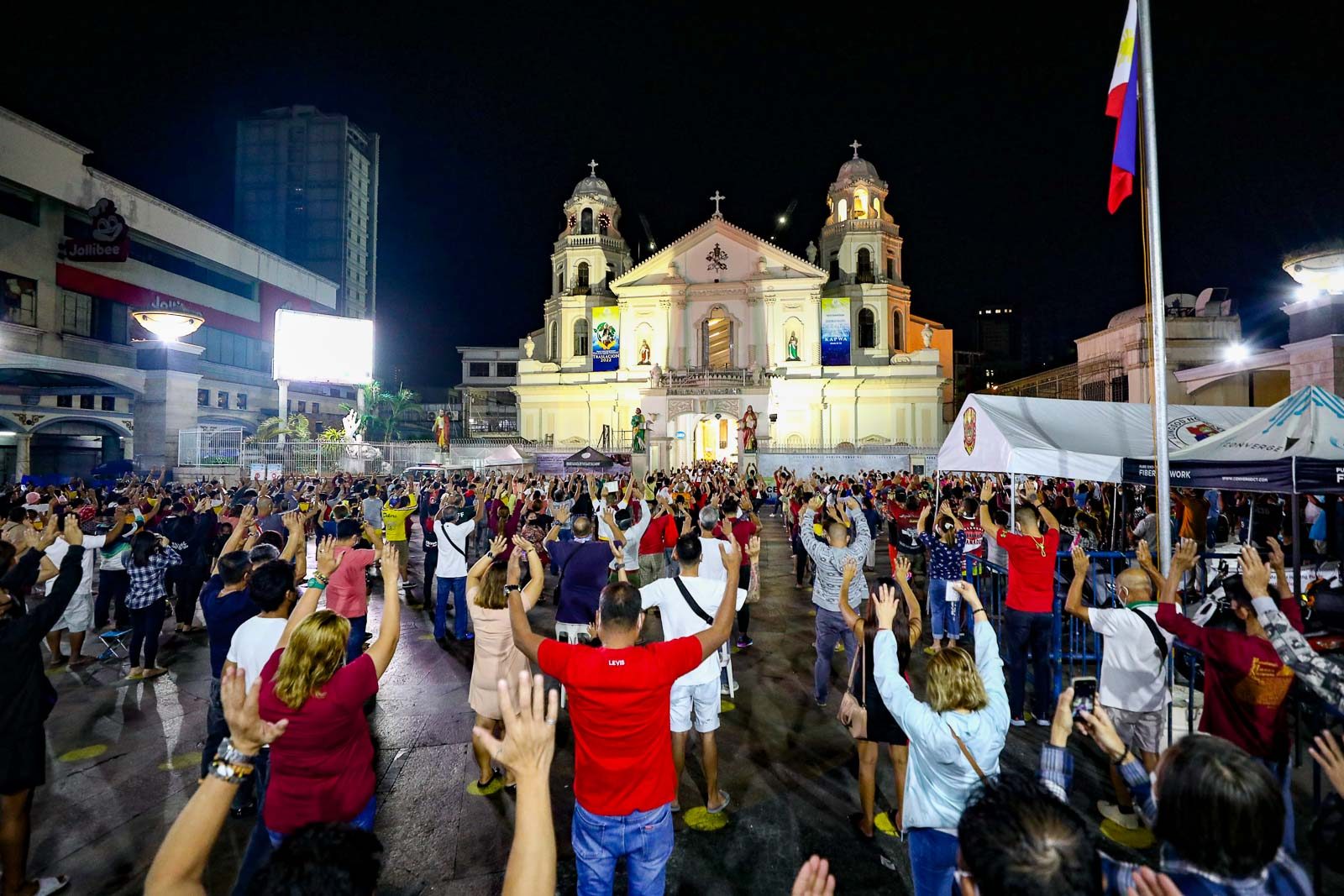
MANILA, Philippines – For many Filipino Catholics, raising or holding hands while singing the “Our Father” or the Lord’s Prayer is among the more tender, heartfelt–at times, awkward–parts of the Mass. But did you know that a debate on the practice’s appropriateness has been ongoing among church insiders?
This debate prompted the Catholic Bishops Conference of the Philippines’ (CBCP) Episcopal Commission on Liturgy to issue a July 16 circular clarifying that both gestures of raising and holding hands are “liturgically accepted to accompany the praying of the Lord’s prayer.”
Prior to the CBCP’s pronouncement, Dumaguete Bishop Julito Cortes released a circular on June 16 decreeing that the laity join their hands while reciting or singing the Lord’s Prayer, as the gesture of stretching one’s hands with palms outstretched–also called the orans posture in the church’s language–is reserved for the priest. Citing “confusions among our lay faithful,” Cortes mentioned that the directive “will ensure clarity and uniformity” of gesture during Mass.
The orans is an ancient gesture of prayer. For early Christians, the orans is a reminder of Jesus crucified. In the current form of the mass in the Roman rite, only the priest is instructed to do the gesture as it symbolizes the priest acting in behalf of Christ. The posture, however, is commonly used by the laity in Eastern rite churches in communion with the Catholic Church.
Earlier this year, Pampanga Archbishop Florentino Lavarias issued a circular for his own jurisdiction “reiterating” previous policy which allows the holding of hands during the Lord’s Prayer. “That the faithful should not do the ‘orans’ position during the Lord’s Prayer is not historically founded; it is not legislated in any rubric or norm in the liturgical books,” the archbishop wrote in his February 7 circular.
Lavarias also pointed out how “every now and then, a mere opinion comes out,” possibly hinting at the varied and sometimes heated posts and discussions online on the issue.
On June 21, Cebu Archbishop Jose Palma called for a “common stand” on the matter among Philippine bishops. While each bishop is autonomous in making decisions for their jurisdiction, Palma said that guidelines from the CBCP will help them “be more united.”
So to hold hands or not: why the confusion? And how is this even relevant to the ordinary Filipino Catholic?
What do church rules say?
The Holy Mass is considered by Catholics as the “heart and summit of the Church’s life” and their highest form of worship. To preserve the celebration’s solemnity, the conduct of Masses is governed by documents such as the Roman Missal and the General Instruction of the Roman Missal (GIRM).
With regards to the Lord’s Prayer, the GIRM only mentions what the priest does: “After the Eucharistic Prayer is concluded, the priest, with hands joined, says the introduction to the Lord’s Prayer. With hands extended, he then says this prayer together with the people.” It does not say what the congregation is doing while praying the Lord’s Prayer.
The controversy lies on whether these documents’ silence means the practice may be permitted or must be prohibited.
The United States Conference of Catholic Bishops (USCCB), a grouping similar to the CBCP, acknowledges the Roman Missal’s silence on the matter. According to the USCCB’s website, “[n]o position is prescribed in the Roman Missal for an assembly gesture during the Lord’s Prayer.”
A 2017 National Catholic Reporter article describes church teaching as “agnostic” on the matter. Given the lack of definitive guidance from the USCCB, US bishops have issued varying opinions on the gesture.
In his 2011 decree,then-bishop of Covington, Kentucky Roger Foys wrote that “extending or holding of hands by the faithful should not be performed” as “no prescribed gesture” for the laity can be found the Roman Missal and the GIRM, and that “only the priest is given the instruction to ’extend his hands.’”
Foys also cited paragraph 42 of the GIRM, which states that “a common bodily posture, to be observed by all those taking part” is a “sign of unity of the members of the Christian community” as it “expresses the intentions and the spiritual attitude of the participants and also fosters them.”
The Vatican II constitution on the liturgy, Sacrosanctum Concilum, is also mentioned by those opposed to the laity’s use of orans, which states that “no other person, even if he be a priest, may add, remove, or change anything in the liturgy on his own authority.”
Bishop Christopher Coyne of Burlington, Vermont, said in a 2014 video that the question is “hard to get a clear answer on.” For Coyne, priests should not instruct people to hold hands because they should not “enforce things that are not legislated or part of the rubrics of the mass.” While the ideal situation is to “simply abide by the rubrics” to avoid confusion, he also said that prohibiting the practice “is probably not worth the upset it will lead to.”
“Sometimes, good pastoral intuition needs to just kind of overlook some things that may not be quite in keeping with the liturgy but you let it go, because it doesn’t affect validity and it doesn’t affect really what we’re all about which is the people of God coming around the altar to celebrate the Mass,” he said.
In 2005, the CBCP issued a circular clarifying that “there has been no directive from the bishops that bans this practice among priests and laypeople.” The only instance the CBCP issued guidelines discouraging the gesture was during the height of the COVID pandemic as a health measure.
The Episcopal Conference of Italy (CEI) is more explicit in allowing the practice. “During the singing and the recitation of the ‘Our Father’ you can keep your hands outstretched; this gesture is done with dignity and sobriety, in an atmosphere of filial prayer,” the Precisazioni (Clarifications) to the Italian translation of the Roman Missal released in 2019 said. The CBCP cited the CEI’s Precisazioni in their latest guidelines.
Inculturation
It is not clear how or when the practice of holding hands during the Lord’s Prayer actually started. In his video, Coyne approximates this to the 1960s and 1970s, when the liturgical reforms of the Second Vatican Council began to be implemented.
Ruben Mendoza, chair of the Theology Department at the Ateneo de Manila University (ADMU), recalls his family doing the gesture even if it was not yet widespread while he was still in elementary school. “It had become more ‘popular’ over time and is regularly practiced in many parishes,” Mendoza, in an email interview with Rappler, observed.
Responding to arguments that the laity’s gesture is “an appropriation of what the priest does or a usurpation of his authority,” Mendoza sees it instead as a “way in which they express their prayer bodily and of their oneness with the worshiping assembly.”
The gesture may also have a deeper cultural significance for Filipinos beyond just mere imitation of the priest.
“In the Philippines, if you really are paying attention to the way people hold hands, they hold hands together–kapit kamay. Or the people, when they are gesturing, it’s really a begging position,” says Tinnah dela Rosa, founder and artistic director of the online liturgical ministry PraySing Ministry.
Dela Rosa, who is also an instructor at ADMU’s Theology Department, argues that the interpretation of holding hands during the Lord’s Prayer as imitation of the priest’s orans gesture “is not very correct,” and “is not very culturally sensitive” to Filipinos’ sensibility.
“There are gestural behaviors that are natural in a culture,” she says. “And to me, holding hands is a very common culture, part of our culture here in the Philippines.”
Dela Rosa recognizes that it is important to “unite the people” in our worship. “That is why I think the church is very careful in prescribing posture, the text that it somehow captures what God, what Christ wants us to do,” she says.
Yet she also believes in the need for “dialogue between culture and faith.”
“Are we forgetting the fact that there is also the component of culture, that we are culturally disposed as Filipinos to seek one another, to connect, to beg, to ask, to not demand? Parang…’yung Filipino sensibility sa aking pang-unawa ay may pagtangi sa kapwa. At ’yung pakikipag-kapwang yan, kitang kita yan sa paghahawak-kamay (For me, the Filipino sensibility in my understanding is characterized by emphasis on community. And that sense of community, that is evident in the holding of hands)”
But beyond being purely liturgical in nature, the debate also reveals ongoing tensions within Catholicism–specifically the role of tradition and culture, as well as the clergy and the laity in the life of the church.
Mendoza cautions those framing the debate “in terms of power,” in which decisions about the liturgy “ought to be decided only by those who are in power,” specifically the clergy. “If the liturgy is truly the ‘work for the people,’ then, should not its practice seriously consider the faithful’s sensibilities as its starting point,” Mendoza asks, referencing the Greek origin of the word liturgy.
Dela Rosa points out how the discussion has become “toxic” in some quarters on social media. She hopes that Catholics “engage with this discourse with a listening ear” in the spirit of synodality.
She admits, however, that the church has more “urgent universal issues” to address. “In this time where people are hungry, and where people are struggling with inflation and with a lack of jobs, and all of these issues confronting the nation, parang these are the least of our problems.” – Rappler.com