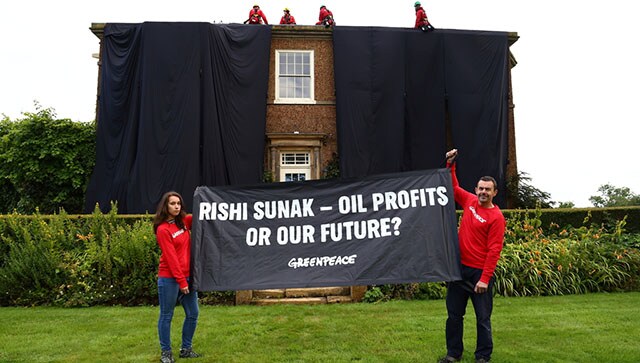
Greenpeace activists pose with a protest poster in front of the manor house of Britain’s Prime Minister Rishi Sunak in Yorkshire, England on 3 August, 2023. AP
Greenpeace has been given the cold shoulder by the British government after its stunt of covering Prime Minister Rishi Sunak’s country home at Kirby Sigston with black cloth to protest against further drilling for oil in the North Sea. But the eco-warriors have actually done the British a favour, although the government appears to be unwilling or unable to recognise it. How else would they have realised how vulnerable their top leaders are in terms of security?
Given his much-envied millions, it is almost certain that Sunak has installed a state-of-the-art alarm system, if not on the estate perimeter then at least on the house itself. Yet, the protesters were reportedly on the property—on top of the house too—for nearly six hours before the police evicted them. Strangely, the first “alarm” from the estate was raised at 8am, two hours after the protesters arrived. And then it took another four hours for anyone to act on the alarm.
Those people may have been just agitated do-gooders but what if they had been terrorists? In six hours, they could have not only booby-trapped the house, but they could also have planted poisonous substances, landmines etc. There should have been heads rolling publicly, after this astounding security breach; yet there is a curious silence. Almost as if they are wilfully downplaying the seriousness to save their skins, or worse still, indicating they are okay with this.
More bizarrely, after this assault on the home of their prime minister, instead of being ashamed of their ineptness and dereliction of duty, the Assistant Chief Constable Elliot Foskett of North Yorkshire Police tried to deflect by saying: “There was no threat to the wider public throughout this incident which has now been brought to a safe conclusion.” The public was not in danger, so was it acceptable? Indians would justifiably cackle at this ridiculous pronouncement.
The Sunaks may not have been in residence at the time but that is no excuse for the security personnel to slack off. It would not be farfetched to speculate that malevolent organisations of all kinds will note with satisfaction that the British security force remains unwilling to own up or face up to the reality of our times. And that could be reason enough for them to plan accordingly. Their target need not even be this PM; lax VIP security puts targets on many backs.
In July 1982, a man climbed up a drainpipe to enter Buckingham Palace and wandered around for 30 minutes, ate and drank whatever he found and left. This even though three alarms went off and security was alerted by a staffer. A few days later, he again scaled the palace’s 14-ft-high boundary wall, went up a drainpipe to enter and reached the bedroom of Queen Elizabeth II. An alarm went off again but the security staff decided it was faulty and ignored it.
No one came even after the Queen called the switchboard for police help and also rang her bedside alarm bell. Only when she got hold of a staffer in the corridor and told her to get security, did two policemen finally arrive. It seems the intruder got in when one of her security detail left after his duty hours ended but before his replacement arrived to take over. Sounds like a Keystone Cops movie, except that it was all too real. How long can security depend on good luck?
There was inquiry into how this was allowed to happen, and a report did criticise the (in)action of the security detail on those days and the haphazard command system. The Home Secretary of that time offered to resign too, but that was not accepted by the then PM. He was not directly responsible anyway. But what of those who failed to do their jobs? Evidently no lessons were learnt about VIP protection or maybe UK’s security services forgot them by 2023.
Indira Gandhi was assassinated by her own security guards within the compound of the prime minister’s house and office complex just two years after the intrusions at Buckingham Palace. Unlike the British establishment, India did not forget the gruesome lessons learnt about VIP security lapses in October 1984, particularly since officials had taken many steps to keep the PM safe but, tragically, had not foreseen that her own close security staff would turn on her.
There is no doubt in any Indians’ minds that those in charge of the prime minister’s security since that tragedy constantly reassess threats to their principal “protectee” and take appropriate action. No place frequented by serving Indian prime ministers and their close relatives are left unprotected. That the Supreme Court appointed a panel to probe why the prime minister’s motorcade was stopped in Punjab for 20 minutes in 2022 is proof of how seriously security is taken by the Indian establishment.
The worst terror attacks are almost always unforeseen but not entirely unexpected. Consider what happened in the US on 11 September (“9/11”) 2001. According to the final report of the National Commission on Terrorist Attacks Upon the United States, “The 9/11 attacks were a shock, but they should not have come as a surprise. Islamist extremists had given plenty of warning that they meant to kill Americans indiscriminately and in large numbers.”
It is wise to reconsider today the warning signals that the report listed. In February 1993, Ramzi Yousef and accomplices hit World Trade Centre with a truck bomb but arrests foiled simultaneous attacks on other New York landmarks. In 1995, Manila’s police uncovered a plot by Yousef to blow up a dozen US airliners over the Pacific. There were more attacks on US citizens in 1995, as well as 1996, 1998, 1999 and 2000. Antennae went up but 9/11 happened anyway.
‘As for Mumbai’s “26/11” attacks in 2008, hotelier Rattan Keswani recounted in a recent memoir that a security professional hired by the company to plug loopholes as intelligence had indicated possibility of terror activity had eerily said short of terrorists landing in boats and entering the hotel all guns blazing, every possible precaution had been taken. Pakistani masterminds may have decided on their Mission: Impossible-type plan precisely because of its improbability.
Of course today’s Britain is not as big a hate figure as the US anymore but that does not mean its senior leaders are safe from terrorists or plain criminals. Much is made of the prowess of MI5 and MI6, bolstered by movies and serials, but villains go by everyday examples of botched security measures and make their plans. By allowing Greenpeace activists to invade their PM’s house, the British establishment has let inimical elements deduce its weaknesses.
The British public, political class and media are also partly to blame for this police lethargy because of their constant carping about Sunak’s millions. They are so scathing about what use “taxpayer money” is being put to, that even legitimate spending is denounced as excessive and unnecessary. Hence their silly opposition to Prince Harry—who remains a royal, whether “working” or not, and therefore a target—getting official security even if only when in the UK.
They forget that the state has a responsibility to guard all its citizens regardless of their financial status, and PMs certainly qualify for extra care given that their official decisions often make them targets of more sinister entities than just Greenpeace type activists. Even if Sunak has installed the world’s best security systems in that house, the police should not have slacked off. Britain cannot wait for a tragedy to happen before acting to prevent more in the future.
The author is a freelance writer. Views expressed in the above piece are personal and solely that of the author. They do not necessarily reflect Firstpost’s views.
Read all the Latest News, Trending News, Cricket News, Bollywood News,
India News and Entertainment News here. Follow us on Facebook, Twitter and Instagram.