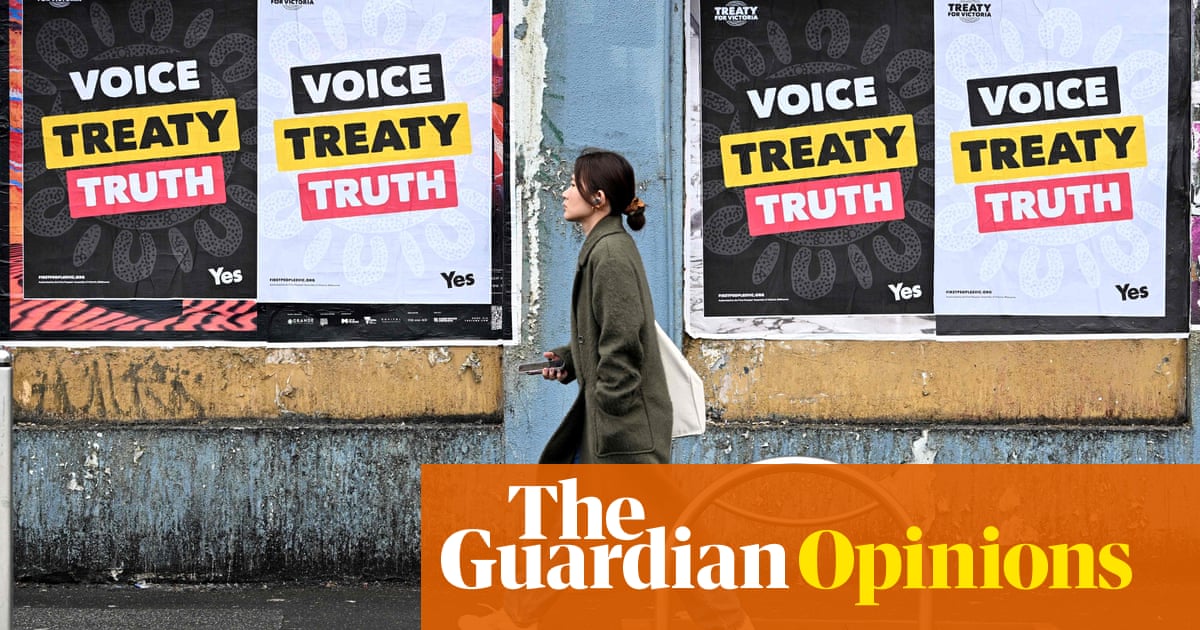
Over the next six weeks Australians will choose between two very different visions of their society, presented by two very different campaigns. This will go beyond the contest between love and fear, beyond social media versus live events, beyond party politics, beyond yes and no.
It will reach, in often challenging ways, into the very soul of the nation.
Ever since John Howard said that Australians were sick of endless seminars on national identity, the habit of critical self-reflection has diminished. The muscle weakened by lack of use, nation-building reduced to satire in the market-driven economy that was its proxy.
Progressives became uncomfortable discussing national identity and rarely got beyond the rhetoric of diversity and inclusion. They failed to repurpose old, enduring, notions of fairness and collective good in a contemporary way.
Meanwhile, the threadbare myths of old Australia noisily but uncomfortably bumped into the new diverse reality. The Aussie Aussie Aussie oi oi oi brigade claimed fairness as their moniker – poised to divide, exclude and demand another handout.
It is a faultline older than the nation. It grows from failing to meaningfully recognise the First Peoples of this continent and the humility that demands.
Once this would have been bridged by the push and pull of the media as new knowledge was tested, and new ways of being, doing and seeing emerged. But the professional media shrank, journalists were besieged, swamped by new, unregulated and partisan platforms.
For five years after the Uluru Statement from the Heart, a new consensus had slowly built. The astonishing achievement of the hard-won agreement embedded in the statement touched the hearts of those who had been paying attention, and over time their number grew. By mid-2022 the polls suggested nearly two in three Australians were ready to embrace meaningful recognition – voice, treaty, truth.
And then in 2023 this new consensus began to crumble. For six months polls slid, the referendum was routinely described as “troubled”. Journalists reported and amplified, but rarely effectively challenged.
This did not happen spontaneously, but by carefully manufacturing a new consensus on social media footings.
In this new order where “facts” are contested, different (contradictory) versions can be targeted at niche communities. The aim is to disrupt, delay, subvert and confuse. Especially to confuse.
In Australia, collective discomfort about race pulses not far below the surface, an itch ready to be scratched. When the no campaign elevated “race” as its central issue, claiming it did not want to divide by race, it did just that. Classic Orwell.
Social media is confusion’s optimised delivery mechanism – short grabs, snappy phrases, endless questions, contradictions – on every device and platform. It is at once communal and intimate; can make you laugh and fume. As Peter Pomerantsev writes, it envelops “your most personal online spaces, spun … into the texture of your life”. Before long it “literally penetrates the country’s subconscious”.
Over the past decade we have watched as other nations have made decisions driven by social media that, from a distance, seemed mystifying: Brexit and the ascendancy of Donald Trump. Similar things were happening around the globe, in the Philippines, Mexico, Estonia, Brazil, India, Canada, Poland, Germany, Taiwan, Spain, in the Middle East and Africa.
This was less about the instinctive appeal of authoritarianism than the deliberate attempt to manufacture a new consensus, using bots, cyborgs, trolls, AI, foreign actors and good old-fashioned keyboard warriors.
Textbooks were written on how to change minds and create a new “ersatz normality”.
Whether no campaigners had read these books, or simply absorbed the lessons, the parallels were uncanny.
The way social media, unwittingly aided by traditional media and foreign actors, can “manufacture consensus” is now well established. It is powerful because most people dread exclusion and want to fit in with the majority.
In Australia, the summer holidays incubate seeds that germinate all year. Howard called them “barbecue stoppers”. Now words that work, facts that stick, are tested on social media and then amplified on TV and radio.
It started last November when David Littleproud announced that the National party would oppose the referendum before the question was formulated. It was easy to underestimate; a party playing to its base.
Five weeks later, after both listening to the barbecue chat and stoking the fire, Peter Dutton announced he was asking the prime minister 15 questions about the voice, ostensibly as part of his decision-making process. Some could not be answered – the process was under way – but the failure of the government to provide a cut-through explanation shaped conversations for the rest of the summer. Online it was off and running.
A cascade of news stories carried messages that activated the special racism reserved for Indigenous people – violence in Alice Springs and Queensland, cultural heritage in Western Australia, art centres in South Australia and Canberra, Stan Grant and the coronation. Whatever the merits of the reports, the imputations they carried – that Indigenous people were somehow less trustworthy – bubbled over in words and images and swamped social media without risk of contradiction.
Then, even as internal Yes23 polling showed that well over a third of the population said they were undecided and knew little about the referendum, the public polls suggested it was all over. Warren Mundine boasted no had Queensland and WA wrapped up.
Yes supporters were confused. The affirmation they felt attending events was not echoed online, instead they encountered a hostile onslaught. Many built DIY pages and groups online. As more institutions signed up, no voters thought they were under attack from “elites”. Indigenous people reported unprecedented lashes of assault online and in person; “a hunting season for Aboriginal people”.
The question is, can the meaningful recognition consensus – which took generations to nurture before it emerged at Uluru – be preserved by the direct one-to-one model of the yes campaign? Or will it be swamped by the virtual poison of the new manufactured consensus online and its media amplification?
This will be a test for Australia, as it is for every country grappling with change in the new information order.
-
Julianne Schultz AM is the author of The Idea of Australia: a search for the soul of the nation, and a signatory to the Together, Yes open letter