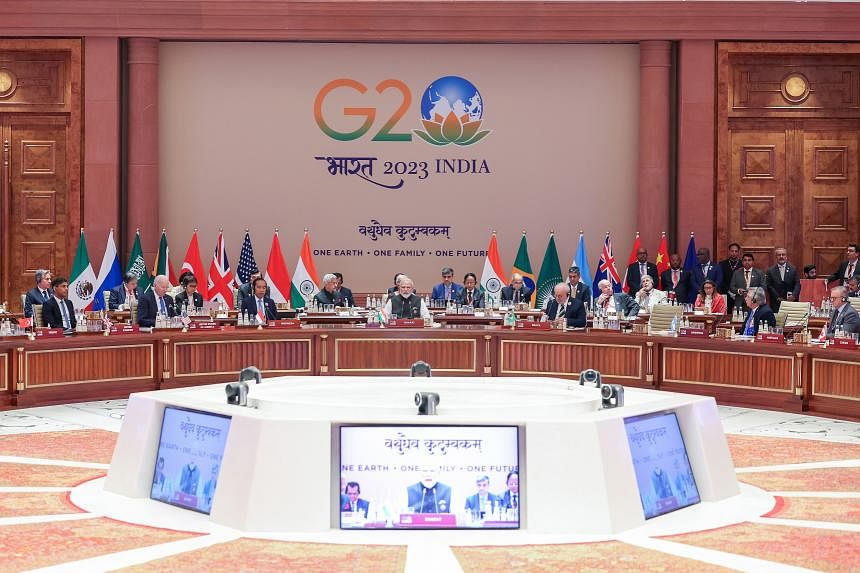
NEW DELHI – India pushed past the deep fault lines over the Ukraine war at the Group of 20 (G-20) leaders’ summit to forge consensus on a New Delhi declaration that refrained from directly condemning Russia.
In a big boost for India’s presidency of the grouping, Prime Minister Narendra Modi announced on Saturday, the first day of the two-day leaders’ summit in the capital city, that the declaration had been adopted by the G-20 leaders.
Negotiations over the wording on the Ukraine war went down to the wire. Indian officials revealed that the help of emerging economies Brazil, South Africa and Indonesia, the earlier G-20 chair, had been crucial in hammering out a compromise between the Western nations on one side and China and Russia on the other.
This involved convincing the Western countries to drop a reference to “the aggression by the Russian Federation against Ukraine”, which was included in the G-20 Bali declaration in 2022.
And then there were lengthy negotiations with Russia and China hours before the leaders’ summit, Mr Amitabh Kant, India’s sherpa or country representative for the G-20, told the local media.
The Delhi declaration said: “We call on all states to uphold the principles of international law including territorial integrity and sovereignty, international humanitarian law, and the multilateral system that safeguards peace and stability.”
Russian President Vladimir Putin was notably absent, as was his Chinese counterpart Xi Jinping. Russia was represented by its Foreign Minister Sergei Lavrov, and China by Premier Li Qiang.
Eight of the declaration’s 83 paragraphs were devoted to lengthy references to the Ukraine war.
Highlighting the economic fallout of the war, the declaration also referred to the Turkey and United Nations-brokered grain deal and called for its “full, timely and effective implementation” to facilitate the movement of grain, foodstuffs and fertilisers/inputs from the Russian Federation and Ukraine.
“This (Ukraine war) is today a polarising issue. There are multiple spectrums of views on this. In all fairness, it was right to record (in the joint declaration) the reality in meeting rooms,” said Indian External Affairs Minister S Jaishankar.
However, the Ukrainian Foreign Ministry said the joint declaration was “nothing to be proud of” and criticised it for not mentioning Russia.
Still, ministry spokesman Oleg Nikolenko, in a Facebook post, said: “Ukraine is grateful to the partners who tried to include strong formulations in the text.”