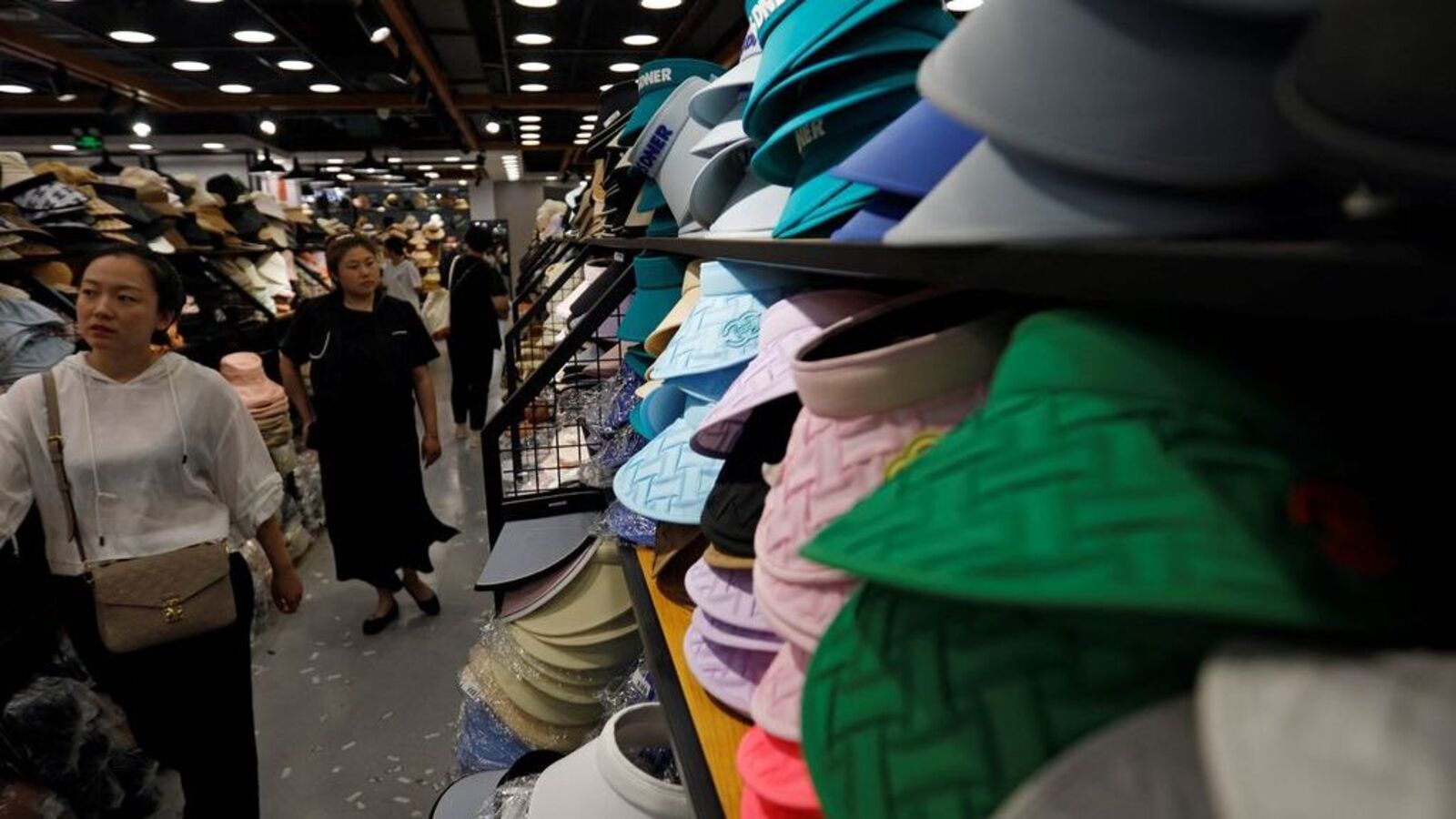
Chinese sales have been soaring at online retailer Pinduoduo, budget household-goods chain Miniso and Japanese fashion brand Uniqlo. The companies have become a magnet for cost-conscious Chinese consumers, and are faring better than their more upmarket rivals.
The country’s postpandemic economic recovery has been uneven so far. Its citizens have resumed shopping, traveling and dining out but more are scrutinizing everything they spend money on. Chinese social-media platforms are rife with discussions about “consumption downgrades,” where people share their experiences of finding cheaper versions of everyday items such as face wash and work apparel. Overall retail sales in China rose in single-digit percentage terms in the past few months from a year ago, according to official data.
Investors are making wagers on the new spending habits of Chinese consumers. American depositary receipts of Nasdaq-listed PDD, which owns Pinduoduo, are up 31% this year and its market capitalization of about $142 billion is now roughly three times that of e-commerce rival JD.com
JD.com’s ADRs are down 50% in the year to date, while the broad MSCI China index has fallen back into a bear market.
PDD’s revenue jumped 66% to $7.2 billion in the second quarter, according to its most recent results. Founded in 2015, Pinduoduo sells groceries, apparel, electronics and other items online at prices lower than many other retailers.
Its platform, which has been popular with people from less developed parts of the country, is also drawing more middle-class consumers in major cities. PDD executives said the company has stepped up its efforts to provide more savings to value-seeking shoppers. It also sells branded goods: A recent promotion saw Pinduoduo offering a discount of up to 500 yuan, equivalent to almost $69, on Apple’s new iPhone 15 Pro Max, whose regular retail price starts at 9,999 yuan.
Revenue at JD.com rose 7.6% to $39.7 billion during the second quarter. The e-commerce giant has also pivoted more toward selling inexpensive and discounted goods.
Earlier in the year, international investors were more optimistic about China’s post-Covid recovery and the spending power of its growing middle and upper-class population. They drove up the shares of luxury goods makers which derive a chunk of their sales from Chinese consumers, such as LVMH Moët Hennessy Louis Vuitton and Richemont, the owner of watch and jewelry brand Cartier. These stocks have slumped in recent months as economic data weakens.
Many Chinese households are grappling with increased uncertainties around their employment and incomes, while the country’s housing downturn is eroding the value of the properties they own. That is making people spend more selectively, and hunt for bargains.
“Consumers are hoping to maintain their quality of life at the lowest possible cost,” said Chris Gao, an analyst with CLSA Securities. People’s income expectations need to recover in order for consumption to pick up, Gao added.
Chinese consumers have been spending less on clothing lately, according to a recent CLSA survey. It also found that many local shoppers think the apparel brand Uniqlo offers the best value for money—more so than Western brands such as H&M, Zara, and Gap—and was the most purchased brand among all age groups surveyed.
On Chinese social media, people have shared anecdotes about how they switched to Uniqlo for work attire and unexpectedly encountered others wearing the same outfits.
The Tokyo-listed shares of Fast Retailing, which owns Uniqlo, have risen more than 30% this year. The company said its same-store sales in mainland China—its biggest international market—expanded 40% in the three months to May from a year ago. Uniqlo’s China sales hit a record for the company’s fiscal year that ended on Aug. 31, Fast Retailing said on Thursday. It noted that the post-Covid recovery was stronger than its expectations.
“It seems that value-for-money products are the theme this year,” said Chelsey Tam, a senior equity analyst with Morningstar. She added that this is partly a result of the weakness in the broader economy and the slow recovery in consumption spending.
Miniso, whose red-and-white logo bears a resemblance to Uniqlo’s, sells toys, cosmetics and stationery with an average retail price equivalent to around $2. Its shares, which are listed in New York and Hong Kong, have more than doubled this year.
Miniso’s in-store sales in China jumped around 40% in the second quarter, far exceeding the roughly 10% increase in national domestic retail sales. Its revenue from the country totaled about $295 million for the period.
Stock investors earlier expected a strong rebound in consumption in China after its lockdowns and other pandemic restrictions were lifted late last year.“Expectations have been reset to a very low level,” said Haider Ali, an associate portfolio manager with T. Rowe Price. He said there have been pockets of growth, and some segments where Chinese consumers are still willing to pay higher prices for premium products, such as alcoholic beverages.
In the longer run, he said he still believes that an increasingly affluent middle class will drive higher spending in China. “People are still going to consume…we need to read the tea leaves and see what are the trends and invest on that basis,” Ali added.
Write to Cao Li at [email protected]