
cent tariffs on Chinese EVs are only hurting Canadians – and 100 per cent helping Americans.’ Letters to the editor for Oct. 17
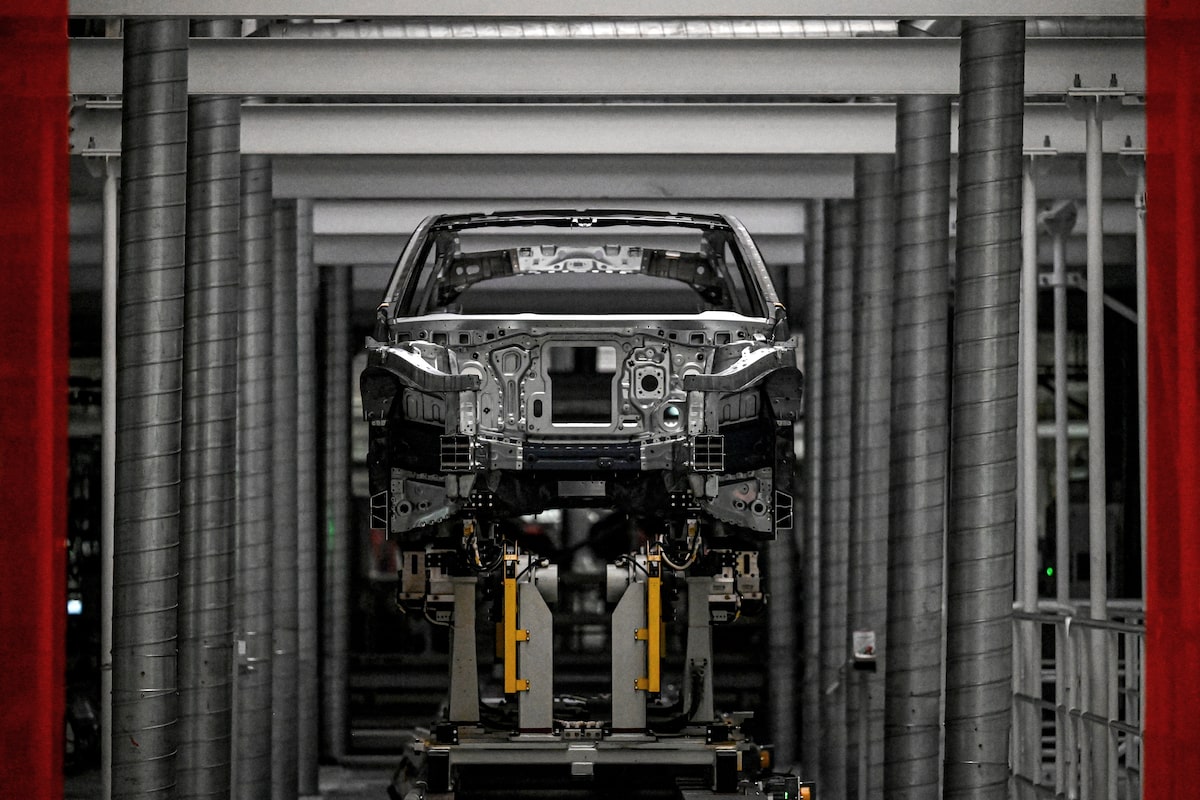
Canada currently has a 100-per-cent tariff on Chinese electric vehicles.JADE GAO/AFP/Getty Images
EVs, please
Re “Stellantis shifts Jeep Compass production to Illinois from Brampton” (Oct. 14): I need someone smarter than me to explain why we continue to put 100-per-cent tariffs on Chinese EVs. I was told that it would help keep car manufacturing in Canada and help transition our production toward greener transportation. Yet U.S. President Trump and the North American car industry that we are trying to protect are both determined to send all car and truck production south of the border.
So what is the point of the tariffs on Chinese EVs, especially when China matched us with their own punishing tariffs on Canadian farmers?
Personally, I’d love to have sub-$30,000 EVs in Canada, as they already do in Europe, to help us meet our climate and electrification goals. And why not sweeten the pot by importing duty-free Chinese solar panels as well?
Hopefully, Mr. Carney will see that in today’s MAGA climate, 100-per-cent tariffs on Chinese EVs are only hurting Canadians – and 100 per cent helping Americans.
Chris Dinsdale Barrie, Ont.
Re “Team Canada is shooting on its own net when it comes to trade” (Oct. 15): Our ability to purchase inexpensive electric vehicles here in the West and continue to sell a very important agricultural product worth billions to China, what’s not to like? David Eby, you were correct in your assessment that the visibility of Western concerns is lost on Central Canada. It has always been thus.
William England Edmonton
Peace dealing
Re “Donald Trump was essential to the ceasefire” (Opinion, Oct. 15): Yes, Donald Trump was essential to the ceasefire. But it seems a bit absurd to credit the chief enabler of the war with its, at least, temporary cessation. The provision of military equipment and other aid by the U.S. to Israel (ramped up under the Trump administration) was essential for Israel to continue to wage war. I suspect it was a threat by Mr. Trump to stop this aid that pushed the Israeli government to get serious about a ceasefire and what ultimately secured the deal. No doubt the erratic, unprincipled, undisciplined behaviour of Mr. Trump gave credence to his threats in the eyes of both Israel and Hamas. The big question is: Why didn’t this happen much sooner?
Mark Roberts Gananoque, Ont.
I would suggest to Ms. Urback that Mr. Trump didn’t get a peace deal that Joe Biden couldn’t, but that Benjamin Netanyahu leveraged the lack of a peace deal in order to hurt the Democrats and get Mr. Trump re-elected, perhaps even at Mr. Trump’s behest.
Tom Reader Peterborough, Ont.
Foreign or domestic?
Re “Ford’s new doctor policy is ridiculous” (Opinion, Oct. 14): Every year, highly motivated and superbly qualified Ontario students decide to attend medical schools abroad in places such as the U.S., Ireland or the U.K., where they receive high-quality medical education. Problem for them is that owing to current rules, the only route to residency is to apply in the International Medical Graduate (IMG) pool, where they are competing with those who have never spent a day in Canada, let alone Ontario.
The changes proposed by Health Minister Sylvia Jones are sound in that now those Ontario students who have studied abroad will have an increased chance of gaining residency positions in Ontario. These students desperately want to train and remain in Ontario, unlike those from outside who choose to return to their place of origin.
Allowing for bona fide Ontarians to have increased access to IMG spots will only enhance the availability of new doctors into our system.
Mark A. Greenberg MD, CCFP (AM), FCFP, ASAM, University of Toronto, Sunnybrook Health Sciences Centre Toronto
André Picard is completely on target. Wealthy individuals whose children had attended foreign medical schools complained that there were not enough residency positions for their children.
Ontario Premier Doug Ford is a person who reacts to rather than reflects upon an issue. Subsequently, pertinent evidence and related research are ignored, leading to hasty decisions regarding complex issues such as access to family doctors. While Mr. Ford interferes with local decisions, such as bike lanes and speed cameras, he ignores complex issues such as health, for which he, as Premier, is responsible.
I also remind Mr. Ford that roughly one-quarter of doctors in this province are foreign-born. How many of them would be practising here today if this silly policy were in effect over the past few decades?
The health care system is not working. It needs creative and broad thinking for its entire population, not facile responses to a small, self-interested and well-to-do group.
Jack Lee Toronto
Read the room
Re “RBC wants wealth management to be its next profit powerhouse, starting with a big U.S. push” (Report on Business, Oct. 15): Sadly, RBC has shown its true colours. Its plans for growth are based upon extending its wealth management operations to the U.S. Has it not been listening or noticing the rest of Canada distancing themselves from the U.S.? I assume it will soon be renamed. RBCUS?
Allan Hutchinson Toronto
War footing
Re “Zip up, Canada: It’s time to build a wartime economy in the North” (Opinion, Oct. 14): All this preparation for war, as Europe is also doing, is false, non-productive growth of the economy, wasting precious resources on implements of destruction. Can anyone at this Russophobic NATOist newspaper even imagine a global north united in peace?
Could Canada again be a leader toward peace in bringing Europe, Russia and Canada together in peace and co-operation toward the betterment of humanity, rather than continue to promote the failing American dominance by military force?
Think about it: One path leads to a successful civilization, the other leads directly into nuclear winter. Choose wisely.
Kathleen McCroskey Surrey, B.C.
AI and kids
Re “As generative AI creeps into children’s tech, parents divided on whether to resist or embrace it” (Oct. 15): Given the well-documented harms and addictive potential of the smartphone, I do not think its habitual use by young children – in the case of this article, seven and four years old – should be normalized. The childhood we used to have, where we spent our time using our bodies to do real things, needs every parent’s effort to support.
That AI is bringing new dimensions into children’s usage of phones, to the point of unhealthy relationships with chatbots that have led to teen suicide, should be a huge and overdue red flag.
I am heartened by psychotherapists like Jennifer Estrela, who does not let even her 16-year-old use social media. I hope that the ample research on this topic (Jonathan Haidt, The Anxious Generation) will lead to firm parental restrictions on children’s cellphone use – which may have to start with parents’ own modelling.
Carol Lewis London, Ont.
………………………………………………………………………………………………………………….
Letters to the Editor should be exclusive to The Globe and Mail. Include your name, address and daytime phone number. Keep letters to 150 words or fewer. Letters may be edited for length and clarity. To submit a letter by e-mail, click here: [email protected]

