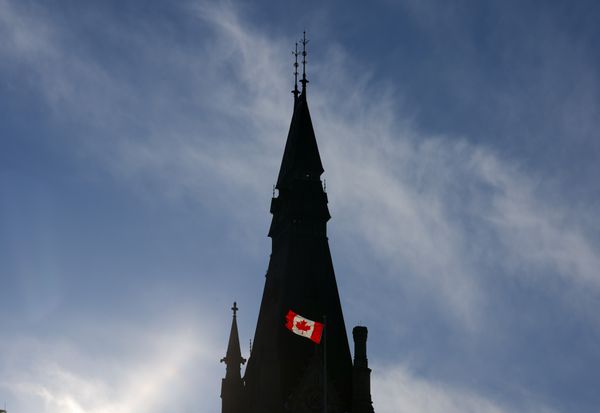
A Canada flag flies beside the West Block tower on Parliament Hill in Ottawa on March 6.Sean Kilpatrick
Earn it
Re “When MPs put lobbyists ahead of a healthy democracy” (Editorial, April 3): The underlying problem is the MP ecosystem that has existed for a couple of decades.
It seems to me that many MPs have never earned their positions. Many bring little real-world experience to the job.
They start off assisting elected officials, learn the campaign game and then throw their hats in the ring. Upon losing re-election or on retiring, many become lobbyists. And so it goes.
For those of us who volunteer, it is troubling to watch. I say ban lobbying. Then we will see if MPs want to work and represent their ridings.
Tom Kent Calgary
Atomic answers
Re “Moltex vows to help Canada recycle its nuclear waste. Critics say the by-products would be even worse” (April 3): Why is Moltex, along with key partners such as NB Power, not answering questions about its technologies? Answers are needed.
Whatever waste there is, how and where will it be stored in an environmentally safe manner? I expect that the poor will, once again, be the ones to suffer because the storage of toxic, long-lasting materials will most likely occur in or near low-income neighbourhoods.
This sounds like a continuation of the production of poisons.
Kathleen Drury Halifax
Let’s chat
Re “The peril and promise of artificial intelligence” (Report on Business, April 1): The development of artificial intelligence raises all kinds of possibilities, both good and bad.
On social media, people may realize that any post should not necessarily be believed. Already “deepfakes” are popping up: Pope Francis in a fashionable white puffer jacket, for example. Photographs and video can also be manipulated at a level that cannot be detected by anyone without access to specialized software.
It might be a good time to sell, or even short, shares in these companies. Meta has poured billions of dollars into creating virtual worlds where people can interact with others, avatar to avatar, no actual contact necessary.
But if we have no way of knowing if even our spouse or friends are real, then face-to-face contact will likely make a comeback. It is hard to believe that might be all bad.
Colin Lowe Nanaimo, B.C.
In a former colleague’s class of 18 international students, she said 12 had used ChatGPT. The responses to her comments about their use of artificial intelligence included annoyance, humiliation, anger and regret.
What seems obvious is nothing new: Critical thinking is important. So is writing in class, even if reading atrocious and unco-ordinated handwriting makes life harder for teachers,
Margaret van Dijk Toronto
So thousands of frightened researchers and executives propose a six-month moratorium on the development of artificial intelligence. I’d be more likely to share their fear if they had exhibited a better grasp of AI’s potential.
I asked ChatGPT to “develop a list of 325,862 highly credentialed scientists who recommend slowing AI research.” Thousands? Pshaw.
Ab Dukacz Mississauga
Following up on a professor at Georgetown Law School’s Centre on Privacy and Technology and her decision to ban the use of the phrase “artificial intelligence,” I’d suggest adopting the alternative name that Emily Bender, a computational linguist at the University of Washington, has suggested: “Systematic Approaches to Learning Algorithms and Machine Inferences.”
Then we would be asking: “Is this SALAMI intelligent? Can this SALAMI write a novel? Does this SALAMI have human emotions?”
Murray Reiss Salt Spring Island, B.C.
Country to country
Re “The wealth of your neighbourhood can affect your chances of surviving a heart attack, study shows” (April 5): Notwithstanding the exclusion of uninsured Americans, the accompanying charts show that the one-year mortality rates for two types of heart-attack victims is higher among the wealthiest quartile of insured Americans than the poorest quartile of Canadians.
And while Taiwan has the smallest gap between the wealthy and poor, the mortality rates for both groups are highest among the cohort studied.
Steve Pedretti Toronto
Shot in the arm
Re “We need to remember what measles can do and ensure it remains in the past” (Opinion, April 1): Thanks for the timely reminder about the importance of measles vaccination. One need not go back to 1713 to find reasons to fear this disease.
As a medical trainee in Hamilton in 1972, I recall trying, and failing, to save a one-year-old with acute measles from dying a terrible pneumonia death. A few months later, it was an older child with intractable seizures from measles encephalopathy, a brain disease which left him permanently brain-damaged.
Given the extraordinary effectiveness of the measles vaccine, it is beyond tragic to contemplate the return of this disease.
David Payne MD, Toronto
Be nice
Re “Is it just me, or is society becoming ruder and meaner?” (Opinion, April 1): I recently met with colleagues from different economic sectors and talked about this very subject. Our answer: Absolutely, the world is getting meaner. We see it every day.
We have created an economic system where employees know they are as disposable as Kleenex. Since their employers have no loyalty to them, they have no loyalty to their organizations. So loyalty is not a value seen as having any cultural importance.
Social media has trained us to be reactive and not reflective. We see no more boundaries of civility. How many organizations must now display posters saying that abusive behaviour will not be tolerated?
We revel in meanness instead of celebrating generosity. We need to fix this. If we don’t, meanness will lead to more violence and chaos.
Kindness and compassion are virtues in all religions, because we know all too well that we cannot survive as a society without them.
Christopher White Reverend, Kedron United Church; Oshawa, Ont.
To-do list
Re “Reply back” (Letters, March 31): A letter-writer brings up the fact that Canada only produces 2 per cent of the planet’s emissions, so why change our ways? I don’t think I could live with myself if I didn’t do as much as possible to reduce my carbon emissions.
I have no dishwasher and no dryer. I use bathwater to flush the toilet. I have a small car, but walk whenever possible instead of driving. I wear old clothes most of the time and keep the house at 16 C. The list goes on.
I’d rather be part of the solution than part of the problem.
Susan Halliday Sarnia, Ont.
Letters to the Editor should be exclusive to The Globe and Mail. Include your name, address and daytime phone number. Keep letters to 150 words or fewer. Letters may be edited for length and clarity. To submit a letter by e-mail, click here: [email protected]