From 35m ago
Russia plans to increase air defences over its north-western border to counter Finland’s accession to Nato, a commander in its aerospace forces has said, Reuters reports.
Lt Gen Andrei Demin, the deputy commander-in-chief of aerospace forces, also said further reforms of Russian air defences were “undoubtedly planned and will be implemented”.
In an interview published on Monday with the defence ministry’s official Red Star newspaper, Demin said the purpose of upcoming changes was “the development of the armed forces, aimed at improving the air defence system of the Russian Federation”.
Russia shares a 1,300km (800-mile) border with Finland, which joined Nato last week – a decision prompted by the invasion of Ukraine in February 2022.
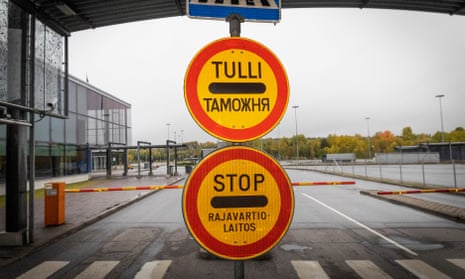
“In these conditions, the air defence forces are working out issues of protecting the state border in the north-west of the country in accordance with the increased threat level,” Demin said.
This is Jennifer Rankin, taking over from Helen Livingstone.
The view from the Ukrainian town of Ochakiv appears idyllic. Beyond the beach, a narrow strip of land stretches out across the sea. The peninsula in Mykolaiv province is known as the Kinburn spit. In happier times holidaymakers would take a boat from Ochakiv and camp among the dunes. The nature reserve is home to swans, pelicans and migrating birds.
Last June it got a new and unwelcome visitor: Russia. Soldiers captured the rustic territory, with its summer houses and mini-lakes, and turned it into a military base. Ever since the Russian army has bombarded Ochakiv, which is five miles (8km) away. Truck mounted launchers release Grad missiles, sending them over the Black Sea. Afterwards the crews speed off and take cover amid the mazy sands.
On Friday, the Russians launched their biggest attack yet. At 5am they hit Ochakiv with 72 rockets. Another 50 fell in the district. The barrage lasted for over an hour. The town’s 7,000 residents woke in darkness to the sound of explosions. Two people were injured, one badly. Thermite projectiles fell from the sky and bathed the waterfront in a strange white light.
“They are swine, savages. They are killing peaceful people,” Serhii Kaminiev, a 52-year-old coffee shop owner, said. Kaminiev’s cafe is in Ochakiv’s central market. One of the Grads landed on the roof of a business selling clothes, setting it on fire. The pavilion was a twisted ruin. Charred T-shirts lay in a heap. Homeless dogs wandered among alleys of broken glass.
Read Luke Harding’s full report from Ochakiv: ‘Savages’: Ukrainian resort town resisting Russian attempts to repeat past glories
Russia continues to prioritise operations around Donetsk in eastern Ukraine “expending significant resources for minimal gains”, the UK Ministry of Defence has said in its daily briefing.
The MoD said that over the past seven days Russia had increased armoured assaults around the town of Marinka, a small town around 20 kilometres southwest of Donetsk city.
Marinka has been on the frontline of fighting since 2014 and now lies in ruins. Before 2014 it had a population of around 9,000 people.
Russia plans to increase air defences over its north-western border to counter Finland’s accession to Nato, a commander in its aerospace forces has said, Reuters reports.
Lt Gen Andrei Demin, the deputy commander-in-chief of aerospace forces, also said further reforms of Russian air defences were “undoubtedly planned and will be implemented”.
In an interview published on Monday with the defence ministry’s official Red Star newspaper, Demin said the purpose of upcoming changes was “the development of the armed forces, aimed at improving the air defence system of the Russian Federation”.
Russia shares a 1,300km (800-mile) border with Finland, which joined Nato last week – a decision prompted by the invasion of Ukraine in February 2022.
“In these conditions, the air defence forces are working out issues of protecting the state border in the north-west of the country in accordance with the increased threat level,” Demin said.
This is Jennifer Rankin, taking over from Helen Livingstone.
The commander of the Ukrainian ground forces has accused Russian troops of switching to “scorched earth” tactics in the embattled eastern city of Bakhmut, in comments quoted by Ukraine’s Media Military Centre and Reuters.
“The enemy switched to the so-called scorched earth tactics from Syria. It is destroying buildings and positions with air strikes and artillery fire,” said Col Gen Oleksandr Syrskyi. “The situation is difficult but controllable.”
Syrskyi said Russian forces were bringing in special forces and airborne assault units to help their attack on the city as members of Russia’s Wagner military group had become “exhausted”. Russia’s assault on Bakhmut, a small city in the Donetsk region, has been the focus of the biggest battle of Moscow’s full-scale invasion launched in February 2022.
Here’s a summary of the key developments:
-
The US Department of Defense says an interagency effort is assessing the impact that leaked intelligence documents, many concerning the war in Ukraine, could have on US national security and on its allies and partners. Officials say the breadth of topics addressed in the documents, which touch on the war in Ukraine, China, the Middle East and Africa, suggest they may have been leaked by an American rather than an ally.
-
South Korea’s main opposition party has urged the government to verify the Pentagon documents, which include claims that the US attempted to eavesdrop on senior officials in Seoul over arms sales. The floor leader of the Democratic party, Park Hong-keun, made the demand after reports that CIA operatives had been monitoring an internal discussion about concerns that artillery shells South Korea planned to sell to the US could ultimately end up in Ukraine.
-
The documents suggest that without a huge boost in munitions, Ukraine’s air defences could be in peril, allowing the Russian air force to change the course of the war, the New York Times has reported. One of the documents, dated 23 February and marked “Secret”, outlines in detail how Ukraine’s Soviet-era S-300 air defence systems would be depleted by 2 May at the current usage rate.
-
Moscow may try to use the upcoming Orthodox Easter holiday on 16 April to delay Ukrainian counteroffensives by calling for a ceasefire out of respect for religion, theInstitute for the Study of War has said in its daily update. It said the Kremlin had selectively called for ceasefires in the past and one at Easter would disproportionately benefit Russian troops preparing for a Ukrainian counteroffensive.
-
Russian shelling killed at least seven civilians in the cities of Kupiansk and Zaporizhzhia over the weekend, Ukrainian authorities said. “This is how the terrorist state marks Palm Sunday,” said the Ukrainian president, Volodymyr Zelenskiy, in his nightly address. “This is how Russia places itself in even greater isolation from the world.” Most Ukrainians are Orthodox Christian.
-
A Ukrainian government minister is due to visit India on Monday and will seek humanitarian aid and equipment to repair energy infrastructure damaged during Russia’s invasion, according to the Hindu newspaper. Ukraine’s first deputy foreign minister, Emine Dzhaparova, will make the first visit to India by a minister from Kyiv since the Russian invasion.
-
Pope Francis and the archbishop of Canterbury, Justin Welby, used their Easter messages to call for peace. The pope asked God to “shed the light of Easter upon the people of Russia”, appearing to ask Russians to seek the truth about their country’s invasion of Ukraine.
-
Russia’s defence ministry claimed it had destroyed a depot containing 70,000 tonnes of fuel near Zaporizhzhia as well as Ukrainian military warehouses in the Donetsk and Zaporizhzhia regions.
That’s it from me, Helen Livingstone, as I hand over to a colleague in London.
South Korea’s main opposition party has urged the government to verify the Pentagon documents, which include claims that the US attempted to eavesdrop on senior officials in Seoul over arms sales.
The floor leader of the Democratic party, Park Hong-keun, made the demand after reports that CIA operatives had been monitoring an internal discussion about concerns that artillery shells South Korea planned to sell to the US could ultimately end up in Ukraine, according to the Yonhap news agency.
South Korea has backed international sanctions against Russia and provided non-lethal aid to Kyiv, but has stopped short of sending weapons. Despite being a major arms exporter, Seoul has a long-standing policy of not selling weapons to countries at war – a stance that has led to charges that the South wants to avoid antagonising Russia, whose support it needs to pressure North Korea into abandoning its nuclear weapons.
The documents highlight South Korea’s ambivalent place in the global weapons trade. While it has baulked at arming Ukraine, its arms sales rose 140% to a record $17.3 billion last year, according to the defence ministry. Currently the world’s eighth-biggest exporter of weapons, the South is aiming to make it into the top four by 2027.
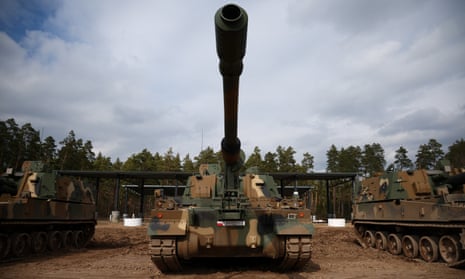
Referring to the New York Times article that reported the alleged eavesdropping, Park said: “If the report is true, it would be an action that can never be acceptable between allies of 70 years, and an infringement of sovereignty and diplomatic foul play that breaks bilateral trust head-on.”
About 28,500 US troops are based in South Korea as a deterrent against nuclear-armed North Korea, while forces from the US and the South regularly conduct joint military exercises.
Park asked the South Korean national assembly to convene meetings of its foreign affairs, intelligence and defence committees to look into the unverified claims, adding that Washington should issue a “polite apology” if they were found to be true, Yonhap said.
The office of the South Korean president, Yoon Suk Yeol, is also facing accusations of a security lapse.
“While it is absurd that a nation’s presidential office is penetrated by eavesdropping, it is also difficult to accept eavesdropping on the offices of an ally’s presidential office,” the Democratic party’s leader, Lee Jae-myung, said.
Earlier this year, the Nato secretary-general, Jens Stoltenberg, called on South Korea to reconsider its stance on arms to Ukraine.
Speaking in Seoul in January, Stoltenberg said the South needed to “step up on the specific issue of military support,” noting that several Nato members and allies, including Germany, Norway and Sweden, had lifted their ban on exporting weapons to countries in conflict to support Ukraine.
Over the last seven days, Russia has likely increased its armoured assaults around the Donetsk Oblast town of Marinka, 20km south-west of Donetsk city, the UK’s Ministry of Defence has said in its daily intelligence update:
Marinka has been fought over since 2014 and has been largely destroyed by artillery exchanges. It commands the approaches to Donetsk and the key H15 road.
Russia continues to give a high priority to resourcing operations in the broader Donetsk sector, including the Marinka and Avdiivka areas, expending significant resources for minimal gains.
Russia’s advance in eastern Ukraine has slowed significantly, with Moscow gaining just three small settlements and part of the city of Bakhmut this year and advancing a total of five miles, according to an analysis by the New York Times last week.
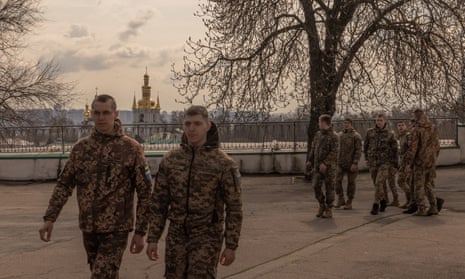
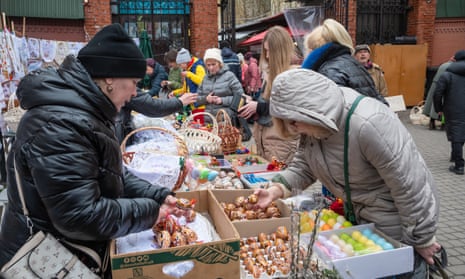
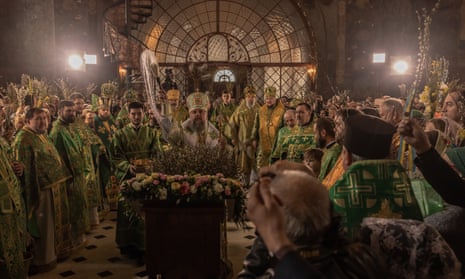
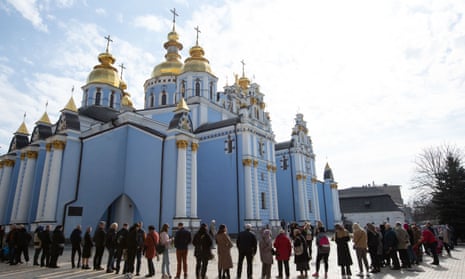
Most of Ukraine’s 41 million people are Orthodox Christians and will mark Easter next weekend. This weekend however was Palm Sunday and worshipers were out in force.
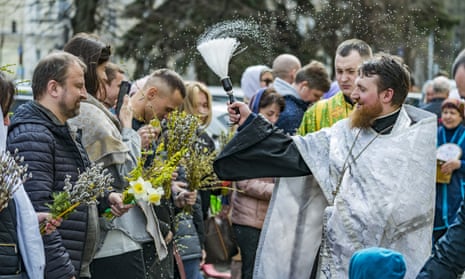
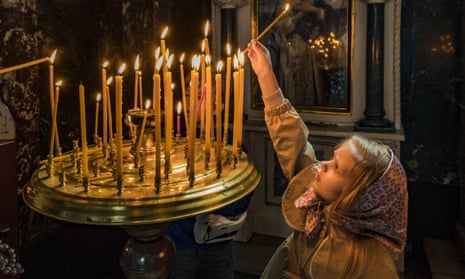
Moscow may try to use the upcoming Orthodox Easter holiday on 16 April to delay Ukrainian counteroffensives by calling for a ceasefire out of respect for religion, the Institute for the Study of War has said in its daily update.
The Kremlin has selectively called for ceasefires around religious holidays to influence the situation on the frontlines. The Kremlin, for example, refused a ceasefire during Orthodox Easter of 2022 “in order not to give the Kyiv nationalists a break” during the Battle of Mariupol.
The Kremlin likely refused a ceasefire because Russian forces still held the initiative on the frontlines at the time, but sought a ceasefire months later over Orthodox Christmas to obtain additional time to prepare Russian forces for the winter offensive.
The Kremlin may call for an Easter ceasefire because such a pause would disproportionately benefit Russian troops and allow them to secure their gains in urban Bakhmut and to prepare defenses against Ukraine’s spring 2023 counteroffensive.
Ukraine’s president Volodymyr Zelenskiy has condemned Russian shelling of the city of Zaporizhzhia on Orthodox Palm Sunday, in which a father and his 10-year-old daughter were killed. A woman, the wife and mother of the dead, was critically injured. In his nightly address Zelenskiy said:
They hit a house, an apartment building. Three people were inside. A man, a woman and a child – a girl, her name was Iryna, she would have turned 11 this year. She died. The man died too. My condolences… The woman is in critical condition, in the hospital, she is being provided with medical care.
This is how the terrorist state spends this Palm Sunday. This is how Russia puts itself in even greater isolation from the world, from humanity.
The majority of Ukraine’s 41 million people are Orthodox Christians who celebrate Easter a week from now.
Kharkiv governor Oleh Syniehubov said another two men were killed by shelling in the city of Kupiansk on Sunday.
A bit more on the leak: One of the most eye-opening revelations from the documents is that Ukraine’s air defences risk running out of missiles and ammunition within weeks, according to the New York Times, potentially changing the course of the war.
One of the documents, dated 23 February and marked “Secret”, outlines in detail how Ukraine’s Soviet-era S-300 air defence systems would be depleted by 2 May at the current usage rate. It is unclear if the usage rate has since changed.
Ukraine’s Buk air defence systems, which it relies on along with the S-300 to protest vital sites from Russian air power, could run into trouble by mid-April, and air defences protecting troops on the front line could be “completely reduced” by 23 May.
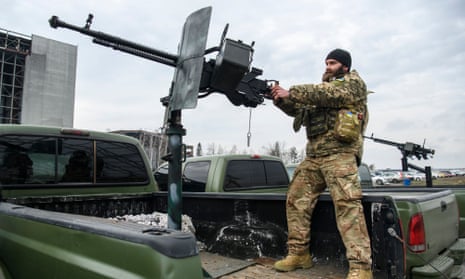
Russian fighter jets and bombers gaining more opportunity to attack Ukrainian forces could prove a major challenge for Kyiv, the Times reported, citing senior military officials.
Colonel Yuri Ihnat, a spokesman for the Ukrainian Air Force, did not comment specifically on the information contained in the documents but told the Wall Street Journal that Ukraine faced serious challenges in finding the Soviet-designed ammunition for its crucial S-300 and the Buk batteries.
“If we lose the battle for the skies, the consequences for Ukraine will be very serious,” he told the paper. “This is not the time to procrastinate,” he said, urging western allies to speed up their assistance.
For more on that, read on here:
The US Department of Defense says it has launched an interagency effort to assess the impact that leaked intelligence documents could have on US national security and on its allies and partners, as it hunts for the source of the leak.
“The Department of Defense continues to review and assess the validity of the photographed documents that are circulating on social media sites and that appear to contain sensitive and highly classified material,” the department said in a statement.
The Pentagon has also referred the issue to the Department of Justice, which has opened a criminal investigation, Reuters reports.
One of the documents, dated 23 February and marked “Secret,” outlines in detail how Ukraine’s S-300 air defense systems would be depleted by 2 May at the current usage rate.
Such closely-guarded information could be of great use to Russian forces, and Ukraine said its president and top security officials met on Friday to discuss ways to prevent leaks.
Officials say the breadth of topics addressed in the documents, which touch on the war in Ukraine, China, the Middle East and Africa, suggest they may have been leaked by an American rather than an ally.
“The focus now is on this being a US leak, as many of the documents were only in US hands,” Michael Mulroy, a former senior Pentagon official, told Reuters in an interview.
US officials said the investigation is in its early stages and those running it have not ruled out the possibility that pro-Russian elements were behind the leak, which is seen as one of the most serious security breaches since more than 700,000 documents, videos and diplomatic cables appeared on the WikiLeaks website in 2013.
The documents first appeared last month on social media websites, beginning with Discord and 4Chan. While some of the documents were posted weeks ago, their existence was first reported on Friday by the New York Times.
Some giving battlefield casualty estimates from Ukraine appeared to have been altered to minimize Russian losses. It is not clear why at least one is marked unclassified but includes top secret information. Some documents are marked “NOFORN,” meaning they cannot be released to foreign nationals.
Hello and welcome to our live coverage of the conflict in Ukraine. I’m Helen Livingstone and I’ll be bringing you all the latest developments as they happen.
The US Department of Defense says an interagency effort is assessing the impact that leaked intelligence documents, many concerning the war in Ukraine, could have on US national security and on its allies and partners.
Officials say the breadth of topics addressed in the documents, which touch on the war in Ukraine, China, the Middle East and Africa, suggest they may have been leaked by an American rather than an ally.
The cache is a growing source of anxiety for US intelligence agencies, while US allies have been forced into denials over the contents.
Among other things, the documents suggest that without a huge boost in munitions, Ukraine’s air defences could be in peril, allowing the Russian air force to change the course of the war, the New York Times has reported.
Other recent developments:
-
Russian shelling killed at least seven civilians in the cities of Kupiansk and Zaporizhzhia over the weekend, Ukrainian authorities said. “This is how the terrorist state marks Palm Sunday,” said the Ukrainian president, Volodymyr Zelenskiy, in his nightly address. “This is how Russia places itself in even greater isolation from the world.” Most Ukrainians are Orthodox Christian and will celebrate Easter on 16 April.
-
The Russian president, Vladimir Putin, chaired a full security council session on 5 April, the first since 2022, according to the latest intelligence update from the UK’s Ministry of Defence. The main report was presented by interior minister Vladimir Kolokoltsev, a choice the MoD said was likely an attempt by the Kremlin to portray the situation in those territories as being “normalised”. However “in reality, much of the area remains an active combat zone, subject to partisan attacks, and with extremely limited access to basic services for many citizens”.
-
A Ukrainian government minister is due to visit India on Monday and will seek humanitarian aid and equipment to repair energy infrastructure damaged during Russia’s invasion, according to the Hindu newspaper. Ukraine’s first deputy foreign minister, Emine Dzhaparova, will make the first visit to India by a minister from Kyiv since the Russian invasion.
-
Pope Francis and the Archbishop of Canterbury, Justin Welby, used their Easter messages to call for peace. The pope asked God to “shed the light of Easter upon the people of Russia”, appearing to ask Russians to seek the truth about their country’s invasion of Ukraine.
-
Russia’s defence ministry claimed it had destroyed a depot containing 70,000 tonnes of fuel near Zaporizhzhia as well as Ukrainian military warehouses in the Donetsk and Zaporizhzhia regions.