In The Trial, one of Franz Kafka’s novels that was posthumously published (all his works were), the protagonist is inexplicably arrested, persecuted, and prosecuted by a totalitarian authority with no plausible reason in a paradigm of information void. The randomness is terrifying.
What happens when Kafkaesque arbitrariness meets Orwellian dystopia? You get the Xi Jinping regime in China, the world’s second-most-powerful nation where a high-profile foreign minister suddenly ‘goes missing’, remains untraceable, and a month later the world is told that he has been removed from his job in a terse one-line statement.
And while Qin Gang — who was last seen publicly on 25 June — apparently still retains his ‘State Councillor’ title, a position that ranks above a cabinet minister, not even a sliver of information about his whereabouts has escaped from the black hole of Beijing.
Let us pause and reflect for a moment on the bizarreness of Qin’s purging. Nobody knows why the minister ‘vanished’ into thin air, and that includes Chinese foreign ministry officials. Nobody knows where he is. Nobody knows whether he is under ‘investigation’, a word that carries a sense of foreboding in China. Nobody knows what will become of Qin, if he is ill, or even alive. And this Theatre of The Absurd is unfolding before our eyes in a world where the very concept of privacy is challenged by mobiles phones, CCTVs, drones and satellites and governments that may track every move of any individual to the accuracy of her last step.
The erasure of Qin Gang resembles the expunges that were normalised during the Mao Zedong era when his political opponents would be wiped out from official documents and photographs, but that was still a different world. In this surveillance paradigm, to pull off what Beijing has done verges on the impossible.
The Qin Gang episode illustrates not only the concentration of authoritarian power, the atmosphere of randomness and impenetrability that mark highest decision-making in Beijing but also the philosophy of the absurd. This has major policy implications for the rest of the world that must engage with China with the knowledge that a grammar of absurdity permeates every level of the Chinese apparatus.
Take, for instance, the exchange between the Chinese foreign ministry spokesperson and reporters during Wednesday’s press briefing in Beijing. Faced with a barrage of questions from various outlets on Qin, Mao Ning meticulously sidestepped and stonewalled each and every query with a template response that was designed to deflect. Pressed further by flummoxed reporters, Mao claimed that she doesn’t have “any more information to share”. Curiously, none of the more than 20 questions on Qin found its way into the official transcript of the media briefing which was scrubbed clean of any mention of Qin.
This was a repetition of an earlier occasion when the foreign ministry refused to provide any information on Qin beyond what was an unspecified “health issue”, and none of those questions were present in the official transcript.
What heightens the sense of arbitrariness, and hence the sense of dread, is that while details on Qin’s removal in Chinese state media is scant and the announcement vague to the point of being a deliberate attempt at obfuscation, yet at another level the voting process at the National People’s Congress (NPC), China’s rubber-stamp Parliament, to oust Qin following an official decree by party chairman Xi Jinping was telecast by CCTV in great detail.
As Phil Cunningham, who tracks CCTV at Substack, writes, “an adept camera crew (showed) the voting process in shocking detail, right down to the very instant that Qin Gang was terminated. Chairman of the NPC and third-ranking member of the party’s politburo, Zhao Leji (reached) forward to press the vote button confirming the removal of Qin Gang. His subordinates, despite a wide array of facial expressions and erratic posture, (followed) suit. Ding! It’s done. Qin Gang is gone.”
This juxtaposition of information blackout on the one hand, and the performative art of Qin’s removal on the other, is curious. In fact, this Kafkaesque absurdity is a recurrent theme. Qin’s name has been expunged from the Chinese foreign ministry website, erasing all evidence of his seven-month tenure as foreign minister.
Searches within China’s Ministry of Foreign Affairs website (both in Mandarin and English for the ‘Qin Gang’ string returns error messages such as “updating”, or the “page that you are searching for does not exist”.
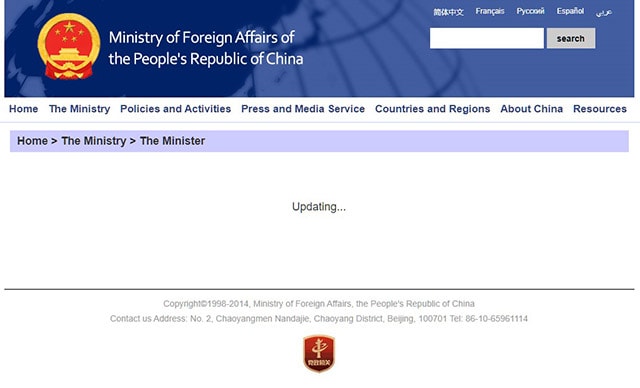
David Bandurski points out in China Media Project that this clean up job seems to have started on Wednesday, and he reckons it as “a further sign of turmoil within the ministry, which has spent several weeks offering no elaboration on the fate of its top leader.”
However, in further example of randomness, while the MFA website has been scrubbed clean of all traces of Qin, Chinese Communist Party mouthpiece People’s Daily, state media websites such as Xinhua, commercial websites such as China Business Network or Caixin Global still carry references to Qin as China’s foreign minister.
Moreover, while the NPC Standing Committee ousted Qin as the foreign meeting after convening at short notice, it refrained from removing him as a CCP central committee member or the State Council, which, as Bill Bishop points out, the NPC could have easily done in accord with the Organic Law of the National People’s Congress of the People’s Republic of China.
To intensify the intrigue, it appears that while some references to Qin have been removed by ubiquitous censors from China’s heavily monitored internet and social media platforms such as Weibo, the scrubbing was not as meticulous as it usually is when censors really want to silence discussions on a topic, leaving enough space for rumours to swirl around the possible reasons behind Qin’s ouster — where speculation is rife that Qin’s downfall was caused by an extramarital affair.
Western media outlets such as The Times, London, or The New York Post are speculating, quoting users from Chinese social media that Qin’s downfall was caused by an affair with TV presenter Fu Xiaotian, 40, who is allegedly the mother of his love child. We may never know the truth or even the full story, but it is instructive to note that when a question was asked about this rumour, foreign ministry spokesperson Mao replied that she had “no understanding of the matter.”
According to NY Post, “if the romance claim wasn’t true, the ministry would have just denied it as baseless, rather than saying they had no information regarding it. Ning’s hesitation suggested the rumours were true.” In any case, if Qin was waylaid by illness, his name wouldn’t have been digitally expunged, which gives credence to the theory that he is indeed facing disciplinary actions for personal transgressions.
Beyond the speculation, the abrupt removal of Qin, the digital purge, the fuelling of rumours, the reinstallation of Wang Yi quite possibly as a placeholder arrangement to conduct the urgent businesses of a crucial ministry — all point to the arbitrary, opaque nature of decision-making within the paradigm of invasive absurdity.
For a regime that is obsessed with control and political stability, Beijing is aware that these actions will send the opposite message. Yet the fact that it has been forced into taking these steps and risking a damage to its global image, points to two factors.
One, the centrality of absolute power in Xi’s hands has rendered every other branch of the administration ineffective, to the extent that no one wants to take a decision and fall foul of the supreme leader. Two, for all its power projection, the Chinese system is inherently weak. These are cold comforts to countries, however, that must engage and grapple with a regime that is strong yet weak, systematic yet absurd.
Views expressed in the above piece are personal and solely that of the author. They do not necessarily reflect Firstpost’s views.
Read all the Latest News, Trending News, Cricket News, Bollywood News,
India News and Entertainment News here. Follow us on Facebook, Twitter and Instagram.