g
- About 1.3 billion people – or one quarter of the world’s population – shopped online in 2017, a 12 per cent increase from 2016.
- Pixabay
Taobao, Lazada, Shopee: these are all common names you hear in Singapore in 2019.
Singaporeans have been assimilating into the e-commerce boom without a hitch. The adoption of online shopping has happened so successfully that, in fact, the Lion City has been ranked among the most prepared economies to participate and benefit from the e-commerce boom.
Out of 152 economies worldwide, Singapore was ranked third on the United Nations’ (UN) B2C (business-to-consumer) E-commerce Index released earlier this month.
The Republic is also one of two non-European economies which made it to the top 10 list of the index, with the other being Australia at 10th place. Netherlands took top spot for a second consecutive year, followed by Switzerland at second place.
Billions shopping online globally
According to the UN, about 1.3 billion people – or one quarter of the world’s population – shopped online in 2017, a 12 per cent increase from 2016.
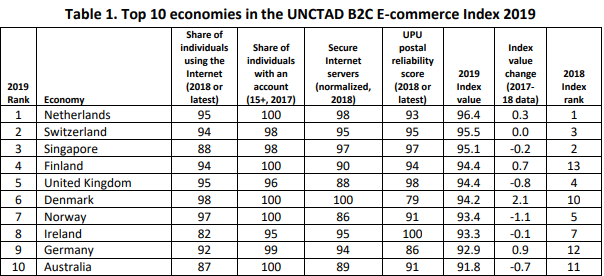
- Scores or index values of those on the top 10 list are close, with a range of just five points separating the first and 10th rank.
- UNCTAD B2C E-commerce Index 2019
Put together by the United Nations Conference on Trade and Development (UNCTAD), the annual index consists of four indicators that have a high correlation with online shopping.
They are: internet server access; postal service reliability; share of population who use the internet; and share of population aged above 15 who have an account with a financial institution or mobile-money-service provider.
According to the report, 88 per cent of Singaporeans use the internet. While this is lower than the other top 10 countries, Singapore had one of the highest proportions of secure internet servers and postal reliability scores, both 97 per cent.
Additionally, 98 per cent of Singaporeans own an account with a financial institution or mobile-money-service provider.
Singapore leads developing economies both globally and regionally
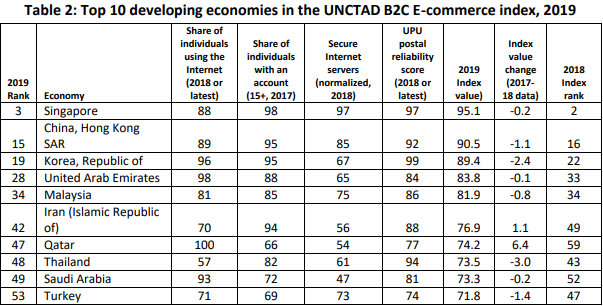
- All top 10 developing economies globally are classified as upper-middle income or high-income economies, UNCTAD said.
- UNCTAD B2C E-commerce Index 2019
The tiny island nation also topped all developing economies for e-commerce preparedness.
The top 10 on this sub-list include Hong Kong, the Republic of Korea, the UAE, Malaysia and others. The difference in index value scores between Singapore and Turkey, which is in 10th place on the sub-list, is around 23 points.
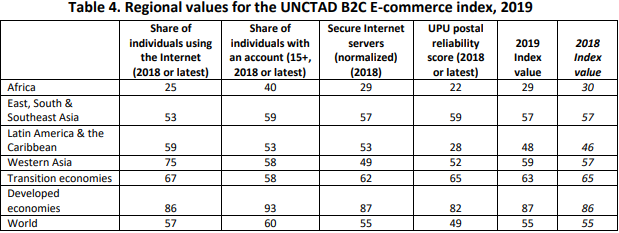
Regionally, Singapore’s average scores are also far above regional averages, which range from 53 to 59.
Despite Singapore’s stellar ranking, the report said that East, South and Southeast Asian regions need to boost Internet penetration, “which currently stands at just over half of the population and is below world average”.
In addition, there is a need enhance e-commerce readiness globally “not only with regard to Internet connectivity but also in other areas”, UNCTAD said.
Earlier in October, a study by Bain & Company projected that e-commerce spend in Southeast Asia will grow to US$120 billion (S$163.2 billion) by 2025, up from US$31.2 billion.
Read Also: