Date Posted: December 18, 2019
By Mika Hyden, Digital Health Advisor, PSI Myanmar
In the country formerly known as Burma, the internet has only been available since 2000.
Today’s Myanmar has a population of over 50 million people who, understandably, have only been introduced to social media recently, and only after the government relaxed its high levels of censorship in 2011. However, according to the Internet World Stats, 16 million of Myanmar’s 18 million internet users have a Facebook account.
The rapid introduction of smartphones and digital access in a country where online browsers and email accessed through computers were never used means that people interact with the internet very differently than other countries. For many people in Myanmar, Facebook is the internet.
In the US, Facebook is currently getting a lot of attention for its potential to do harm. But in Myanmar, PSI is working with Facebook to support positive messaging for healthcare.
Myanmar is one of the world’s poorest countries, and many people (especially the 13 million Burmese who live on less than $2 a day) delay seeking treatment for illnesses due to the high cost of care, a phenomenon that exacerbates and perpetuates poverty. Despite this, only 2.5% of government funds currently go to healthcare.
So, PSI Myanmar used the country’s large number of Facebook users to drive action toward Universal Health Coverage (UHC)—and a healthier Myanmar—changing the landscape for UHC across the country.
UHC Education Through Social Media
PSI Myanmar brought together UHC experts, including members of the Ministry of Health and Sports (MoHS) who work directly on UHC, to explore what messages they needed to create to reach key decision-makers and their influencers. Since UHC in Myanmar is in a very early phase, most members of the government are still grasping what it means and what it will look like in their country. It became clear that the most realistic and important outcomes for this campaign were to increase awareness around – and motivation for – UHC, its purpose, and its processes.
These discussions with UHC experts also led to a key insight into PSI Myanmar’s target audiences for the campaign. The group distinguished that there are four categories of influencers for their UHC decision-makers: the traditional press, spouses of decision-makers, the decision-makers’ staff and their peers.
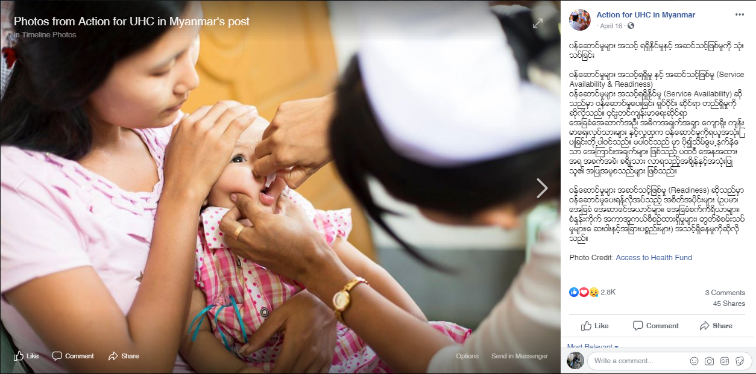
With support from Upswell, a US-based organization that specializes in helping non-profits reach their goals with Facebook, PSI Myanmar used Facebook’s Audience Insights and targeting tools to learn what types of content these audiences engaged with and their characteristics on Facebook so that they could easily inspire them with messaging designed to ignite discussions regarding UHC. Once the audiences were identified, PSI Myanmar created the “Action for UHC in Myanmar” Facebook page, and used the following engagement methods to educate their audiences and highlight support, including:
-
-
- Hosting a “definition day” on the page, to educate their key decision-makers by clarifying complex terms around UHC.
- Highlighting influential users as “Champions of UHC” on the page, hosting a Facebook Live event to showcase support from a prominent director in the Ministry of Health and Sports, and to discuss the Ministry’s plans to educate the community about UHC.
- Posting a “thank you” video created by PSI Myanmar from a new mother showcasing the success of the UHC pilot program, and thanking all the people involved in her baby’s safe and healthy birth.
[embedded content]
“We can’t choose our race, religion and birth place. Universal Health Coverage aims for all citizens and no one should be left out.”
– Dr. Wit Yee Win
National Health Plan Implementation Monitoring Unit, Myanmar Ministry of Health and Sports
From Education to Action
 Myanmar has had a goal of achieving Universal Health Coverage in the country since 2015, but action toward UHC was ramped up by the government in 2019. With the creation of the Action for UHC in Myanmar page, officials at the MoHS saw the power of Facebook to mobilize their peers around UHC. This experience grew their understanding of the role that Facebook can play in advocacy efforts. For example, in a survey given to members of the MoHS about the impact of the campaign, 100% agreed that this type of Facebook campaign would be useful for other policy issues.
In May 2019, the Ministry of Health and Sports approved a set of “Strategic Directions” toward a final strategy to finance UHC. PSI Myanmar was also invited to present campaign progress and insights at two quarterly UHC financing coordination meetings with stakeholders from various government departments and international NGOs, organized by the MoHS. Each time, presenting the high volume of Facebook content shares sparked a larger conversation about the need for continued communication campaigns about UHC.
PSI Myanmar was invited to participate in the planning of Myanmar’s World UHC Day event in Yangon on December 12, 2019, and to host the UHC Day celebration in Mandalay on December 15, 2019. The events were publicized and live-streamed on the Action for UHC in Myanmar Facebook page.
Small but Mighty Results
Facebook Audience Insights and targeted advertising were the keys that PSI Myanmar needed, in order to show that key influencers among Myanmar’s government officials had the power to initiate engagement and momentum for UHC. The campaign was not intended to reach millions of people. Instead, PSI Myanmar set out to influence a relatively small number of people who are likely to have a high level of influence in these areas’. PSI Myanmar was certain that their campaign reached their key audiences. Here’s how far they reached, by the numbers:
-
-
- 429K influencers reached in Myanmar
- 192K reactions
- 10K shares
- 3K comments
-
The path to achieving UHC in Myanmar is unprecedented, unpredictable and undoubtedly challenging. But with Facebook, Myanmar is one step closer to knowing what it will take to get there.
-