
Spoof, smear, sabotage: How disinformation marred Cagayan de Oro’s 2025 polls
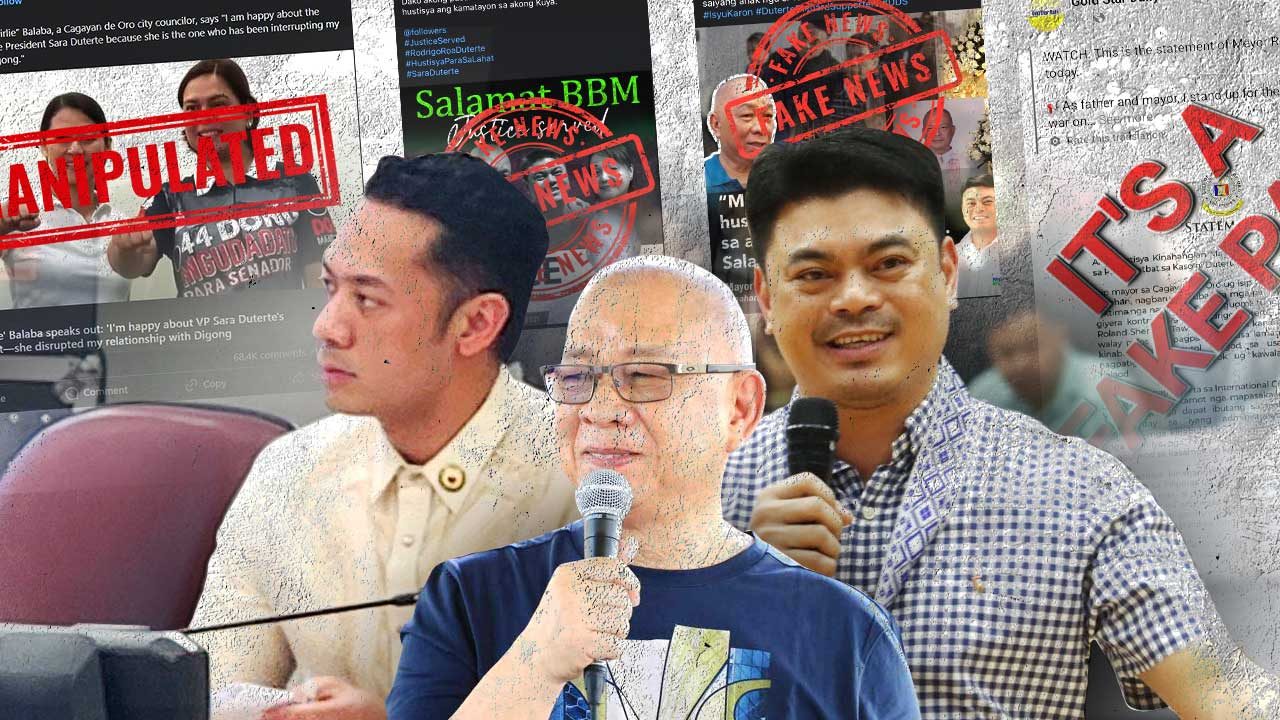
CAGAYAN DE ORO, Philippines – Days before the May elections, people began arriving outside the home of a member of Congress. Some came alone. Others brought friends, neighbors, even entire families. They all had one question: how to claim the cash aid they had been told he was giving away.
Cagayan de Oro 1st District Representative Lordan Suan said he made no such promise. Still, his phone buzzed constantly with messages. Outside, a growing crowd gathered, hopeful and insistent. They had all received the same text.
“This is CDO 1st District Congressman Lordan G. Suan. Visit my office at Suan Arcade, Barangay Carmen, tomorrow, Saturday, May 10, 2025 at 3 pm, and show this text message so you can claim your P50,000 ‘vitamins’ per person,” the message in Cebuano read.
It was fake.
Suan said the chaos caught his entire household off guard. His father, Agapito “Jun” Suan, panicked and had his mobile number disconnected. Campaign workers, who were supposed to be preparing for election day, were instead forced to manage a confused and disappointed crowd.
“It was absurd,” Suan said. “Instead of focusing on my campaign, I was answering questions about money we never promised.”
Suan’s team traced the source to a coordinated text blast. The messages had spoofed not only his number but also those of his family and staff, making it appear that he was personally behind the bogus giveaway.
By the time the truth caught up, the damage was done. After being told it was a lie, people left, frustrated and some angry, with Suan and his group just hoping that the voters understood that they’ve been had, and none of that was their group’s doing.
Same tactics, different target
Cagayan de Oro Mayor Rolando Uy’s family faced similar attacks. His son, former vice mayor Raineir Joaquin “Kikang” Uy, was running against Suan. On election day, text messages circulated claiming barangay leaders allied with the Uys were distributing cash for votes.
Jann Actub, the mayor’s spokesman, said it was another hoax and a carefully timed mass text blast meant to undermine the Uys’ election bids.
The attacks started much earlier. In the weeks leading up to the election, at least 10 small food caterers received bogus orders via text messages, supposedly from city hall, for packed meals. Believing the orders were official, the vendors prepared the food, only to their disappointment.
“These were prank messages,” Actub said. “City hall never made those orders. We did not pay for any of it.”
Like Suan, they could only hope the establishments realized they had been played, and that the con was not of their own design.
Actub did not disclose the total amount of the bills, but the scam was far from cheap. One food caterer alone, he said, had billed for 500 food packs.
Actub said the online smear campaign was uncontrollable. Fake Facebook pages mimicking that of the Uys and city government offices began appearing, followed by troll accounts posting spliced videos, fabricated quotes, and outright lies.
Even the social media pages of trusted news organizations were not spared — they were cloned to spread falsehoods.
On March 17, for instance, the Cagayan de Oro-based Gold Star Daily warned the public about a Facebook page impersonating its brand and posting a fabricated statement attributed to the Uys.
The imposter account, originally created as “Bold Star Daily News” on April 3, 2024, was renamed “Gold Star Daily News” on March 12, just weeks before the elections, and had been flagged for spreading disinformation.
Gold Star Daily editor-in-chief Cong Corrales urged readers to check and verify posts using the newspaper’s official page ID and URL, and cautioned against social media content that were using Bisaya captions, which the news outlet never published.
Even Rappler was not spared from the disinformation campaigns swirling in Cagayan de Oro. A Facebook post, falsely attributed to Rappler, claimed Councilor Joyleen Mercedes “Girlie” Balaba, a known ally of the Dutertes who ran for reelection under the Uy ticket, supported the impeachment of Vice President Sara Duterte. It was a false narrative clearly out of step with Balaba’s political loyalties.
Rappler said the post was a manipulated version from its legitimate September 2021 report about Balaba’s likely bid for a congressional seat in 2022.
“These were not random attacks,” Actub said. “The posts were boosted. It was systematic. It was funded.”
One viral post on March 11, he said, crossed a personal line. It claimed that the Uy family lauded the arrest of ex-president Rodrigo Duterte so he could be tried before the International Criminal Court (ICC) over his administration’s bloody drug war, and answer for the killing of one of their family members.
According to Actub, the post falsely implied that Mayor Uy’s late son, Roland Sherwin “Tawie” Uy, who was killed in a shooting at a quarry site in Barangay Pagatpat in November 2021, was among the victims of the Duterte drug war, making it appear that his murder was drug trade-related.
“That was a lie,” Actub said. “The mayor or his son Kikang never issued that statement.”
Although police arrested a suspect in July 2022, identified as alleged former New People’s Army (NPA) hitman Edgardo Gaabucayan, the motive for Tawie Uy’s murder remained unclear.
Actub said the pattern was unmistakable. Fake orders, doctored posts, and spoofed messages pointed to a broader effort to discredit the Uys and confuse the electorate.
“They tried to discredit the mayor and his son online,” he said. “It was designed to sow confusion and anger on the ground.”
City hall sought help from the police’s cybercrime unit, but no one has been identified as the mastermind behind the campaign to this day.
“This will likely worsen as technology continues to evolve,” Actub added. “Unless we act, future elections could be defined by this.”
Suan was also targeted on Facebook. A page posing as one of his official accounts, “The Working Congressman,” posted a fabricated quote attacking Vice President Duterte.
The quote, attributed to Suan, read: “If VP Sara plans to run for president in 2028, she might be in jail by then. Our investigation is almost done, and most Filipinos already support her impeachment. It is just a matter of time.”
Suan, who had voted to impeach Duterte, said he never made that statement and called it a deliberate attempt to erode support among Duterte loyalists.
New playbook
What unfolded in Cagayan de Oro showed a continuing and growing trend: the use of technology to spoof phone numbers, impersonate public officials, and flood social media with disinformation.
One likely tool is the International Mobile Subscriber Identity (IMSI) catcher, a device that mimics cell towers and intercepts mobile signals. Although it can be effectively used as a tool by law enforcement and emergency responders, it can be repurposed for political sabotage.
“They can input your number and make it appear that you sent the messages,” said Maricel Rivera, a former city hall spokesperson. “It’s scary. People we knew received fake messages from those pretending to be us.”
Rivera supported Suan and former mayor Oscar Moreno in the election. Moreno lost in his bid to unseat Klarex Uy, while Suan defeated Kikang Uy. The campaign was bitter, with facts blurred by fiction. Trolls thrived. Mudslinging was relentless.
Legal gray area
The National Telecommunications Commission (NTC) confirmed IMSI catchers can intercept calls and texts or send out altered mass messages.
NTC-Northern Mindanao Director Teodoro Buenavista Jr. said the devices may have been used during the campaign.
Such devices, about the size of a backpack, have legitimate uses. In Cagayan de Oro, one such text-blasting device is owned by the local government.
Actub said he was unaware of this city hall capability, and they did not use such a device during the election campaign.
“We only boosted content from our official Facebook pages. We did not do anything beyond that,” he told Rappler.
In 2022, the city government acquired an P18-million, satellite-enabled system for its 911 network. The device operates independently of commercial mobile networks under the city government’s disaster management department. It remains functional even when mobile signals are down.
Based on technical specifications signed by City Disaster Risk Reduction Management Department (CDRRMD) head Nick Jabagat, the equipment scans GSM, 2G, 3G, and 4G signals, and can relay text and voice messages to mobile providers. It can record messages and reach 99% of phones in its coverage area, with a capacity of 100 to 300 text messages per minute.
Jabagat said the system is for emergency use only, and the supplier secured an NTC approval. Asked if it could have been misused during the campaign, Jabagat said, “I will not allow that.”
Outside of authorized use, devices such as IMSI catchers are illegal without NTC clearance.
“These are the same devices recently confiscated by the NBI and PNP,” Buenavista said.
In April, a Chinese national, Tak Hoi Lao, was arrested near the Commission on Elections office in Manila with an IMSI catcher. The NBI said it could intercept signals within a three-kilometer radius.
Similar devices were previously found near the US embassy in Manila and Malacañang.
Threat to democracy
The legal framework for regulating such devices remains weak. Their availability in gray markets has turned them into tools for manipulation and identity theft.
“That is why cybercrime prevention is a must,” Buenavista said. “The Bureau of Customs needs to step up its enforcement and prevent their entry.”
Cagayan de Oro 2nd District Representative Rufus Rodriguez, alarmed by the volume of disinformation during the campaign, filed House Bill No. 11506 weeks after the elections. The measure seeks to criminalize the deliberate spread of false content that threatens public order or national security.
“I think both camps (Uy and Suan groups) resorted to that,” Rodriguez told Rappler. “Fake news groups on social media were associated with both sides.”
Rodriguez, who aligned with the Uys, said he too was targeted. Photos circulated online showed him in Suan’s party color, falsely implying he endorsed the then-reelectionist congressman.
“One image was edited. Another was taken years ago,” he said.
Rodriguez warned such tactics could be used by foreign actors like China to influence the outcome of Philippine elections, ensuring that those in power would be friendly to their causes. He cited the West Philippine Sea dispute as a likely flashpoint.
In a way, engineering a bandwagon on social media to sway voter preference is the equivalent of turning democratic processes like elections against the very interests they are meant to serve, he said.
His proposed law imposes six to 12 years in prison and fines between P500,000 and P2 million for those found guilty of knowingly and maliciously spreading false information.
The bill defines fake news as deliberately false or misleading content presented as factual news. It excludes satire, parody, honest mistakes, and good-faith reporting. It also seeks to penalize funding troll farms or bot networks, and cyber-enabled dissemination of disinformation meant to incite violence or undermine institutions.
Platforms covered include Facebook, YouTube, TikTok, Instagram, and X (formerly Twitter). The bill proposes a congressional oversight committee with participation from media and civil society groups.
“We want to make sure this is not a shotgun approach,” said Rodriguez, stressing the need for consultations and thorough House deliberations. “This is about balancing free speech with accountability.”
Nef Luczon, corporate secretary of the Cagayan de Oro Press Club, said disinformation, particularly on social media, has become an escalating menace. But he voiced unease over the proposed law that, under the guise of order, could be twisted into a bludgeon against journalists who dare to confront power and reveal its abuses.
“A law like that could be weaponized against the free press, and the freedom of speech and expression, and could go against constitutional rights,” Luczon said. “We need to look for solutions with caution.” – Rappler.com
