
Business Brief: Putting in the foot work
Good morning. The downtown cores of major Canadian cities might feel more vibrant these days, but data show they are only just half as busy as they were before the pandemic. More on that plus, meet the “grandfluencers” and greedy investors. But first, today’s news:
Up first
In the news
Trade: U.S. President Donald Trump announces 35-per-cent tariffs on all Canadian goods starting Aug. 1
Analysis: Trump’s message to trade partners? Trim ties with China
Real estate: Residential real estate developers cut jobs as downturn deepens
Management: Ex-MLSE chief executive Tim Leiweke pushes back on DOJ allegations he was involved in bid rigging as CEO of Oak View Group
On our radar
- Today, Statistics Canada releases June jobs numbers. The Street is expect a decline of 3,000 jobs. We will also see building permits for May, which The Street is expecting to decline as well.
- In the U.S., the budget balance for June is coming
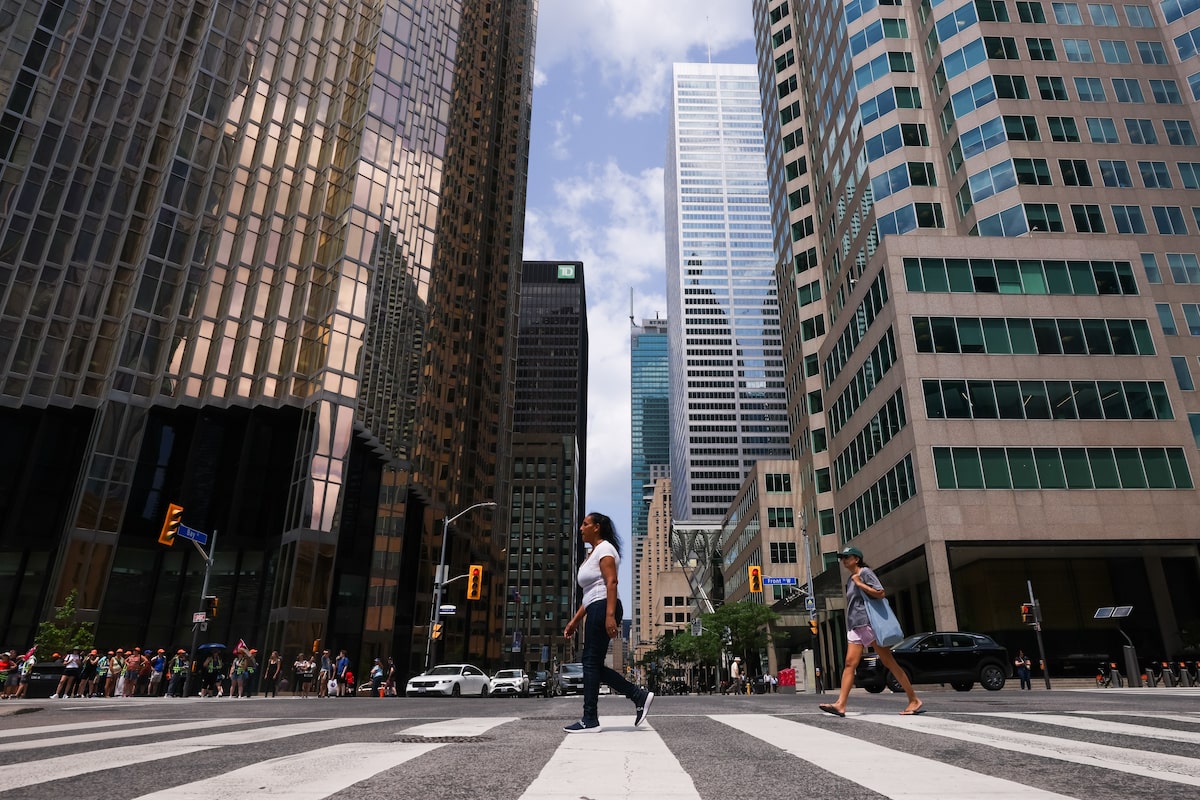
People walk in Toronto’s financial district on July 3, 2025.Cole Burston/The Globe and Mail
In focus
Office hours ramp up, but foot traffic is slow to rebound
Hi, I’m Vanmala Subramaniam, The Globe’s Future of Work reporter.
I had spent much of 2022 covering return-to-office policies in Canadian cities. Communities had significantly emptied out at the height of the pandemic, and the drastic shift from full-time in-office work to hybrid work quickly became a norm in the white-collar world.
By all accounts, the return-to-office debate was over — most employers offered long-term flexibility and employees embraced it.
Recently however, a major employer bucked the trend. Royal Bank of Canada, which employs more than 90,000 people, summoned its staff back to the office four days a week, up from three. Then Bank of Nova Scotia and Bank of Montreal followed suit, both implementing the same policy.
The banks’ push to ramp up in-office days prompted me to revisit foot-traffic data. Downtown Toronto sure felt more vibrant to me this year, so I was curious to see if foot traffic had indeed increased.
To do this, The Globe worked with Environics Analytics, a marketing company and data provider to sieve out the relevant data points. Environics tracks cellphones of people entering and exiting office buildings in the major cities (stripped of personally identifying information) and is able to estimate the relative foot traffic of office workers. The data does not include all foot traffic − for example, residential and retail traffic.
In Toronto as of April, 2025, foot traffic in the downtown core was about 43 per cent less than it was in January, 2020. That number hovered at approximately 50 per cent for both Montreal and Vancouver.
Overall, the Environics data captured from five cities − Toronto, Vancouver, Calgary, Montreal and Ottawa − appeared to point toward a trend of a gradual increase in the number of office workers in cities since mid-2022, but plateauing growth in the past year.
The big question then is: Will the banks’ stricter in-office mandates spark a domino effect across other white-collar employers? And if so, will it increase the density and vibrancy of downtowns that have never fully recovered from the pandemic?
Karen Chapple, an expert in the urban planning field and director of the School of Cities at the University of Toronto, believes that recent return-to-office mandates will push cities to revitalize. Turning the downtown cores of cities away from office traffic is a long-term process, she says, so in a way it makes sense that they have only half recovered from the pandemic using the measure of foot traffic.
Prof. Chapple’s own foot-traffic tracker (measuring all foot traffic, not just office workers) showed that between February, 2024 and February, 2025, Toronto and Vancouver saw a 10 per-cent increase in foot traffic. Montreal saw a 15 per-cent increase. So perhaps downtowns are returning to their former vibrancy but due more to a boost in domestic tourism and less so from the presence of office workers.
Cole Burston/The Globe and Mail
In researching city recoveries after the height of the pandemic, I also explored the question of why employers might be pushing their workers to come back into the office more frequently.
One theory that I thought was particularly interesting was the change in the overall macroeconomic environment of hiring.
The pandemic was characterized by a labour shortage. Workers, both blue-collar and white-collar, had much more choice to switch jobs simply because there were more jobs available. The job vacancy rate has reduced sharply of late and unemployment numbers are ticking up.
All this to say: The balance of power is shifting back in favour of employers, perhaps prompting them to be able to demand more in-office presence, without the risk of losing talent.
Charted
Unanswered questions
Concerns are building around the lack of transparency in the United States’ expansive use of detention as a tool for immigration enforcement. A Canadian man, Johnny Noviello, was held in ICE custody for 40 days and then died in detention. Now, his family is searching for answers. But with the Trump administration still ramping up its immigration crackdown, Noviello’s case raises more questions about process and conditions.
Bookmarked
On our reading list
Inside the market: Why every investor is Warren Buffett now
Inside the “granfluencers”: Retirees are reinventing themselves with online followings as they share their post-retirement lives on social media.
Inside the crime: Business owner says he cut ties with accused soldier in alleged extremist plot following RCMP raids
Morning update
Global stocks fell after U.S. President Donald Trump ramped up his tariff war against Canada and leaving Europe squarely in the firing line. Wall Street futures were in negative territory and TSX futures followed sentiment lower.
Overseas, the pan-European STOXX 600 was down 0.97 per cent in morning trading. Britain’s FTSE 100 slid 0.56 per cent, Germany’s DAX fell 1.12 per cent and France’s CAC 40 dropped 0.99 per cent.
In Asia, Japan’s Nikkei closed 0.19 per cent lower, while Hong Kong’s Hang Seng advanced 0.46 per cent.
The Canadian dollar traded at 73.04 U.S. cents.


