
[OPINION] Senate blocs should be about citizens vs dynasties, not Marcos vs Duterte
The more things change, the more they stay the same. This well-known phrase traces its origins to French satire in the mid-19th century: Plus ça change, plus c’est la même chose. It is said to have been coined by Jean-Baptiste Alphonse Karr, a French writer and satirist, in 1849 as a commentary on the duality of drastic political change and the continuity of societal conditions — that is, continuing social conflicts and inequalities alongside regime shifts from constitutional monarchy to republicanism, and the sudden rise of Napoleon Bonaparte as emperor.
Today, two centuries later, the phrase can still be used to accurately describe the fundamental irony in many political systems. Shifts are supposed to represent change. In politics, however, they often represent the status quo. Changes, thus, are merely enhancements or drawbacks within political systems. The political systems themselves remain unchanged.
Shifting alliances as status quo
In the 2025 Philippine elections, we saw dramatic shifts in electoral outcomes, most especially the victory of the “yellows-pinks” and other reform-oriented or progressive forces:
- Bam Aquino and Kiko Pangilinan emerging as the top 2 and top 5 winners in the Senatorial race, respectively
- Akbayan winning more than 2.7 million votes, the largest vote delivery for any party-list group
- Former senator Leila de Lima making a political comeback after six years in prison as the Number 1 representative of the winning Mamamayang Liberal
- Other progressive party-list groups — like Kamanggagawa, Kabataan Party List, and ACT Teachers — winning one seat each
- In local races, Leni Robredo winning the Naga City mayoral race, Mayor Vico Sotto winning re-election in Pasig City, and Kaka Bagao’s return to the Lower House as congresswoman of Dinagat Island.
These outcomes were “dramatic” because, before the 2025 elections, the yellows and pinks were practically decimated: only one win in 2016 and 2022 (Senator Risa Hontiveros), zero victory in 2019 (with the Otso Diretso slate), and a heartbreaking loss in 2022 (Leni Robredo losing to Bongbong Marcos). Suddenly, there was a glimmer of hope: Philippine politics could now go beyond the factionalism of the Dutertes and the Marcoses. There were alternatives to these competing political dynasties.
That glimmer of hope quickly turned into an avalanche of frustration when the supposed “opposition” and “alternative” candidates Aquino and Pangilinan decided to align with the majority in the Senate. As of this writing, it is still a few weeks away from the official opening of the 20th Congress on July 28, 2025. It was Senator Jinggoy Estrada who let the cat out of the bag. In a radio interview on July 6, Estrada claimed that Aquino and Pangilinan would “most likely” (malamang) be joining the majority and throwing their support behind Chiz Escudero as Senate president.
This announcement created a lot of buzz because of two immediate contexts:
- Escudero was the Senate president who showed favor for the Dutertes by delaying the impeachment trial of Vice President Sara Duterte, so how could joining him be considered as “opposition” or “alternative”?
- A few days earlier, Hontiveros had already declared that she intended to form an “independent bloc” since the minority bloc was likely to be dominated by Duterte supporters. In other words, there was an alternative, why not choose that?
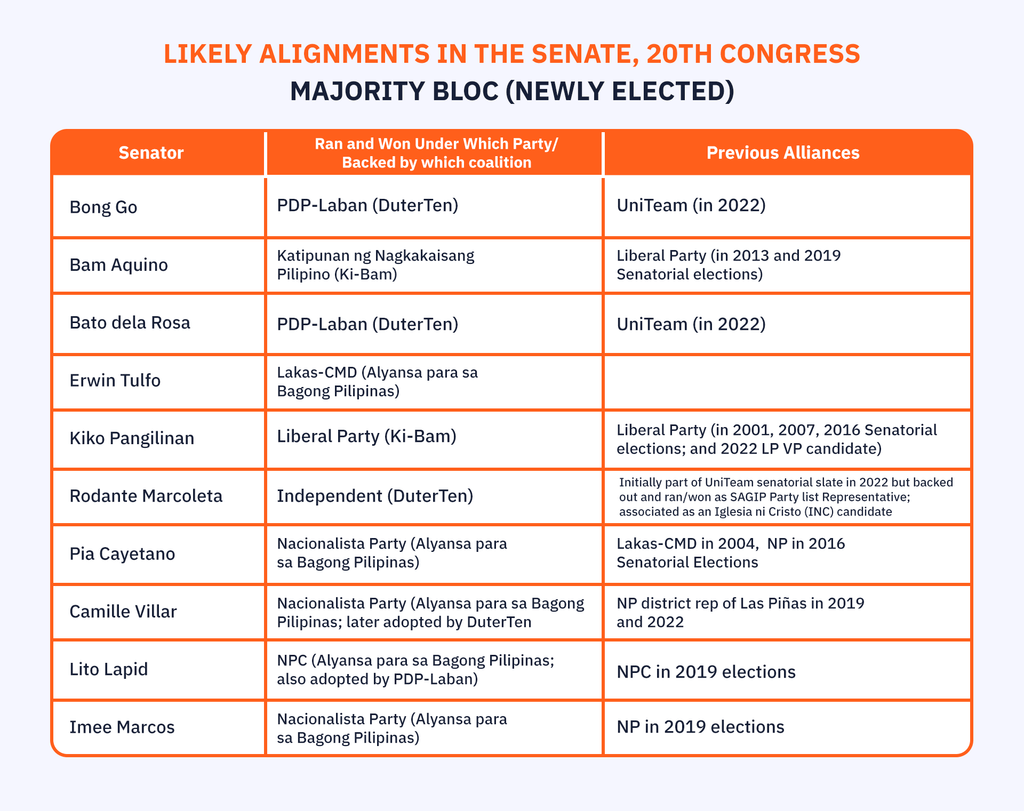
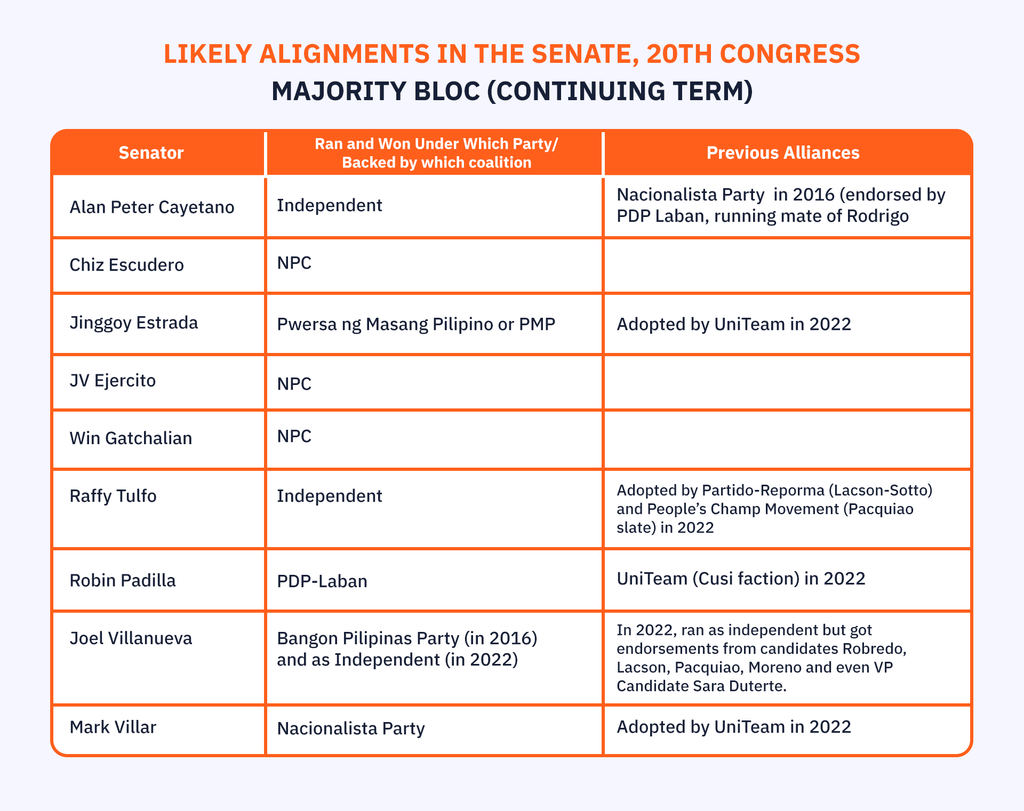
In the scenario of senators Aquino and Pangilinan voting for Escudero as Senate president of that majority, the Senate will consist of:
- A majority composed of a mixed bag of Marcos and Duterte allies and Liberal Party members (historically anti-Marcos and anti-Duterte)
- A minority composed of “veteran senators” (Migs Zubiri’s term), most of whom often present themselves as “independents” but have a track record of defending or staying silent about the abuses of the Marcoses or the Dutertes (Let’s get real — Did we ever hear these guys challenge the extrajudicial killings during the Duterte Presidency?)
- An independent bloc composed of one senator.
Likely alignments in the Senate, 20th Congress
Majority bloc (continuing term)
Minority bloc (newly elected)
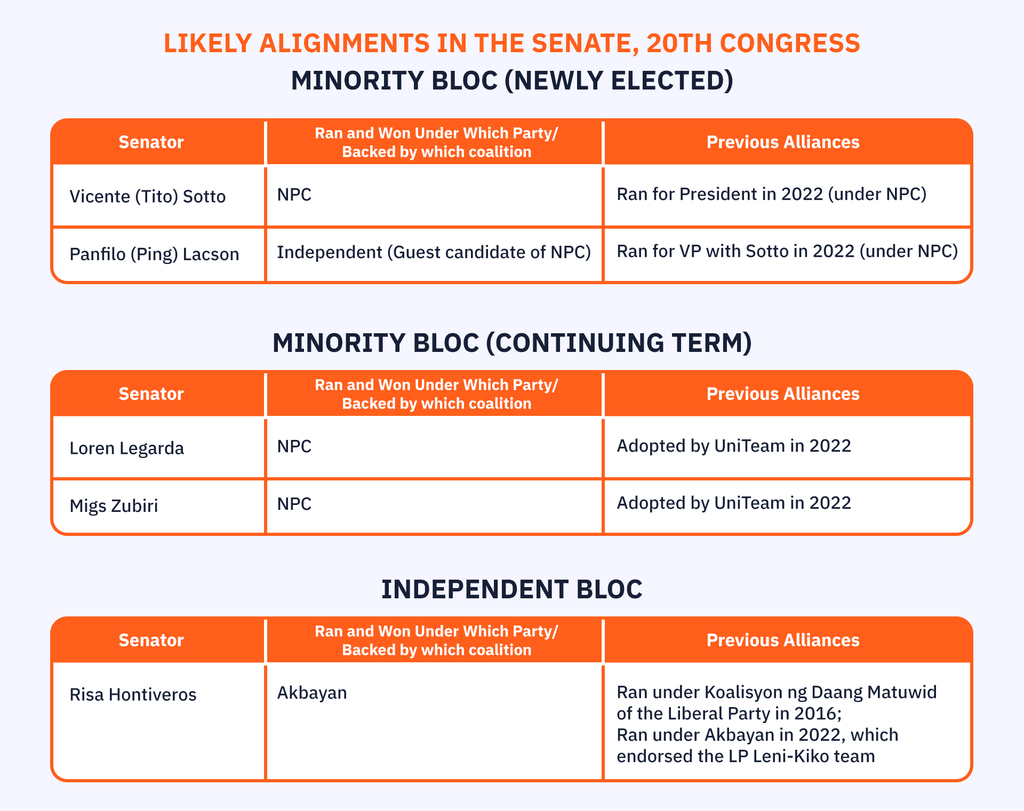
The tables above reveal not just the problem of long-time enemies suddenly becoming allies, but of structural problems besetting our political system, supposedly a working democracy:
- Cooperation and conflict revolve around personalities (especially presidential hopefuls), not platforms or parties.
Except for Akbayan, which has always publicly presented itself as an ideological (social democratic/socialist) party, the parties mentioned above are associated more with presidential candidates rather than ideologies or platforms: the Liberal Party with PNoy (won in 2010), Mar Roxas (defeated in 2016), and Robredo (defeated in 2022); the PDP with Rodrigo Duterte (won in 2016); the Partido Federal ng Pilipinas with BBM (won in 2022); Nacionalista Party with Manny Villar (defeated in 2010); NPC with Danding Cojuangco (defeated in 1992); Lakas CMD with Ramos (won in 1992) and GMA (won in 2004); and Bangon Pilipinas with Eddie Villanueva (defeated in 2004).
Whether people care to admit it or not, presidential elections shape cooperation and conflict in different political arenas. The possible run of Sara Duterte in 2028 and the Marcos’ camp’s need to find a suitable candidate against her will shape the dynamics of the Senate as a legislative body and an impeachment court.
Escudero’s postponement of the Duterte impeachment trial already speaks volumes of such dynamics. The majority that he is now forming is a hodgepodge of Duterte and Marcos supporters (plus the two LP members), and that means he intends to navigate the bargains between the two main factions.
As of this writing, Bato dela Rosa has already declared a “Duter7 bloc: Bato, Bong Go, Robin Padilla, Rodante Marcoleta, Imee Marcos, and Mark and Camille Villar. The others in this majority are clearly not enemies of Dutertes: siblings Alan and Pia Cayetano, and brother Raffy and Erwin Tulfo. Moreover, in that majority, only Bam and Kiko have a history of being in the opposition to the Dutertes.
The scenario of the impeachment trial being dismissed is increasingly becoming real because of this alignment. If the impeachment trial pushes through, that could still be dangerous waters, given the many bargains that are likely to take place — outside of the view of citizens.
2. Political dynasties have become the name of the game.
In the Senate of the 20th Congress, there will be 2 Cayetanos, 2 Estradas/Ejercitos, 2 Tulfos, and 2 Villars — and a presidential sister. And they will all be in Escudero’s majority. As Senate president, Escudero will have to deal with different fiefdoms, not just different legislators. He will also have to deal with BBM or pressure from Malacañang. Most likely, his decisions will not be entirely his own (whether he admits that or not).
And that’s just the Senate. In the Lower House of Congress, we now see the next generation of political dynasts: Sandro Marcos (son of President BBM, grandson of Ferdinand Marcos, nephew of Senator Imee Marcos); Andrew Julian Romualdez (son of House Speaker Martin Romualdez, who is the cousin of President BBM); Angelo Marcos Barba (cousin of BBM); Javi Benitez (son of Albee Benitez); JC Abalos (grandson of Benjamin Abalos and son of Benhur Abalos); Brian Llamanzares (son of former senator Grace Poe); Christian Recto (son of Governor Vilma Santos and former senator Ralph Recto, who is now finance secretary); Ysabel Zamora (daughter of former congressman Ronaldo Zamora); Mark Cojuangco (son of Danding Cojuangco); Jocelyn Tulfo and Ralph Tulfo, wife and son of Senator Raffy Tulfo,respectively); and Leandro Leviste (son of Senator Loren Legarda).
The list of political dynasties is long, but they represent only a few families in the country. Having them as legislators means that laws and resolutions are likely to be bargains among these families, not bargains between different sectors and interests in Philippine society. Moreover, every session of the Philippine Congress will look like a bring-your-child-to-work day. This makes Philippine Congress the workplace of the rich and famous, not the democratic institution where laws that bind all citizens, rich or poor, are supposed to be proposed and debated on.
We need alternatives, not just advocates
Thus far, only Pangilinan has released an explanation about his choice to join the majority (I assume under Escudero). Bam Aquino has continued to remain silent.
I read Pangilinan’s explanation on his Facebook page “Kiko Pangilinan” on July 10. It’s a short one, but it contained several messages:
- He has always said that his priorities are “hunger, corruption, poverty” (gutom, korupsiyon, kahirapan), and that he has never abandoned these and never will.
- He is crossing political divides because of these priorities. His exact words were, “Walang kulay ang gutom” (Hunger doesn’t have a color).
- The accusation that he is “selling out to the enemy” is thus unfair
- He has talked, and continues to talk, with senators Aquino and Hontiveros.
- Whatever his decision is on July 28, the opening of the 20th Congress, should not be taken to mean that he is abandoning his advocacies against hunger, for the farmers and fisherfolk, and to lower price of rice and food.
Pangilinan does not say categorically that his decision is to join the majority. His statement, however, points to that likelihood, and he seems to be delivering this main message: “It’s a difficult decision, but, trust me, I am making it for the good of the people.” (My interpretation of his message, not his words). I could be wrong, of course, but there is no suggestion in his statement that he is still mulling over a decision; otherwise, he would have said that he sees the validity of other options; he would have said that he is considering all sides. He does not even mention options.
Full disclosure: I voted for Pangilinan and Aquino. I do not regret my vote. But I want to challenge their decisions, or at least Pangilinan’s decision since it is now out in the open.
I believe Pangilinan is saying that he has his priorities and that he can pursue these priorities better if he aligns with the majority. That is a valid position. Aligning with the majority is important for at least three reasons: getting Senate committee chair posts, more chances of getting bills passed into law, and greater access to Senate resources.
The committee chair posts are especially important. One can chair a committee while in the minority, but that would be the result of a bargain with the Senate president, not an entitlement (so, depende kung mapapakiusapan ang Senate president). One can also author and push for bills and access Senate resources while being in the minority, but only a committee chair has the power to calendar — and, conversely, “sit on” — legislative bills.
Agenda setting is a power that lies only with the majority, most especially the committee chairs and the Senate president. So, if Pangilinan is given the chair post of the Senate committee on agriculture, that means his bills for farmers and fisherfolk will not be blocked by anyone. Pangilinan could thus be right. He can pursue better his legislative agenda if he joins the majority.
I have no doubt at all that Pangilinan’s heart is in the right place. I want to question his mind, not his heart. I want to question his theory of change, not his values. Why is he prioritizing legislative work over the creation of an alternative movement? Why is he focusing on why farmers and fisherfolk are poor and not on why they remain poor?
I want to challenge Pangilinan:
- To look at root causes and structures, not just problems — most especially the structural problem of our democratic institutions being captured by dynasties and elites
- To consider seizing and prioritizing the political opportunity that may never come this way again — that is, the re-emergence and recent victory of the democratic forces. Can he not focus and lend his energies on consolidating these democratic forces towards 2028 and beyond?
I know one can argue that Pangilinan and Aquino can still be a “minority” or an “opposition” within the “majority.” That “pragmatic” move could prove to be more effective than the “purist” track of creating an independent bloc. The terms pragmatic and purist, however, are not very useful terms when talking about courses of action. “Pragmatic” has become the catch-all term for all compromises, and “purist” the catch-all term for all bottom lines. I think the more useful conversations will be on long-term versus the short term, tactics and strategies, means and ends.
At this point, the most important question that we should be answering is this: what is the best way to resurrect our democracy — that is, insist on accountability, lessen if not remove the exclusionary politics of dynasties, make the economy more inclusive and raise incomes, deliver social and public services without patronage, curb corruption? Is it through championing laws or championing an alternative movement? I say, now, it is the latter. For what would the laws mean if our democracy continues to backslide in the hands of autocrats like Sara Duterte? Can this country really afford a Duterte 2.0? Or a Marcos 2.0?
I know Pangilinan and Aquino could still present themselves as an alternative in 2028 even while joining the majority now and in the next three years. But why be an alternative only during elections and not in between elections?
Given the limits and opportunities of the current conjuncture, I think the primary task is to build a citizens’ movement that will demand for structural change, most especially the removal of political dynasties. Having senators Risa, Kiko, and Bam choose an independent bloc over the majority means that we can all build this movement together: them in the Senate and us in our own communities.
If Kiko and Bam choose to align with the majority in the Senate, that space for “working together” will have serious limits, because dealing with the majority means making bargains that may work only if citizens are not looking in — all realpolitik, no citizen participation. In that scenario, we will just be spectators, or cheer leaders.
We keep saying, “Let’s rally behind Risa, Bam, and Kiko.” I think it’s time to turn the tables. Let’s tell Risa, Bam, and Kiko: “Rally behind us.” Don’t let us be just your supporters. Let’s create something together. Something strategic. Something that’s never been done before. Let’s build a citizens’ movement that will insist on citizenship, not transactional politics — on inclusion, not dynastic succession. There is an alternative to this rotten system. We can work together to build that alternative. Not just in 2028, but now.
I know this phrase may be overused, but I can’t think of a more apt way to end this piece: Let’s be the change we want to see. Then, maybe, change itself will have a deeper meaning. – Rappler.com
Carmel V. Abao is associate professor at the Department of Political Science, Ateneo de Manila University.
