
At Pittsburgh summit, Trump turns AI evangelist in push for U.S. tech and energy dominance
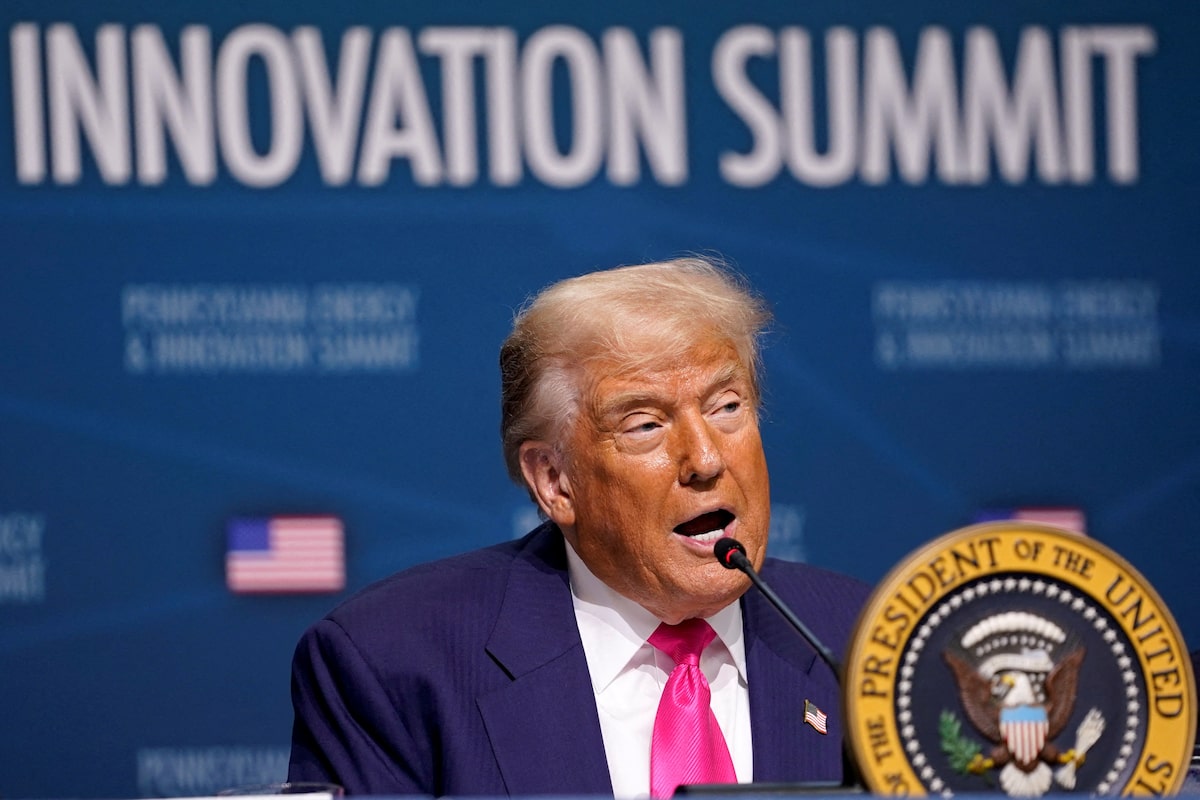
U.S. President Donald Trump speaks during the Pennsylvania Energy and Innovation Summit, at Carnegie Mellon University in Pittsburgh, Pennsylvania, on Tuesday.Nathan Howard/Reuters
U.S. President Donald Trump took a few hours off from adjusting tariff rates and ordering the deportation of migrants to become the world’s least likely – but for an instant the most visible – artificial intelligence evangelist.
In the unfamiliar environs of a top university (his campus visits have been largely confined to military academies and Christian colleges) and with an audience of six university presidents (an academic order that customarily regards him as a sworn enemy), Mr. Trump said the investment commitments made at the Energy and Innovation Summit were insuring that the United States became the “number-one superpower” in artificial intelligence.
“Today’s commitments,” Mr. Trump said, “are ensuring that the future is going to be designed, built and made right here in Pennsylvania and right here in Pittsburgh, and I have to say, right here in the United States of America.”
A man in his 80th year, he is possessed of little known interest in, affinity for, and confidence with contemporary technology besides his early-morning social-media posts and the adoring hymns of conservative online influencers, most of whom he didn’t know existed until his teenaged son convinced him last autumn that they were a powerful untapped political resource.
But like Ronald Reagan, whose brand of conservatism the 47th President has foresworn, Mr. Trump is an intuitive politician with a gift for performance. So after being pressured to be the keynote speaker for a technology and energy summit held on the campus of Carnegie Mellon University Tuesday, Mr. Trump, who otherwise likely considered artificial intelligence to be conflicting reports on the Iran bombing raid, soldiered on gamely, if slightly off his game. “It’s not my thing,” he said, “although my uncle was at MIT.”
The President spoke of an economy “beautiful to behold” in an atmosphere punctuated by heady assertions that AI was the future of the world; that, as BlackRock investment powerhouse CEO Larry Fink put it, a test “to show the world that capitalism works”; and that, as a video presentation bellowed, “THE GOLDEN AGE OF ENERGY DOMINANCE IS HERE.”
The President delivered what essentially was a pep talk, even for “clean, beautiful Pennsylvania coal.” His audience (unofficial count, made from an obstructed view: 43 men, two women) was American captains of energy (CEOs of major corporations, some of them old-school) and architects of AI (many of them leaders of companies whose names look like typos).
Mr. Trump noted how much electricity China is producing and said, “We just started. We will eventually do more than them,” vowing that the U.S.’s goal was to “be the first in every technology.”
U.S. President Donald Trump travelled to Pittsburgh on Tuesday to tout more than US$90-billion dollars in new energy and technology investments while boasting of a ‘true golden age for America’ in energy policy and artificial intelligence.
The Associated Press
In a day of bold promises and daring commitments, many attendees pledged as much as US$92-billion – the exact number varied depending on who was counting, and of course on who was fibbing – to join Pennsylvania’s energy resources with its technology research in a rush for development and dominance.
“Trump’s aware of tech and knows enough to know it’s important,” Kara Swisher, an influential tech commentator, said in an interview. “The issue remains how AI is regulated. The tech companies want minimal oversight, and Trump’s been okay with that. And Pennsylvania’s coal and gas make it an attractive place for these new investments.”
The President’s remarks occurred in a city that once was the site of several landmarks of the old economy – a mere eight kilometres away sat the Carnegie Steel Company, which once employed 15,000 workers and was the battlefield of the 1892 Homestead strike. For the past quarter-century, a sprawling shopping mall has stood where seven workers and three private security Pinkerton guards were killed in one of the bloodiest labour conflicts in American history. The pockmarked brick smokestacks and the rusting gantry crane remaining at the site are weathered homages to a period long gone.
“This was a centre of energy over many different epochs, and now technology and the emergence of private-sector technology have allowed Pittsburgh to evolve,” said Christopher Briem, a regional economist at the University of Pittsburgh and author of the forthcoming Beyond Steel: Pittsburgh and the Economics of Transformation. “The seeds stretch back decades and converge when Pittsburgh is challenged to translate research success into commercial success.”
The President’s appearance was the culmination of a day of addressing a matter that Pennsylvania’s Senator David McCormick, who convened the summit, called in an interview “the existential struggle with the Chinese.”
For just a bright shining moment in this era of dark rhetoric and disruption, there was no partisan disputation.
Opinion: The beginning of Chinese AI is the end of the American golden age
Pennsylvania Governor Josh Shapiro, a Democrat, spoke of “a global race for energy and for AI.” Mr. McCormick, a Republican, chimed in with a cheer for Pennsylvania’s unusual mix of energy and AI innovation, asserting, “You have to have the energy before you have the AI.”
Data centres consumed 4.4 per cent of American electricity in 2023 but, according to a study the Lawrence Berkeley National Laboratory prepared for the U.S. Department of Energy, that figure could triple by 2028.
In a day of paeans to the bright future and sunny promises of prosperity – Blackstone pledged US$25-billion for a data centre and energy infrastructure development, and Google unveiled a 20-year deal with Toronto-based Brookfield Asset Management to upgrade two hydropower facilities – a discouraging word was seldom heard.
But memories persist in Southeastern Pennsylvania of how the boom-era talk of local Marcellus shale natural-gas frenzy faded and how the landscape marked from earlier-era unplugged wells posed environmental threats. Four months ago, Governor Shapiro himself plugged the 300th orphaned or abandoned well. And though Pennsylvania has a clean-energy work force in the tens of thousands, according to E2, a non-partisan group of business leaders, environmental activists warn the rush to power AI data centres will further entrench fossil fuels in the economy.

