
Opinion | Operation Sindoor: A Triumph Politicised, Not Celebrated
Last Updated:August 01, 2025, 14:21 IST
While the Opposition’s intent might have been to embarrass the government on Operation Sindoor, it ended up portraying the armed forces as having failed

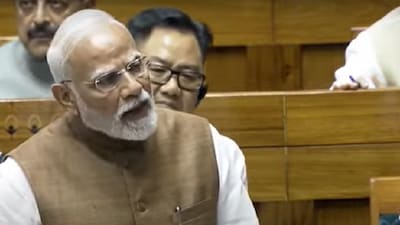
It was the Prime Minister and his cabinet colleagues who appreciated the success achieved by the armed forces. (File/YouTube)
The Operation Sindoor debate in Parliament was very disappointing. The impression conveyed was that Indian politicians, desperate to take over the reins in Delhi, were speaking through their hats, without a clue about the basics of military strategy and largely unaware of what transpired in those few days of operations between India and Pakistan. Even schoolchildren would have had better knowledge than most of them.
It appeared that their intent was to discredit the armed forces for conducting a successful operation without major loss of military lives on our side and avoiding collateral damage across the border. Negativity was visible throughout the debate. Not a single Opposition politician began his address by congratulating the forces for having brought Pakistan to its knees in just 88 hours—something Israel failed to do in 12 days against Iran, despite Iranian air defences being rendered redundant and Israel having to beg the US for help.
Recommended Stories
In India’s case, China was behind Pakistan, providing it with satellite and real-time inputs on the movement of weaponry. In reality, India was fighting Pakistan backed by Chinese weaponry, technology, and intelligence inputs—all by itself. Its performance was truly laudable.
One member questioned why India’s top aircraft, Rafale, engaged enemy targets from within Indian territory rather than crossing the border, unaware that this is exactly why modern aircraft are procured. His remarks displayed that he had no clue about air operations but had to speak to impress his party leader, even at the cost of displaying ignorance. The end result was that he became a laughing stock, not only within the military and veteran community but also across the nation. Social media enthusiasts seemed to know better than these so-called political heavyweights.
Another quoted Pakistani media on Indian aircraft losses. His statement, lacking any proof, provided anti-India elements, especially those across the border, the very fodder they were seeking. Even Donald Trump mentioned that four to five aircraft were downed, avoiding naming any country. It was a desperate Pakistan that twisted Trump’s statement to imply India. Pakistan has been trying to hide its aircraft losses, and Indian politicians in Parliament seemed eager to help them do just that.
A third MP called Operation Sindoor a ‘tamasha’. An operation whose success was noted worldwide and that brought a nuclear power to its knees in days can be anything but a ‘tamasha.’ Such poor statements indicate how biased some of our politicians are. It also displays their poor regard for the efforts put forth by the armed forces in protecting national interests. Do we deserve such thankless leaders?
One politician even went on to compare Donald Trump with McDonald’s, claiming India must ban McDonald’s because, he assumed, it was owned by Trump. Don’t our politicians check their facts before they speak and embarrass themselves? Another questioned the timing of Operation Mahadev, where the three Pakistani terrorists involved in the Pahalgam attack were gunned down. If the Army has to seek permission from Parliament prior to launching anti-terrorist operations, then the nation’s future is in jeopardy.
Why is the loss of Indian fighter jets so important for our politicians? Is it to let the nation’s forces down or prove they failed? No nation ever declares its material losses, even if they occur, and India is no different.
As rightly brought out by the defence minister, not a single Opposition politician wanted to know how many enemy aircraft were downed, nor the number of terrorist camps and Pakistani posts destroyed, as also the material and personnel losses they had suffered. These are the very politicians who hope to lead our nation in the future.
The whole game plan of the Opposition in Parliament was to blunt the success achieved, thereby reducing the ability of the ruling dispensation to exploit it politically. They ended up degrading the armed forces while giving Pakistan a safe base to cover their losses and justify their promotion of Asim Munir as their failed field marshal.
The Indian armed forces are appreciated across the nation for their selfless sacrifice and devotion to duty. However, for politicians, they seem to be a white elephant because their performance supports the government in power. It was embarrassing to listen to the knowledge levels of those we elect to represent us. It actually compels some of us to think whether we truly deserve this form of democracy where anyone can be elected.
What was worse was that political parties kept those with knowledge and awareness of Operation Sindoor out of the debate, solely because they would not toe the anti-armed forces and anti-national line. It only highlighted that political parties had an agenda of announcing to the world that India’s armed forces had failed—and that too publicly in Parliament, whose proceedings are globally observed.
Every political party in the country has former military officers in their ranks. They are seen in flights, airports, rallies, and walkathons wearing miniature service medals and side caps, conveying their status as veterans. It is incumbent upon them to brief those nominated on what the reality is, to prevent them from displaying ignorance in public. Possibly, political parties consider them unworthy of being listened to.
While the intent may have been to embarrass the government on Operation Sindoor, it ended up portraying the armed forces as having failed. This played to the advantage of Pakistan and China, which were desperate to project the operation as unsuccessful and the losses largely Indian. Rather than boosting the morale of the forces, it ended up politicising them—something that should always be avoided.
Imagine the impact of the debate on the morale of a soldier who is involved in operations in Kashmir, battling terrorists and preventing infiltration, as also of pilots who risked their all to destroy Pakistani terrorist camps and their strategic assets. Not a word was mentioned for the efforts of those who used their ingenuity to ensure that not a single Pakistani missile or drone caused damage to Indians or its strategic assets. In sum, the armed forces are expendable except when votes are sought.
It was the Prime Minister and his cabinet colleagues who appreciated the success achieved by the armed forces and sought appreciation from all present, to which the response was muted. While the national public respects the soldier, some politicians mock him and his efforts. A glance at social media indicates how the Indian public viewed the Parliament debate and what their opinion of our so-called high-flying leaders is.
The author is a former Indian Army officer, strategic analyst and columnist. Views expressed in the above piece are personal and solely those of the author. They do not necessarily reflect News18’s views.
view comments
Read More
