
Church, local leaders push to end Davao Oriental mining over environmental ruin
DAVAO ORIENTAL, Philippines – Calls to shut down mining operations in Davao Oriental for good are snowballing, as local officials and the head of the Catholic Bishops’ Conference of the Philippines (CBCP) joined forces in condemning the environmental damage near a world heritage site and a Philippine eagle sanctuary, and urging accountability from the companies involved.
Davao Oriental Governor Nelson Dayanghirang led local officials in appealing to the national government to stop mining activities in the province, saying they have caused massive environmental destruction and displaced many residents from their homes and sources of livelihood.
Davao Oriental officials found an ally in Cardinal Pablo Virgilio David, president of the influential CPCP, who described the environmental damage as “a crime against the community and creation itself.”
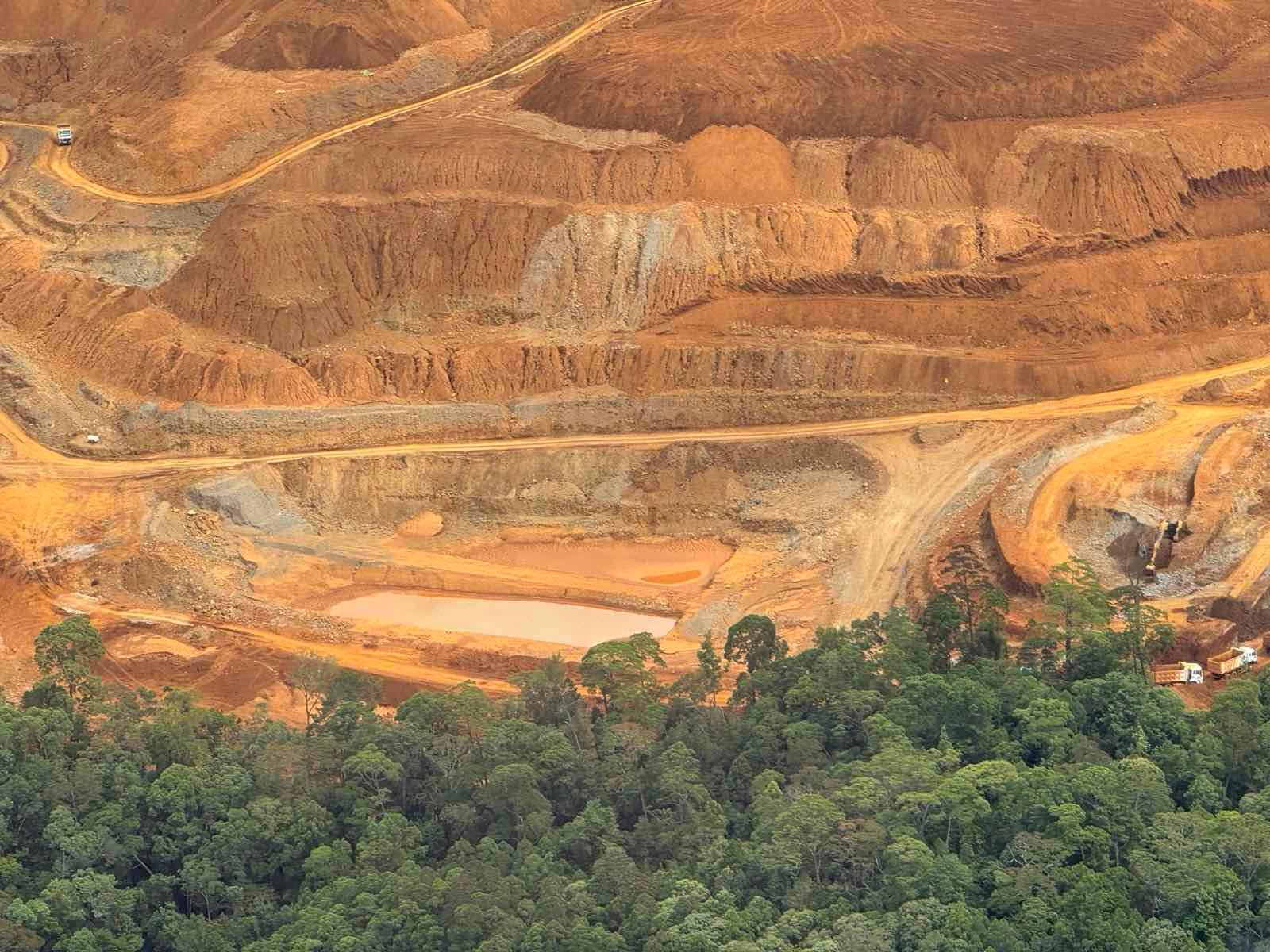
In a statement posted on his Facebook page on Tuesday, October 7, David said, “The nickel laterite mining operations of Riverbend Consolidated Mining Corporation and Arc Nickel Resources Inc. have turned the Mapagba and Pintatagan Rivers into rust-colored streams of poison. Heavy rains simply revealed what was already wrong – massive siltation, careless overburden disposal, and weak safeguards that allowed waste materials to overflow into vital waterways.”
David urged the filing of a Writ of Kalikasan against the companies, calling for accountability beyond suspension.
During a dialogue with residents and officials in Mati City on Monday, October 6, Dayanghirang showed the extent of ecological damage caused by mining in Mati alone.
“Mahurot ang kwarta, apan dili nato mapulihan ang atong kalibotan (Money can be depleted, but we cannot replace our planet,” Dayanghirang said.
He urged local officials and residents to embrace tourism instead of mining, noting that the province hosts a Philippine eagle sanctuary.
Dayanghirang said mining activity in Barangay Macambol, Mati, alone has already damaged at least 200 hectares of forest cover.
He added that a vital government-funded road project in the area – which would have connected the geographically isolated villages of Macambol, Cabuaya, Luban, and Lanca – was stalled because of mining activities.
In a text message to Rappler on Wednesday, October 8, the governor said he was grateful that his call had drawn strong support, particularly from the influential CBCP led by Cardinal David.
“I am glad to see massive support for our effort, so this will compel the national government to look into our plight,” Dayanghirang said.
In a statement, Cardinal David said, “Governor Dayanghirang is right to call for an immediate halt to the mining operations. But stopping is only the first step. There must be accountability. The people of Banaybanay deserve justice for the loss of their clean water, their livelihoods, and the integrity of their land.
David said what is happening in Davao Oriental is the same situation across the country where extractive industries were profiting from natural resources while communities are left to suffer the consequences.
“A Writ of Kalikasan should be filed against these companies – a constitutional remedy precisely meant to defend the right of every Filipino to a balanced and healthful ecology. The mining operators must be held liable for the ecological damage they have caused and compelled to rehabilitate what they have destroyed,” he said. “Enough of the apologies. Enough of the excuses. Suspend, sue, and hold them accountable – for the sake of our common home.”
Australia’s BHP Group Ltd, one of the world’s biggest mining companies, and its former local partner Asiaticus Management Corporation (AMCOR) once operated the mining project in Barangay Macambol, Mati. But the two firms became embroiled in a protracted legal battle in the Philippines and abroad, ending in a multimillion-dollar settlement.
The settlement allowed AMCOR to pursue a US$2-billion mining project in Davao Oriental on its own or with a new foreign partner.
The companies took their dispute to courts in the Philippines and Singapore more than a decade ago after AMCOR canceled its joint venture agreement with BHP Billiton for the Pujada Bay mining project in Mati City in 2007.
Formerly known as BHP Billiton, the Melbourne-based company was the world’s largest miner in 2017. AMCOR, meanwhile, is a consortium of Austral-Asia Link Mining Corporation and Hallmark Mining Corporation, and holds the rights over a 17,000-hectare mining concession in Davao Oriental.
AMCOR’s concession area includes parts of the Mount Hamiguitan Range Wildlife Sanctuary, the first and only UNESCO-declared World Heritage Site in Mindanao, as well as portions of the Pujada Bay Seascape and Landscape, recognized as one of the world’s most beautiful bays.
“The legal battle between AMCOR and our foreign partner BHP Billiton is over,” Dr. Arvin Carlom, AMCOR’s manager, said in a 2022 interview.
In his statement, Cardinal David identified two other firms – Riverbend Consolidated Mining Corporation and Arc Nickel Resources Incorporated – that have been operating in other parts of Davao Oriental.
Based on data from the Mines and Geosciences Bureau (MGB), Riverbend holds the government’s Mineral Production Sharing Agreement (MPSA No. 263-2008-XI, Amended I-B), covering more than 6,300 hectares across Banaybanay, Davao Oriental, and parts of Pantukan, Davao de Oro.
Company filings list Nicanor Escalante as Riverbend’s president. Under the MPSA, Arc Nickel Resources, led by Josue Lapitan, serves as the mine operator. MGB records describe Arc Nickel as an all-Filipino firm engaged in lateritic nickel extraction.
The two companies had been under close monitoring since a 2022 siltation incident that turned the Mapagba and Pintatagan rivers reddish-brown. The Department of Environment and Natural Resources (DENR) temporarily suspended operations after heavy rain triggered mine waste overflow.
The DENR later lifted the suspension after the firms built new siltation ponds and drainage systems, allowing them to resume under a three-year work plan with stricter environmental rules.
Local officials, however, continue to demand a permanent shutdown, citing recurring floods and sedimentation risks. Both companies have denied negligence, blaming the incident on extreme rainfall rather than operational lapses.
Beyond mining, Riverbend gained attention in 2017 after winning the government bid for the decommissioned Sucat Thermal Power Plant, signaling its wider business interests. – Rappler.com
