
What a difference a decade makes – looking back at the market’s muted response to the first Frankel yearlings
Good Morning Bloodstock is an exclusive daily email sent by the Racing Post bloodstock team and published here as a free sample.
On this occasion, Martin Stevens takes a trip down memory lane as Frankel’s first crop hit the yearling sales – subscribers can get more great insight every Monday to Friday.
All you need do is click on the link above, sign up and then read at your leisure each weekday morning from 7am.
The talk of the bloodstock world ten years ago this week was not the blockbuster prices being paid at Book 1 of the Tattersalls October Yearling Sale, but rather the smaller than expected sums being given for Frankel’s first-crop offerings.
Excitement for the debut lots by the unbeaten dual world champion, surely the best racehorse most of us will see, had reached fever pitch by the summer of 2015. How many millions would they make? Would records be broken? Who would buy them?
However, the industry’s hive mind had other ideas. Frankel’s early progeny came in all shapes and sizes, so the sire wasn’t stamping his stock, and that was A Very Bad Thing according to the self-appointed sales-house cognoscenti.
Therefore, in spite of Frankel’s own brilliance and the blue-chip pages of his introductory commercial yearlings who had been conceived at Banstead Manor Stud at a fee of £125,000, he was given a relatively lukewarm reception by the market.
The son of Galileo had 19 of his 26 yearlings that year sell for an average of around 555,000gns and median of 450,000gns – perfectly respectable amounts that left plenty of room for profits, but not the feeding frenzy the public had expected.
The problem, such as it was, lay in the fact that ‘just’ two lots made seven-figure sums – fillies out of Alexander Goldrun and Platonic who sold for €1.7 million at Goffs Orby and €1.15m at Arqana August respectively.
The eagerly anticipated Book 1 beanfeast just didn’t materialise. The best price paid at the sale was 750,000gns for a colt out of Dar Re Mi, which was only the joint-11th highest value overall, behind a bucketload of Dubawis and Galileos.
Those fewer-than-hoped-for Frankel fireworks set tongues wagging in sales-house bars and fingers typing furiously on social media. So much so, in fact, that Richard Hughes was moved to write on the subject in his Racing Post column.
“One of the big talking points of Book 1 was the Frankel yearlings, of whom some were extremely nice,” he opined that October. “They did not, on the whole, make the same sort of money as the Galileos and the Dubawis, but I don’t believe you could have expected them to – and I do believe they were making the right money.
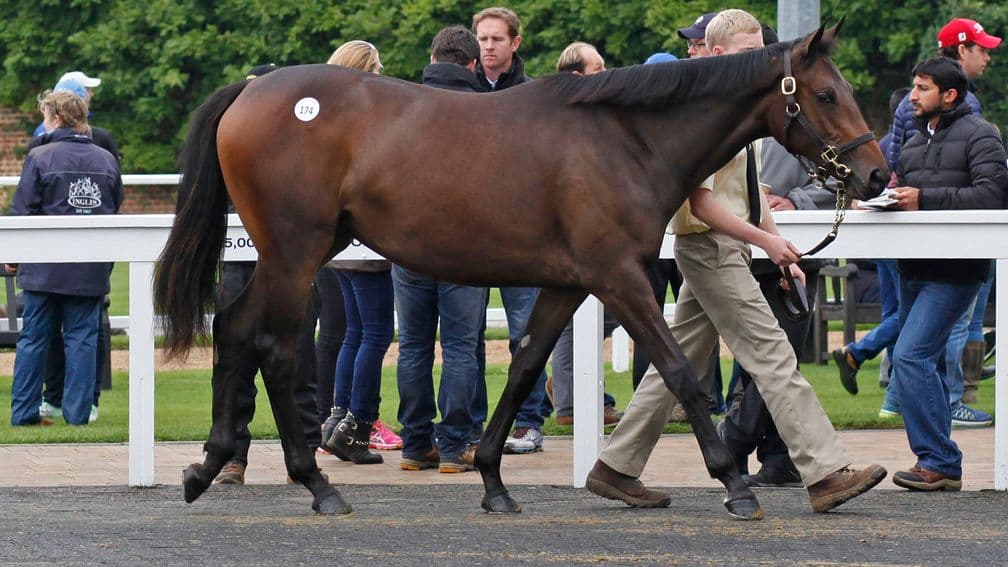
Aljezeera: stakes-winning filly from the first crop of Frankel sold for 450,000gns at Book 1 Credit: Laura Green
“Frankel is a first-season sire. You have to remember that. If I gave you £1 million to buy a single yearling, would you want to buy one by Galileo, the stallion long since proven to be the best sire in the world, or would you want to buy one by Frankel, an unproven first-season sire?
“Frankel might well show himself to be every bit as good as Galileo in a few years’ time, but at the moment we don’t know how effective he is going to be at passing on his ability. That isn’t a criticism of him – the same would be true of any first-season sire.”
Hughes summed up sagely: “That being the case, Frankel fared really well this week. I’m sure anyone who went home with one of his sons or daughters will be very much looking forward to the coming months.”
Looking back a decade later, the crack jockey turned crack trainer was bang on the money. Several buyers did unearth some serious bargains by ignoring whispers about the sire, and a few breeders were rewarded for keeping hold of their lots instead of selling them for barely more than the cost of production.
The cheapest first-crop Frankel yearling to change hands, bought for €130,000 at Goffs by Mark Johnston (natch), was Frankuus. The half-brother to Prix Thomas Bryon winner Kitaya proved his price-tag all wrong by winning the Ascendant Stakes and Prix de Conde at two and the Rose of Lancaster Stakes at three.
Dermot Farrington also played a blinder by buying the colt out of the regally-bred Fillies’ Mile third You’ll Be Mine for 150,000gns at Book 1, on behalf of Kiwi owner Sir Peter Vela. That was Eminent, who won the Craven Stakes and Prix Guillaume d’Ornano and finished a close fourth in the Derby and third in the Irish Champion Stakes at three, and is now standing at stud in New Zealand.
Prince Faisal’s Nawara Stud gave $500,000 – about £320,000 or £440,000 back then – for a colt out of a winning daughter of Kingmambo and Damson at Keeneland. That was not an outlandish figure considering the pedigree, although it was apparently the most ever given for a yearling by the shrewd operation.
Either way, it was money well spent as the Kentucky-bred crossed the Atlantic, was named Last Kingdom and was sent out by Andre Fabre to win the Prix Daphnis before a presumably profitable sale to continue his career in Hong Kong.
Aljezeera, a filly out of US Grade 1 heroine Dynaforce, was purchased by Al Shaqab Racing for 450,000gns and won the Beckford Stakes and finished second in the Park Hill Stakes, while Seven Heavens, a colt out of dual Group 3 scorer Heaven Sent, was bought by Juddmonte for 620,000gns and won at Ascot and Goodwood and notched three Listed placings before also being sold onto the Hong Kong circuit.

Goldrush: €1.7 million Goffs Orby purchase and Listed winnerCredit: Patrick McCann (racingpost.com/photos)
Hell, even Frankel’s most expensive debut yearling, the €1.7m filly out of Alexander Goldrun, could be described as decent value, knowing what we do now about the sire and comparing with current market conditions.
Goldrush, as she was named, secured a brace of Listed victories at Dundalk in the autumn of her three-year-old campaign for her buyer the China Horse Club and, although she produced only one foal before her early death, that was thankfully a daughter, who is the Group 3-placed Siyouni filly Love Rush.
Similar comments apply to a lesser degree to Ghalyah, the €1.15m filly out of Platonic purchased by Charlie Gordon-Watson for Abdullah Saeed Al Naboodah.
She didn’t make the track, which was far from ideal, but she did become a useful member of the Rabbah Bloodstock broodmare band, producing this year’s Bronte Cup winner Scenic and progressive handicapper King Of The Sea.
Among the Frankel yearlings who went unsold, and were raced by their breeders or moved on privately instead, Mozu Ascot (vendor at $275,000) struck at the highest level in Japan in the Yasuda Kinen and February Stakes; Toulifaut (not sold at 285,000gns) scored in the Prix d’Aumale and was sold to Japan for €1.9m; Cunco (vendor at 280,000gns) became his sire’s first winner and took the Sandown Classic Trial; and Atty Persse (vendor at 160,000gns) bolted up on debut to spark a sale to Godolphin, for whom he landed the King George V Stakes at Royal Ascot.
Perhaps the wisest long-term decision that year was made by Jean-Pierre Dubois, who kept hold of his Frankel half-sister to the brilliant champion Stacelita despite her being knocked down for €450,000 in Deauville.

Frankel: champion sire is now carrying all before himCredit: Marina Cano
Speralita, the filly in question, didn’t race but two of her first three foals, both by Kingman, were Noble Truth, who was sold to Godolphin as a yearling for €1.1m and scored in the Jersey Stakes at the royal meeting for Sheikh Mohammed’s outfit, and Sparkling Plenty, who carried home silks to victory in the Prix de Diane before a part-sale to Al Shaqab Racing for £5m and another sale to Coolmore for €5m.
Sure, there were some duds among Frankel’s debut yearling draft, but no sire with large numbers of offspring has ever boasted anything like a 100 per cent strike-rate of success.
It had to be remembered, too, that many of his progeny were in the hands of owner-breeders and were never going to be offered to market untried.
That was the case for many of Frankel’s finest first-crop representatives, including Call The Wind (bred and raced by George Strawbridge), Cracksman (Anthony Oppenheimer), Dream Castle (Godolphin), Fair Eva (Juddmonte), Queen Kindly (Jaber Abdullah) and Soul Stirring (Shadai Farm).
Ten years on from Frankel’s inauspicious start at the sales the sire has delivered 40 top-level winners, his exceptionally gifted daughter Minnie Hauk has just gone down all guns blazing in the Prix de l’Arc de Triomphe and his 11th-crop yearlings were selling for an average just shy of 1,000,000gns after the first day of Book 1.
All that when his foals suffer from the grave handicap of not bearing many similarities to one another!
Really, what was all the fuss about?
Refer a friend!
If you have a friend who would like to receive Good Morning Bloodstock please send the following link where they can sign up.
What do you think?
Share your thoughts with other Good Morning Bloodstock readers by emailing [email protected]
Must-read story
This story is exclusive to Racing Post + Ultimate subscribers. Sign up here to get unlimited access to our premium stories.
“For most of its history the Dewhurst was overshadowed by the Middle Park Stakes, whose winner was usually the official champion two-year-old,” writes John Randall as he marks the 150th anniversary of the prestigious Newmarket contest.
Pedigree pick
Did I write in this space yesterday that Proposition, who made his debut for Aidan O’Brien at Navan yesterday, was one of the best-bred two-year-olds in training anywhere in the world? I might have spoken too soon as a filly who has an equal, if not stronger, claim to that title is given her first outing by the Ballydoyle maestro today.
Mother’s Day, who is declared for the fillies’ maiden over a mile at Thurles (1.45), is by Frankel out of Coronation Stakes and Matron Stakes heroine Lillie Langtry, who has produced three individual Classic winners – Minding, Empress Josephine and Tuesday. The magnificent Minding is also the dam of National Stakes winner Henry Longfellow.
Lillie Langtry, who has bred six winners in total, is a Danehill Dancer half-sister to black-type winners Count Of Limonade and Danilovna from the family of high-class sprinters Great Commotion and Lead On Time.
Jky: Jack Cleary (5lb)Tnr: A P O’Brien
Don’t miss ANZ News
Subscribe for the latest bloodstock news from Australia, New Zealand and beyond.
Read these next:
A different type of gamble: the pro punter on a run with his small group of homebreds
‘If we can’t get the old man, let’s go for Vandeek’ – Arrowfield’s bold new sprint bet

Good Morning Bloodstock is our unmissable email newsletter. Leading bloodstock journalist Martin Stevens provides his take and insight on the biggest stories every morning from Monday to Friday.
