
South Africa pushes ahead with genocide case against Israel despite Gaza ceasefire
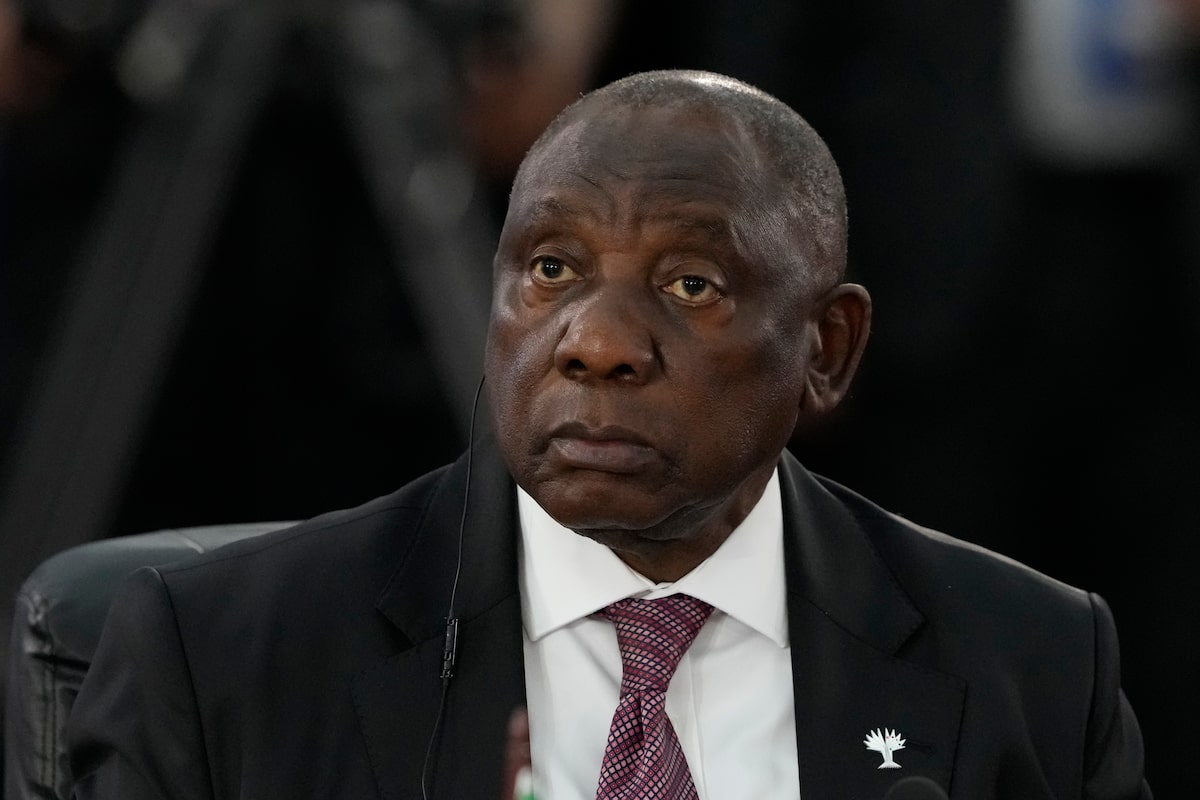
The ceasefire agreement between Israel and Hamas ‘will have no bearing’ on the ICJ genocide case against Israel, South African President Cyril Ramaphosa said earlier this week.Eraldo Peres/The Associated Press
South African leaders say they are pushing ahead with their genocide allegations against Israel at the International Court of Justice, despite the latest Gaza ceasefire and the threat of further U.S. pressure against Pretoria.
The country’s genocide case against Israel has emerged as a major grievance for U.S. President Donald Trump’s administration and for Israeli Prime Minister Benjamin Netanyahu, who has called it a “blood libel.” But South Africa insists it will not abandon the case, even after the peace agreement reached between Israel and Hamas last week.
South Africa launched the case against Israel at the world court in The Hague in December, 2023. It accuses Israel of violating the international genocide convention by killing and starving Palestinians in Gaza.
“The peace deal that has been struck, which we welcome, will have no bearing on the case that is before the International Court of Justice,” South African President Cyril Ramaphosa told the upper house of Parliament this week.
“In the end, real justice must be done for the people of Palestine,” he said. “We cannot go forward without the healing that needs to take place, which will also result from the case that was launched being properly heard.”
Mr. Ramaphosa said his government has taken “decisive action” to advocate for the rights of Palestinians. “At times we’ve done it at great cost to ourselves as a country,” he said.
Opinion: Peace can’t be attained until Gaza and its people have been rebuilt
He may have been referring to the penalties imposed by Mr. Trump, who cited the genocide case as one reason for his executive order in February that terminated all U.S. assistance to South Africa. The case has also been cited by members of the U.S. Congress who have tabled legislation calling for sanctions against South African officials and a full review of American relations with the country.
The ICJ is not expected to make a ruling on the genocide allegations until 2027 at the earliest. But in provisional orders last year, the court directed Israel to take emergency action in Gaza, including the provision of humanitarian supplies and other measures to prevent any violation of the genocide convention.
The genocide case has continually rankled the Israeli government. In a visit to Washington last month, Mr. Netanyahu complained about “lawfare” against Israel at the ICJ and the International Criminal Court.
Joshua Meservey, an Africa analyst at the Hudson Institute, a conservative U.S. think tank, said the Gaza peace deal is a “fascinating dilemma” for South African officials. “Will they seize the opportunity to step back from the ICJ case and remove a massive bone of contention between the U.S. and [South Africa], or will their categorical anti-Israel ideology make it impossible?” he asked in a social-media post this week.
Despite the U.S. pressure, the South African government has been pleased that its court case has won support from many countries worldwide, including Brazil, Spain, Ireland, Turkey, Chile and Colombia. A United Nations commission of inquiry also concluded last month that Israel has committed genocide against Palestinians in Gaza.
“Our case was initially rejected in some quarters as populist, blood libel, meritless and baseless,” South African deputy foreign minister Alvin Botes told an international conference in Malaysia on Tuesday.
“Today … there is a growing body of consensus that what has taken place in Gaza is indeed genocide,” he said. “We have chosen to be on the side of the global majority that has rejected these horrific actions.”
For those caught in the middle, the path to Middle East peace is a long one
In another sign of defiance against the United States and Israel, South Africa has become a leader of the recently formed Hague Group, which promotes support for the ICJ and ICC, including the Israel-related cases at both courts.
Eight countries belong formally to the group, but more than 30 countries have participated in some of its meetings. “We look forward to more states joining our initiative and civil society to support us,” Mr. Botes told the conference in Malaysia.
Many South African civil-society groups have supported the accusations against Israel. The Nelson Mandela Foundation has invited Francesca Albanese, the UN special rapporteur on human rights in the occupied Palestinian territories, to give its annual Mandela lecture this year, despite U.S. sanctions against her and sharp criticism of her by Israel.
The Israeli embassy in South Africa, in a social-media post this week, ridiculed the foundation’s invitation to her, saying that Ms. Albanese was being “rewarded” for hate. But the foundation said it had to move the lecture to a bigger venue because of high public demand.

