
Matt Frei: Western media in Gaza would have curbed IDF excesses
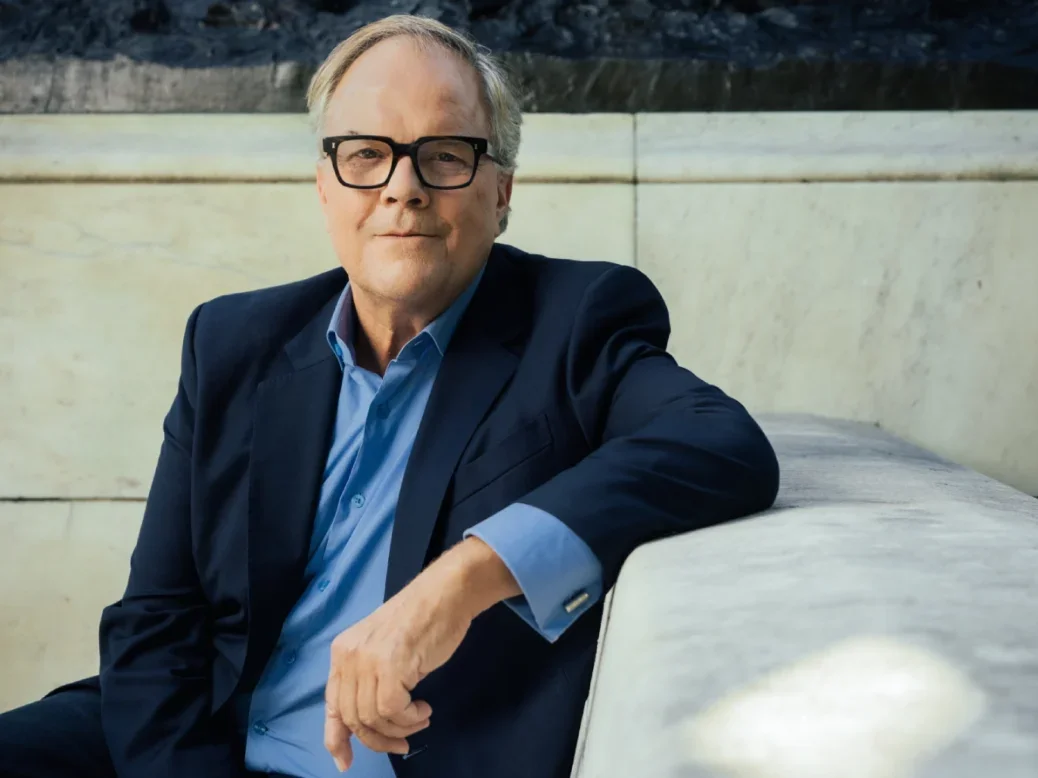
Channel 4 News presenter and Europe editor Matt Frei has shared advice on surviving the challenges facing journalists in 2025, suggesting we need some kind of “journalistic hippocratic oath”.
He said: “At the very least not to set out to do harm, to twist the facts. To make stuff up. In this tribal landscape of opposing versions of information, we are increasingly mocked for being ‘mainstream’.”
Frei noted that the business model for media in the US frequently “rewards partisanship”.
Frei was delivering the Steve Hewlett Memorial Lecture 2025 in Lonon on Wednesday night, titled “Who gets to tell the story?” Scroll down to read the lecture in full (not checked against delivery).
He spoke at length about Israel and Gaza and the challenges facing journalists trying to tell the truth about what is going on when international reporters have not been allowed to enter Gaza for more than two years.
“Had we been allowed to enter Gaza after 7 October I believe the worst excesses of the IDF would have been avoided,” he said.
“Moreover, a greater number of Israelis would have had access to more information inside Gaza. The antiwar demonstrations that we saw in recent months would have happened earlier. Maybe the first ceasefire brokered in part by Trump and broken by the Israelis would have been allowed to continue.”
Comparing this with the clamping down on press freedom in the US, Frei advised journalists use the internet “smartly”, spoke on the need for government support instead of antagonism, and the importance of authenticity, truth and bearing witness.
“How to survive this – as a reporter who wants to report rather than repeat or repent?” he said.
“If you’re lucky enough to work for one of the great institutions that still value genuine journalism, like the BBC, Channel 4, ITV, Sky, LBC, the Financial Times, Reuters – we have plenty more – count yourself lucky.
“They have your back. They have some institutional clout. Politicians mess with them at their peril. But don’t take anything for granted.”
Frei added that “America these days makes me laugh and wince”, referencing recent new rules imposed on journalists covering the Pentagon by defence secretary Pete Hegseth.
“The majority chose to walk out of the building. Good for them. In genuinely free nations this is a choice no journalist should have to make.”
He added that some “great” US networks such as ABC, NBC or CBS have made “deals with the Trump administration that their journalists regretted or opposed”.
“Some of them now regret folding early on. Some have rediscovered that they have a spine.”
Matt Frei’s Steve Hewlett Memorial Lecture 2025 in full:
This speech is a survival kit for well-meaning journalists today, especially in a time of war.
It is an attempt to put the truth on life support in an era in which more and more come up with their own version of it to suit their employers, their governments, their egos, their ratings or their censors.
And let’s just define well-meaning or benign as a journalist who is not in it to give a sermon or plug a cause – said the man about to launch into a sermon.
There is no such thing as perfect objectivity. The best we can do is to try and see the facts, the events, the drama from as many sides as are possible or relevant, knowing that parts of the audience will never buy what we’re selling.
It is about establishing a context. And yes, you could call it a fool’s errand. So, hold your nose, open your eyes and ears and join me on this short journey into the known unknown.
‘Journalism is under threat’
First of all let us be honest: journalism is under threat, physically, politically and digitally. There are plenty of powers who see us a menace.
One example: I remember with lingering horror the day that my journalistic innocence died on the battlefield.
It was Bosnia 1992, the beginning of the most vicious war in Europe, on the EU’s doorstep since 1945. We were staying at the Holiday Inn in Sarajevo, although by the time we got there the Holiday Inn corporation had disowned the place.
A few months after the war had started, the front facade facing the Serbian lines was shot to pieces. The loos on that side could still be flushed. But the call of nature could be fatal.
A notice went up warning guests not to use the fire hoses for their ablutions and the hotel food was whatever you had brought along yourself. We used gaffer tape to write the word press or TV on our cars, thinking innocently that this would shield us from attack.
We soon realised that it made us journalists a target. Not that the people shooting at us had a definite dislike for our reporting per se. It’s just that we had unwittingly become part of the military calculation. If the Bosnian Muslims – the weaker side – could get us to film and witness atrocities perpetrated by the stronger side – the Bosnian Serbs backed by Belgrade – then our pictures beamed into the living rooms of America or Britain might persuade reluctant leaders in London, Paris or crucially Washington to intervene military on behalf of the losing side and thus tip the balance.
This is exactly what happened. What was first dismissed in the White House – in the unforgettable worlds of PJ O’Rourke as a war between the unspellables and the unpronounceables – now became a war over the protection of Western values.
Nato eventually intervened. Then there was a peace process in the Dayton Accords which is just about still holding three decades later. Just about.
Arguably, without the presence of journalists providing crucial information leading to political pressure and military intervention, the accords may never have taken place.
Information had been mobilised with a good outcome that ended badly for the people who started the war: Radovan Karadžić, Ratko Mladić, Slobodan Milošević.
They all eventually got captured and went on trial. Two are still serving long prison sentences. One died in jail while on trial. No wonder we journalists had become targets in this war. The truth that we exposed of concentration camps, bread queue massacres and civilian executions did not allow our elected leaders the luxury of sitting by and doing nothing.
‘War over narrative’ in Israel and Gaza
Fast forward to 7 October and we find a similar battle for the truth, a war over narrative.
Only the Israelis have used a different approach. It is designed to either discredit or disrupt the flow of news from Gaza. They closed the doors on us. They shut the place to outside journalists.
Yes, there have been so called embeds with the IDF. They are heavily controlled. They are time limited. They do not allow you to speak to Palestinian civilians, whose stories we want to tell, whose painful stories deserve to be heard as much as the painful stories of Israeli hostage families.
[Read more: ‘We accept the risks’: Sky News boss calls for journalists to be allowed into Gaza]
But this was an access not granted by the Israelis. It is still not granted. Had it been granted we might have been able to investigate whether Hamas was indeed using people as human shields, hospitals as artillery positions or tunnels under schools to hide hostages.
Or, at the very least, we would have been able to say we tried to tell the truth about Hamas but Hamas wouldn’t let us, as opposed to Israel wouldn’t let us go anywhere near the truth.
But denying us foreign journalists access Israel, a country that prides itself on being a democracy and having a free press, did not help its own cause. You can’t claim the moral high ground and then commit atrocities behind a cloak of censorship. Hamas, of course, also commits atrocities. But they never bother claiming the moral high ground.
Luckily for us as broadcasters, luckily for the audiences and essentially for the Palestinians, there have been hundreds of brave Gaza journalists who have told their stories, filmed their stories and got them out. The Israeli authorities have either tried to discredit them – they work for Hamas, they peddle propaganda etc – or at worst they have killed them.
More than 250 have died since 7 October 2023. Some of them have been targeted, according to Reporters Without Borders. Gaza was and continues to be a very dangerous place to be a journalist.
[Read more: Stop killing journalists in Gaza and allow international media in]
Even if and when the Israelis open the gates it will be a very treacherous place to operate in. Just ask Allan Johnston, the BBC correspondent who was kidnapped in Gaza in happier times and held for almost four months.
But you can see what the Israelis were attempting to do. If you own the narrative you have a better chance of owning the audience. The competition for soft power is fierce and has an impact on hard military power.
So, the Government Press Office in Jerusalem was extremely efficient in giving us access to first responders after 7 October.
They organised daily bus trips to the Kibbutzim that had been turned into slaughterhouses by Hamas and Islamic Jihad. We spoke openly and often to the hostage families. I could imagine my own kids going to the music festival. Not picking up the phone. Sending a last text. It was all so easy to imagine. It was all true. And any reporter who failed to be moved by this, who failed to see its impact on Israeli society should be looking for a new line of work.
One tragic story that we can connect to is more powerful than the rawest and grimmest statistic.
Which is probably why the Israelis never wanted us to have access to those individual stories on the Palestinian side. They knew that numbers, even alarming ones that rang true, could be disputed. And every time we gave the Gaza death toll and added the words, “according to the Hamas health ministry” we somehow diminished the veracity of that number.
[Read more: Nearly 1,000 journalists sign new petition urging end to Gaza ‘information blackout’]
Crucially also Israel never provided rival casualty numbers, apart from time to time the number of Hamas fighters they thought they had killed. But, as far as I remember, they never counted the civilian casualties.
They of course kept claiming that they went out of their way to avoid civilian casualties.
Think of the pain suffered by the intrusion of brutality into your Saturday family life in the kibbutz on the Gaza border or in Khan Younis during bombardment. The IDF brings down an entire apartment block because of one or two Hamas operatives living there with their families, despite its repeated claims that it went out of its way to save civilian lives.
In previous Gaza wars the Israelis used to give the so-called tap on the roof. A warning in the form of a smaller missile that allowed the inhabitants to grab a few things and run. Although they never knew if they being given an hour or ten minutes to gather their lives. Apparently, they stopped doing the tap in the last war. I would love to know if that’s true.
But how could I without gaining access?
Whether you’re butchered by a Hamas machete or butchered by an Israeli F-16 or a drone, the result is the same. One is a medieval death. The other belongs to the digital age. Both end life.
What is worse: the impersonal act of killing by video game? Or the personal act of butchery where you meet your victim? Just making those comparisons, just asking those questions every day as a journalist, let alone a citizen who lives there, is traumatic and draining. It made this war so much vexing than the one in Ukraine, where – forgive me President Putin – the role of aggressor and victim is, to my mind at least, very clearly cast.
At the beginning of the Gaza war, the Israeli government went out of its way to claim that by defeating Hamas they were doing the difficult, dirty work of lady liberty. They were doing as much to protect the values of freedom and democracy as Ukraine’s Nato allies were doing against Russia.
But as the pictures from Gaza got out, much of the global audience stopped buying it. In the digital era information has a way of getting out. Truth seeps through. The pictures amongst the rubble soon ended up telling a very different story.
One of collective punishment. One, according the UN’s panel of independent experts, of genocide. And not mountains, but mountain ranges of rubble.
As the Gazans return to the smouldering ashen wasteland that had been their home, what will they find? How many more bodies are buried under those stones. We can’t tell you. Because we can’t get there.
Has the population of Gaza turned against Hamas, whose attack on 7 October triggered the most devastating response in Gaza? We don’t know. We’re not there.
And then there was the attitude in Israel proper. The government didn’t want to show its people what it was doing in Gaza. And to be honest, the Israeli public weren’t all that interested. That I can tell you. Because I was allowed to report it. In Israel, free to talk to whomever, whenever. Their cup was full of their own grief for their own people. And I get it. If I was an Israeli citizen, I might feel the same.
On Channel 4 we also reported about Israeli soldiers who were traumatised by what they had experienced in Gaza. When the truth comes out and filters through to Israeli society many people may be horrified by what was done in their name.
I know Israel quite well. I lived there for almost a year in 1989, as the BBC Arabic service stringer for Gaza and the West Bank. I loved living in Jerusalem. I liked the directness of Israelis. Their resilience. Their openness.
This year, I thought there was something both eerie and admirable about how you could go swimming on the beach in Tel Aviv minutes after an Iranian missile alert had been called off.
And down on the same beach in Gaza – roughly Brighton to Hastings – all hell was still being unleashed. The same sand. The same warm water. But everything else might as well belong to a distant galaxy. The swimmers in Tel Aviv were oblivious.
If Israelis don’t understand how Palestinians feel, how their yearning for self-determination and safety is just as legitimate as their own, they will never understand the rage and the resentment. This isn’t just about Hamas or about the extremist settlers in the Netanyahu government. If Palestinians and their supporters in London or Paris don’t understand how 7 October made Israelis feel, they will never grasp Israel’s sense of vulnerability converted in the last two years into, I believe, excessive, often indiscriminate force.
‘Sometimes our reporting can even save lives’
Sadly, for this Israeli government every problem is a nail. And every solution involves a hammer. The Middle East needs to find a different tool set.
I spent ten days in Gaza reporting on the last war in 2021 and it felt like an open air prison where the Israelis controlled the skies and seas and the walls.
But everything inside was run by some vicious inmates called Hamas. The sound of Israeli drones overhead 24/7 was deeply unnerving. It was the Truman show from hell.
This last war was very different. But it gave me a taste for Gaza. It allowed me to experience – however briefly – what it was like living there.
It made me a better reporter. Had we been allowed to enter Gaza after 7 October I believe the worst excesses of the IDF would have been avoided. We might have acted as a disincentive.
Moreover, a greater number of Israelis would have had access to more information inside Gaza. The antiwar demonstrations that we saw in recent months would have happened earlier. Maybe the first ceasefire brokered in part by Trump and broken by the Israelis would have been allowed to continue.
Yes, sometimes our reporting can even save lives in as much as it constrains political leaders in the throes of revenge. Controlling the narrative in a time of war has become part and parcel of the information age. Israel is obviously not alone in that.
Embeds, as they are weirdly called, conjuring images of swaddling and safety are almost part of the rule. With the British Army or the American army in Kuwait, Iraq or Afghanistan, departments of defence want to give us enough access to the battlefield to satisfy the demands of an open society.
But they don’t want us to get killed or to compromise their ability to win a battle. What’s new and what worries me is that embedding journalists in civilian political life is also catching on.
And I’m not talking about heavily censored societies like China, Iran, or Russia. But in a country that has on the whole been an inspiration when it comes to press freedom, underpinned by the first amendment to the Constitution, freedom of speech.
In Trump’s Washington journalists are increasingly being denied access if they don’t toe the line or criticise or make fun of a leader and a cabinet who are, let’s face it, often comedy gold.
America these days makes me laugh and wince. The laughter is essential for the sake of sanity but also it is also increasingly hollow. Last week we saw the newly minted Secretary of War, Pete Hegseth, himself a former journalist – of sorts – give the accredited Pentagon press corps a choice: either sign a pledge that limits your freedom to report what you find out or lose your credentials and your access to the Department of War.
The majority chose to walk out of the building. Good for them. In genuinely free nations this is a choice no journalist should have to make.
Early on in his administration the President decreed that the Associated Press, the most venerated and trustworthy news organisation, which has been operating in the White House since its foundation in 1846, was denied access to the daily Oval Office gaggle.
Which has become ever more important under the garrulous Trump, because it refused to call the Gulf of Mexico the Gulf of America. Seriously?!
And when comedians are being taken off air because media empires are intimidated by what the federal government can do to their bottom line, well that’s a whole new world of hurt.
Jimmy Kimmel was cancelled by ABC’s parent company Disney until viewers started cancelling ABC with their remotes. What a sorry state of affairs! American politics has been increasingly tribal and divided since the mid-1990s. The media has been playing catch up.
American cable television is now as partisan as our newspaper landscape has always been.
Watch Fox and MSNBC on any given night and you’re think you’re watching news from two very different countries. And to make the experience even more miserable there are ad breaks every few minutes that mostly sell medicines to diseases you don’t want to know about. It has also introduced me to the weird and wonderful art form of the medical disclaimer. My personal favourite: if your erection lasts more than eight hours, ring your doctor. Good luck with that in this country!
The point is that the business model rewards partisanship. The audience doesn’t necessarily want to see the other side of the story and the cable channels won’t offer it or feel obliged to offer it. The algorithm rules: on cable TV, on social media.
We live in a landscape of reinforced and reinforcing prejudices. And sadly, what happens in Vegas or Washington doesn’t tend to stay in Vegas or Washington. We may complain about the BBC or Channel 4 – some newspapers love to hate public service broadcasters – but when we’re gone you will miss us, and it will be too late.
Let’s hope that the BBC is as enduring as some other quintessentially British and much maligned institutions, like the Constitutional monarchy, or Crufts dog show.
But the monarchical presidency of Donald Trump is certainly the biggest stress test to America’s freedom of the press. Since the McCarthy era and the red scare and perhaps ever.
Isn’t it ironic that 250 years after America celebrates a revolution against monarchy, its president is behaving like he wants to rule like one. So, challenges there are plenty: from the gates of Gaza closed to foreign journalists to the gates of the Pentagon closed to those who are impertinent enough not to toe the line, to the groupthink of a tribal media landscape where you are required to pick your team.
How to survive these challenges as a reporter?
How to survive this – as a reporter who wants to report rather than repeat or repent? If you’re lucky enough to work for one of the great institutions that still value genuine journalism, like the BBC, Channel 4, ITV, Sky, LBC, the Financial Times, Reuters – we have plenty more – count yourself lucky. They have your back. They have some institutional clout. Politicians mess with them at their peril. But don’t take anything for granted.
Look at the great broadcasting networks in America: ABC, NBC or CBS. They had all decided to make deals with the Trump administration that their journalists regretted or opposed. Some of them now regret folding early on. Some have rediscovered that they have a spine.
Then there’s the internet: our best friend and our worst enemy. The freedom of the web, the chaotic democracy of the web, has diminished the audiences of the big beasts but it has also given us the freedom to create new content cheaply.
Podcasts are flourishing like mushrooms on a wet October lawn. We have several at Channel 4 – mine is called Trumpworld (and it has no medical ads).
The internet is an accelerator of good stuff and bad stuff. It is disruptive, creative and destructive, all at once.
So, let’s use it smartly especially at a time when even democratic leaders are tempted to divide and rule us, companies feel they need to muzzle us for money and governments at war want to shut us out altogether.
And let’s never forget that what makes journalism great – to borrow a phrase – is authenticity, bearing witness, yes that old fashioned aspiration of telling the truth. It ain’t easy. But really, would you buy the alternative?
But for public service journalists to carry on doing what we do best, we also need not to be vilified by the government. We need their support. We need politicians to understand that even if we are a pain in the neck – in Labour necks and Tory necks and Reform or Lib Dem, Green and SNP necks – that’s how the democracy cookie crumbles.
It is inconvenient and uncomfortable, but do we want the alternative currently taking shape in the world’s most powerful democracy? Do we want a climate of retribution and revenge against those who dare to criticise or make fun? This is not a distant dystopia. It is taking shape. Let’s wake up before it’s too late.
Whatever the government does, whatever the law protects, whatever our employers say to reassure us – ultimately it comes down to us as individuals.
We need to have the courage of our own convictions. The only conviction that matters: which is to tell the truth, as only we can see it with all the caveats of context and imperfection, to report the facts as we witness them.
Perhaps we need a kind of journalistic hippocratic oath: to do no harm. At the very least not to set out to do harm, to twist the facts. To make stuff up. In this tribal landscape of opposing versions of information, we are increasingly mocked for being “mainstream”.
Mainstream: how did that even become an insult? It’s like the word liberal. Liberal has become an insult in the nation that has enshrined liberty in its own hallowed constitution.
Instead of ducking and making excuses and pulling our punches we should wear “mainstream” as a badge of honour. To swim in the main stream is still better than to thrash around in the gutter on either side.
Email [email protected] to point out mistakes, provide story tips or send in a letter for publication on our “Letters Page” blog
