Trump halts Canada tariff talks over TV ad
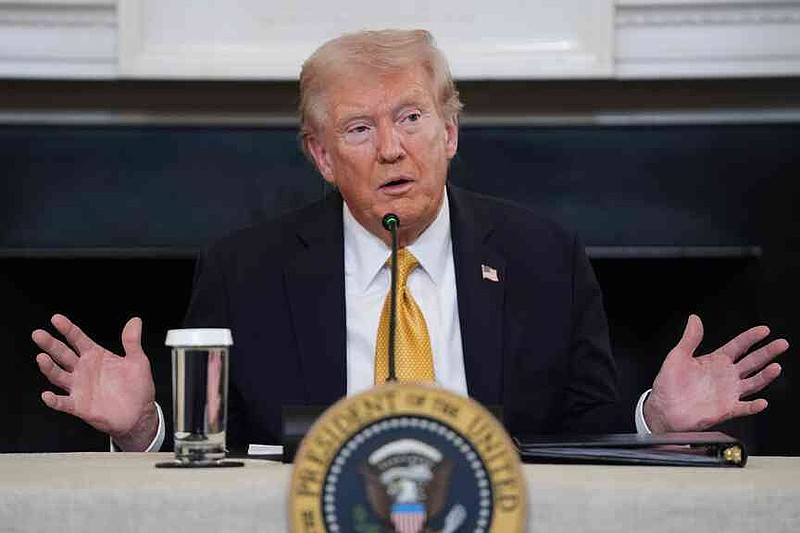
WASHINGTON — President Donald Trump announced he’s ending “all trade negotiations” with Canada because of a television ad sponsored by one of its provinces that used the words of former President Ronald Reagan to criticize U.S. tariffs — prompting the province’s leader to later pull the ad.
The post on Trump’s social media site Thursday night ratcheted up tensions with the U.S.’s northern neighbor after Canadian Prime Minister Mark Carney said he plans to double his country’s exports to countries outside the U.S. because of the threat posed by Trump’s tariffs. White House officials said Trump’s reaction was a culmination of the administration’s long, pent-up frustration about Canada’s strategy in trade talks.
Later Friday, Ontario Premier Doug Ford, whose province had sponsored the ad, said it would be taken down.
Ford said after talking with Prime Minister Mark Carney, he’s decided to pause the advertising campaign effective Monday so trade talks can resume. Ford said they’ve achieved their goal, having reached U.S. audiences at the highest levels.
“Our intention was always to initiate a conversation about the kind of economy that Americans want to build and the impact of tariffs on workers and businesses,” Ford said. “We’ve achieved our goal, having reached U.S. audiences at the highest levels.”
The U.S. president claimed the ad misrepresented the position of Reagan, a two-term president who remains a beloved figure in the Republican Party, and was aimed at influencing the U.S. Supreme Court ahead of a hearing scheduled for next month that could decide whether Trump has the power to impose his sweeping tariffs, a key part of his economic strategy. Trump is so invested in the case that he has said he’d like to attend oral arguments.
“CANADA CHEATED AND GOT CAUGHT!!!” Trump wrote on his social media site Friday morning. “They fraudulently took a big buy ad saying that Ronald Reagan did not like Tariffs, when actually he LOVED TARIFFS FOR OUR COUNTRY, AND ITS NATIONAL SECURITY. Canada is trying to illegally influence the United States Supreme Court in one of the most important rulings in the history of our Country.”
The ad was paid for by Ontario’s government, not the Canadian federal government. Ford, the premier, didn’t initially back down, posting Friday that Canada and the U.S. are allies “and Reagan knew that both are stronger together.” Ford then provided a link to a Reagan speech where the late president voices opposition to tariffs.
Ford had said the province plans to pay $54 million for the ads to air across multiple American television stations using audio and video of Reagan speaking about tariffs in 1987.
Even though the ad will eventually be taken down, it’ll still run this weekend, including during Games 1 and 2 of the World Series between the Toronto Blue Jays and Los Angeles Dodgers on Friday and Saturday night.
Ford is a populist conservative who doesn’t belong to the same party as Carney, a Liberal.
For his part, Carney said his government remains ready to continue talks to reduce tariffs in certain sectors.
“We can’t control the trade policy of the United States. We recognize that that policy has fundamentally changed from the 1980s,” he said Friday morning before boarding a flight for the Association of Southeast Asian Nations summit in Malaysia. “We have to focus on what we can control and realize what we can’t control.”
Trump was set to travel to the same summit Friday night.
NO PERMISSION
Earlier Thursday night, the Ronald Reagan Presidential Foundation and Institute posted on X that the ad “misrepresents the ‘Presidential Radio Address to the Nation on Free and Fair Trade’ dated April 25, 1987.” It added that Ontario did not receive foundation permission “to use and edit the remarks” and said it was reviewing legal options.
The foundation in Simi Valley, Calif., is perhaps best known for maintaining the Ronald Reagan Presidential Library and Museum. Its board includes longtime Republican Party stalwarts such as former Trump Transportation Secretary Elaine Chao, who resigned after the Jan. 6, 2021, riot at the Capitol, and former House Speaker Paul Ryan, whose free-market philosophy often clashes with Trump’s protectionist tendencies.
Another board member is Lachlan Murdoch, the son of Rupert Murdoch, who is executive chairman and CEO of Fox Corporation. The board is chaired by Fred Ryan, the former publisher and CEO of The Washington Post.
Trump wrote Thursday night that “The Ronald Reagan Foundation has just announced that Canada has fraudulently used an advertisement, which is FAKE, featuring Ronald Reagan speaking negatively about Tariffs.” He added, “TARIFFS ARE VERY IMPORTANT TO THE NATIONAL SECURITY, AND ECONOMY, OF THE U.S.A. Based on their egregious behavior, ALL TRADE NEGOTIATIONS WITH CANADA ARE HEREBY TERMINATED.”
Reagan did not actually love tariffs. He often criticized government policies — including protectionist measures such as tariffs — that interfered with free commerce and he spent much of that 1987 radio address spelling out the case against tariffs.
White House spokesman Kush Desai said talks with Canada have not led to any constructive progress.
“Ontario’s taxpayer-funded ad campaign on American TV networks — that misleadingly edited President Reagan’s 1987 radio address about trade — is the latest example of how Canadian officials would rather play games than engage with the Administration,” Desai said in a statement.
“As President Trump made clear on Truth Social, further talks are a futile effort if Canada can’t be serious.”
Kevin Hassett, director of the National Economic Council, told reporters at the White House on Friday that Canada has shown a “lack of flexibility” and also cited “leftover behaviors from the Trudeau folks,” referring to former Prime Minister Justin Trudeau, who had a frosty relationship with the Trump administration.
“If you look at all the countries around the world that we’ve made deals with, and the fact that we’re now negotiating with Mexico separately reveals that it’s not just about one ad,” Hassett said.
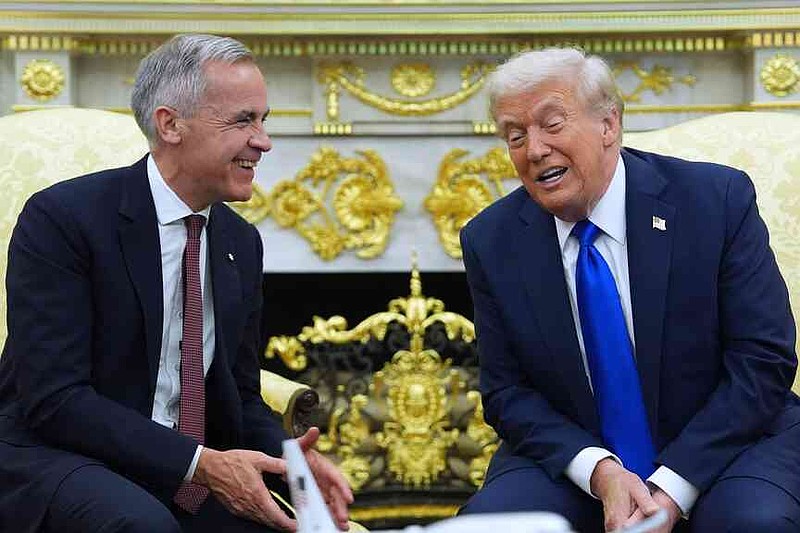
Carney met with Trump earlier this month to try to ease trade tensions as the two countries and Mexico prepare for a review of the U.S.-Mexico-Canada Agreement, a trade deal Trump negotiated in his first term but has since soured on.
More than three-quarters of Canadian exports go to the U.S., and nearly $2.7 billion U.S. worth of goods and services cross the border daily.
‘I’D TAKE THAT SAME AD’
Trump said earlier in the week that he had seen the ad on TV and didn’t seem bothered by it. “If I was Canada, I’d take that same ad also,” he said Tuesday during a lunch with Republican senators.
This went along with Ford’s comments earlier in the week that Trump had seen the ad.
“I’m sure he wasn’t too happy,” Ford said.
He said the aim was to “blast” the pro-trade message to Americans.
“It’s real, because it was coming from the best president the country’s ever seen, Ronald Reagan,” Ford said. “I feel the Reagan Republicans are going to be fighting with the MAGA group, and let’s hope Reagan Republicans win.”
Manitoba Premier Wab Kinew and British Columbia Premier David Eby backed Ford.
“It’s clear that these ads are working. If you throw a rock at a lake and you don’t hear a splash, you probably missed. So to my good friend Doug Ford, keep the ads on TV. They’re effective, and this country is behind you,” Kinew said.
Daniel Béland, a political science professor at McGill University in Montreal, said the ad has backfired “big time.”
Jason Kenney, a former Conservative cabinet minister under ex-Prime Minister Stephen Harper, called Trump’s posts “just embarrassing.”
“The Ontario ad does not misrepresent President Reagan’s anti-tariff radio address in any respect whatsoever. It is a direct replay of his radio address, formatted for a one-minute ad,” Kenney posted on social media.
Kenney also took aim at the Reagan Foundation, saying it “now has gormless leadership which is easily intimidated by a call from the White House, yet another sign of the hugely corrosive influence of Trump on the American conservative movement.”
Ontario bought more than $275,000 of ad reservations for the spot to air in 198 of the nation’s 210 media markets this month, according to data from the nonpartisan media tracking firm AdImpact. It was broadcast most frequently in the New York market, with more than 530 airings, followed by Washington, D.C., at around 280. The only other markets with more than 100 airings were those around Harrisburg, Pa., and West Palm Beach, Fla.
HURTING AUTO SECTOR
Ford previously got Trump’s attention with an electricity surcharge to U.S. states. Trump responded by doubling steel and aluminum tariffs.
The president has moved to impose steep U.S. tariffs on many goods from Canada. In April, Canada’s government imposed retaliatory levies on certain U.S. goods — but it carved out exemptions for some automakers to bring specific numbers of vehicles into the country, known as remission quotas.
Trump’s tariffs have especially hurt Canada’s auto sector, much of which is based in Ontario.
As a result, the Canadian government is limiting how many vehicles Stellantis and GM can import tariff free after the automakers ended some production in Canada, a government official said Thursday.
The official said the companies will no longer be eligible to get the full break on Canadian countertariff duties on autos and auto parts. The official spoke on condition of anonymity as they were not authorized to speak publicly about the matter.
Stellantis said earlier this monththat it was moving planned production of its Jeep Compass from Canada to the U.S. And this week, General Motors announced it will end production of BrightDrop electric vans in Ontario.
Trump has been urging the Big Three American automakers to move production to the U.S.
Fear has spread in Ontario over what will happen to Canada’s auto sector. Autos are Canada’s second-largest export and Carney has noted that the sector employs 125,000 Canadians directly and almost another 500,000 in related industries.
Ottawa said accessing the tariff-free quota came with terms requiring each company to maintain Canadian jobs and investment, and both companies have announced cuts in recent weeks.
Ottawa is reducing the exemption quota for General Motors by 24%, and is doing the same for Stellantis by 50%.
Information for this article was contributed by Will Weissert, Seung Min Kim, Rob Gillies, Maya Sweedler and Paul Wiseman of The Associated Press.