
How lobbyists retook the Berlaymont
Welcome to Tuesday’s Rapporteur. This is Eddy Wax and Nicoletta Ionta.
Thank you to the 100+ readers – including MEPs, diplomats, EU officials and European politics enthusiasts – who joined our Live Rapporteur event with Polling Europe last night. It was great! If you missed the discussion, you can watch it back here.
Send us your tip-offs, documents and story ideas at [email protected] and [email protected]
Need-to-knows:
🟢 How lobbyists retook the Berlaymont
🟢 Ukraine loan proposal imminent
🟢 The Council’s civil service wants more jobs
Today’s edition is powered by Wilfried Martens Centre for European Studies
The European Ideas Forum (EIF) is back!
Join us on December 9&10 at the Renaissance Hotel in Brussels, as we debate the pressing challenges ahead and explore the innovative solutions driving the EU’s next chapter.
Register today to secure your seat!
From the capital
Call it a vibe shift. After years of championing tougher regulation, the Commission’s new “simplification” push is handing corporate lobbyists the kinds of wins they used to only dream about, writes Elisa Braun.
From dialling back GDPR to easing pesticide approvals and weakening sustainability requirements, the EU’s regulatory machine is being unwound at a pace that even lobbying consultancies admit they are struggling to match as they rush to recruit staff.
Corporate pressure had been building for more than a year – from the Antwerp Declaration to BusinessEurope’s list of 68 laws to weaken – but the real breakthrough came after the 2024 EU elections, when Commission access suddenly opened.
Donald Trump’s return added momentum: US warnings about retaliation and Washington’s cheering of Parliament’s efforts to gut sustainability rules further emboldened Europe’s biggest business lobbies.
The change is not merely commercial. It is reshaping Brussels’ culture and internal power dynamics in ways no one has quite mapped out. Commission officials who have spent a lifetime keeping lobbyists at arm’s length are now asking them for their wish lists, while racing to rewrite rules in a panoply of sectors, helped by a right-to-far-right majority in Parliament intent on deregulation.
NGOs warn the EU is torching its legacy in the name of “competitiveness,” but their concerns are gaining little traction.
Read the story of how the shift unfolded – reported by Elisa and colleagues across our newsroom here.
Ukraine loan proposal imminent
EU ambassadors could get first sight of an EU proposal to fashion a “reparations loan” for Ukraine using immobilised Russian assets on Wednesday, two people told Rapporteur. The move follows pressure from Emmanuel Macron and Friedrich Merz on Monday for Brussels to table a proposal, and after the EU’s top diplomat Kaja Kallas suggested Belgian concerns could be resolved ahead of the leaders’ summit starting on 18 December.
António Costa has privately told leaders they should be prepared to remain in Brussels for one, two, or even three days, an official told Magnus Lund Nielsen. The last summit of that length was in 2020, when leaders hashed out the details of the bloc’s current multiannual budget. This time, securing fresh financing for Ukraine before existing funds run dry in early 2026, will be the thorniest issue.
Belgian PM Bart De Wever, who has remained silent since writing to Ursula von der Leyen last week, appears increasingly isolated. Dutch Foreign Minister David van Weel last week said he “did not want to support Mr. De Wever” – a blow that may well cut deep for the Flemish nationalist, who dreams of stronger ties with the Netherlands and Luxembourg.
The break-up of the Low Countries was “the greatest disaster that ever befell us,” De Wever said earlier this year, in words oddly reminiscent of what Vladimir Putin said about the break-up of the Soviet Union in 2005.
Council warns Parliament is outmuscling it
The Council of the EU’s administration has warned of a growing imbalance with the European Parliament, arguing that a decade of staffing cuts has left it structurally weaker than its co-legislator, according to a document seen by Rapporteur. The complaint is striking, given that Parliament pushed through a major internal overhaul this year, creating several new DGs, on the grounds that the Council secretariat was far better organised than its own services.
According to the document, Parliament – with around 7,000 staff – has added 139 posts since 2012, while the Council – roughly 3,000 staff – has lost 123, even as its workload has surged by up to 50% with more meetings, sanctions, legal revisions, and compliance demands.
The Council argues this “capacity gap” is undermining the institutional balance and leaving it outpowered in negotiations. To restore equilibrium, it is requesting 200 additional posts in the next EU budget cycle. Good luck with that!
Functions frictions
As trilogue talks resume today on the EU’s anti-corruption directive, one EU diplomat described the mood as “cautiously optimistic” – a notable shift from July, when Italy, Germany, and a group of allies derailed efforts to make “abuse of functions” an EU-wide criminal offence.
Months later, the issue remains at the heart of the deadlock. An internal Council document seen by Rapporteur in October called abuse of functions “of primordial importance” to reaching a final compromise, with Parliament still pushing for mandatory criminalisation of at least certain acts falling under the definition.
EU agrees to pair trade perks with returns
Negotiators from the European Parliament and Council struck a deal late on Monday to update the bloc’s trade preferences scheme, endorsing a mechanism to cut tariff perks for developing countries that fail to cooperate on migrant returns and ending a two-year impasse over rice safeguards.
Under the agreement, Brussels would be able to suspend trade benefits for governments that refuse to readmit their own nationals. MEPs secured a longer evaluation procedure – including at least a year of engagement with the country concerned – and a two-year grace period before the conditionality kicks in for the poorest states, my colleague Sofia Sánchez Manzanaro reports.
The package also settled a long-running row over rice, with most-favoured-nation tariffs to snap back if imports rise 45% above a baseline of 387,000 tonnes. The compromise clears the way for ambassadors to sign off on the updated scheme in the coming weeks.
The capitals
BERLIN 🇩🇪
Germany will on Wednesday formally unveil its newly procured Arrow 3 missile defence system – one of Berlin’s most significant security investments post-Ukraine invasion – though neither Friedrich Merz nor Defence Minister Boris Pistorius will attend, officials told Euractiv. The €3 billion Israeli-made system, a pillar of Germany’s “Zeitenwende” and the European Sky Shield Initiative, will be presented at Holzdorf Air Force Base by State Secretary Jens Plötner.
– Björn Stritzel
PARIS 🇫🇷
After a meeting with Prime Minister Sébastien Lecornu, Socialist Party leaders said talks on the 2026 budget were “moving in the right direction.” The Social Security financing bill returns to the National Assembly today after the Senate rewrote key provisions, including scrapping a proposed suspension of the 2023 pension reform – a PS demand for avoiding a no-confidence vote. The Assembly is due to vote on 9 December, with the state budget required to be adopted by 23 December, or pushed through via a special bill.
– Laurent Geslin
STOCKHOLM 🇸🇪
Sweden has ordered 94 additional Patria 6×6 armoured vehicles worth SEK 1.5 billion (€130 million), the Defence Materiel Administration said on Monday. The purchase follows last year’s order for 321 vehicles, bringing total deliveries to 415 between 2025 and 2030. FMV said a significant share of components will be produced domestically. The order forms part of the multinational CAVS defence cooperation framework with Finland, Latvia, Denmark, Germany, Norway, and the UK.
– Charles Szumski
ATHENS 🇬🇷
Farmers’ protests intensified across Greece on Monday, with new roadblocks and tractor convoys as unions stepped up pressure on the government. Demonstrators are seeking relief from soaring production costs, low farm-gate prices, and delayed compensation payments. Several farmers arrested during clashes in Larissa on Sunday were released pending testimony on Thursday. Major highways near Malgara, Nikaia, and across northern Greece saw rolling blockades, while unions prepare fresh assemblies this week to coordinate nationwide action.
– Charles Szumski
WARSAW 🇵🇱
Germany and Poland held high-level intergovernmental consultations in Berlin on Monday, with Friedrich Merz and Donald Tusk issuing a joint declaration casting the neighbours as “indispensable partners.” Merz said Germany “needs a strong Poland” as Europe confronts Russia’s revisionism, and set out priorities on defence cooperation, infrastructure modernisation, and historical remembrance, including a new memorial to Polish victims of WWII. Both leaders pledged continued support for Ukraine, backed the use of frozen Russian assets, and called for faster progress towards Europe’s energy independence from Moscow.
– Aleksandra Krzysztoszek
DUBLIN 🇮🇪
Volodymyr Zelenskyy arrived in Dublin late on Monday for a one-day visit aimed at deepening political and economic ties with Ireland. The Ukrainian president and first lady, Olena Zelenska, were greeted at the airport by Taoiseach Micheál Martin before holding bilateral talks and meeting newly inaugurated President Catherine Connolly. Zelenskyy is also due to address both houses of Parliament and attend the launch of the Ireland-Ukraine Economic Forum. Dublin said the visit underscores the “close and warm” relationship between the two countries.
– Christina Zhao
BRATISLAVA 🇸🇰
Slovakia’s Ministry of Investments is proposing a ban on social media access for children under 16. On Monday, it outlined plans to create a specialised oversight department and launch a grant scheme for NGOs working on online safety. The draft law is expected to enter inter-ministerial consultation in early 2026. “We will coordinate all state activities in this area so they operate as a single, comprehensive protection system,” said Investment Minister Samuel Migaľ.
– Natalia Silenska
SOFIA 🇧🇬
Thousands rallied in the Bulgarian capital on Monday night to protest the government’s draft budget, which includes a new business tax to finance higher public spending, particularly on defence. The ruling coalition – led by the centre-right GERB and including the Russia-friendly Bulgarian Socialist Party – has since signalled it will withdraw the proposal and present a revised plan amid concerns the tax hike could undermine economic stability.
– Aurélie Pugnet
Also on Euractiv
Macron seeks to rebalance trade as Chinese exports flood Europe
PARIS – French President Emmanuel Macron will travel to China from 3-5 December seeking to…
3 minutes
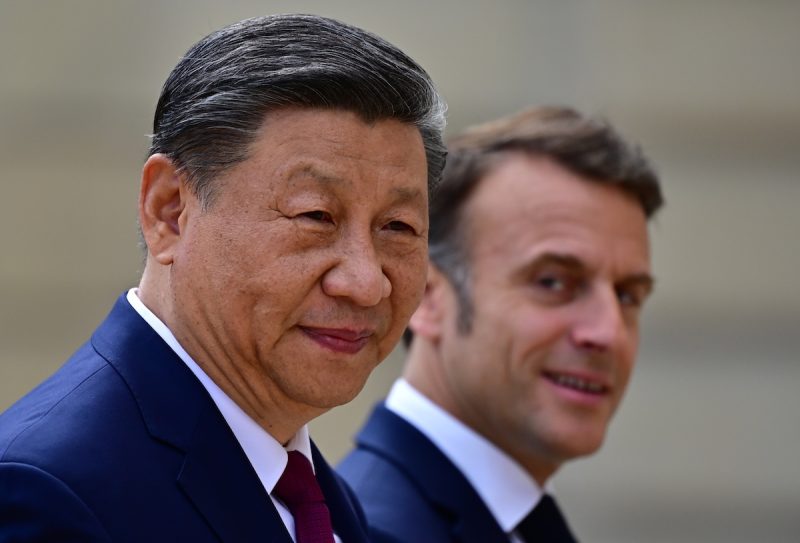
Emmanuel Macron will travel to China this week as Paris seeks a more “balanced” economic footing with Beijing amid a surge in Chinese industrial exports to Europe. China’s trade surplus with the EU has climbed above its surplus with the US, underscoring a widening structural imbalance.
French experts warn that Chinese manufacturers have moved rapidly upmarket – from autos to chemicals and pharmaceuticals – threatening European industry, even as Paris explores ways to lure high-tech Chinese investment under stricter conditions on employment and technology transfer.
Contributors: Elisa Braun, Magnus Lund Nielsen, Charles Cohen, Chris Powers, Kjeld Neubert, Alice Bergoënd, Sarantis Michalopoulos, Claudie Moreau, Stefano Porciello
Editors: Christina Zhao Sofia Mandilara
