
Indian states are competing to be the concert capital. Post Malone in Assam a turning point
“We’ve seen audiences travel not just to the biggest metros, but to a growing number of tier-2 and tier-3 cities that are now part of the live entertainment circuit,” Naman Pugalia, Chief Business Officer of BookMyShow Live. “We’re working closely with various state governments to build the foundation for the next stage of this growth.” Over the past few months, the ticketing platform has signed MoUs with Assam Tourism, Telangana Tourism, Gujarat Tourism, and Delhi Tourism.
This was attested to by District as well, the Zomato offshoot that’s emerged as a critical force in sculpting the concert economy. “The boom isn’t solely tier-2 driven, but they’re increasingly integral,” said CEO Rahul Ganjoo.
A tourism push
While Assam and Meghalaya are the only states with concert tourism policies, other states have integrated the provisions into their upgraded, larger tourism frameworks. Delhi Chief Minister Rekha Gupta has said that the capital is carving a new reputation for itself as the “creative capital.” Fastening the nuts and bolts of this fresh identity are lower rental rates for stadiums and auditoriums.
Last year, at a meeting, Goa tourism minister Rohan Khaunte announced that the government would also like to promote Goa as a “concert hub” and that they would be building a venue that can host 20,000 people in Mandrem.
At Meghalaya’s recently concluded Cherry Blossom Festival, in which the tourism ministry was a partner, Chief Minister Conrad Sangma spoke about what the state government was imagining.
“When the government came in, I was very clear that we would like to make this a national level festival. We have really invested a lot of time and resources. A large number of tourists are coming; they’re experiencing the culture—not only of Meghalaya, but the entire North East and even Japan,” he said in an interview. “More importantly, this is also leading to a large number of jobs being created.”
Deepmala Chaudhuri, GM, Sales and Revenue at The Lalit, said their properties operate at “almost-full capacity” in the days preceding a concert.
While the young and the wealthy might come to fulfil a dream of seeing their favourite artist perform, the idea is that they’ll awaken to reality; to clean air, a rich history, and perhaps a national park.
“We have wildlife tourism, religious tourism, and wedding tourism. Now, there’s concert tourism,” said Padmapani Bora, Managing Director of Assam Tourism. “We’re giving incentives to organisers, and through this, we’ll exhibit our culture; putting Assam on the global map.”
What the policy does is effectively pave the way for PPP (Public private partnership) between the government and concert organisers—in the case of Post Malone, Book My Show. Through a Viability Gap Funding Scheme (VGF), the state government will provide organisers with up to Rs 5 crore, and also facilitate tedious parts of the process, particularly the acquisition of a liquor license—a formidable hurdle in the live-experience scene.
It was the Meghalaya government’s formulation of a concert policy that galvanised Assam, many say. Bora said otherwise, Assam’s policy “isn’t in response” to Meghalaya.
The Meghalaya government’s policy was instituted in 2024, and that year, Bryan Adams, an evergreen India favourite, performed to hordes of people at Shillong’s JLN stadium. Chief Minister and BJP leader Conrad Singma said that in 2024, the state generated revenue of Rs 133 crore against an investment of Rs 23.3 crore.
The Cherry Blossom Festival, which had headliners like The Script, Jason Derulo and Aqua, all three of which were debuting in India, was evidence of the frenetic pace at which the concert space is growing; even beyond the usual suspects of Delhi, Mumbai, and Bengaluru.
Also read: Ahead of a Travis Scott concert & a half marathon, a doggone disaster for JLN Stadium
Tier-1 concerts
But it’s been a busy couple of months for the metro cities as well. Delhi played host to Travis Scott, Passenger, Akon, and Enrique Iglesias. Other than Travis Scott, they comprise the diet on which millennial Indians were fed. They belong to a pre-Spotify era, where downloads on Limewire and VH1 dictated music taste. Mumbai saw the same acts performing—with some major additions. Rolling Loud, touted as the world’s largest hip-hop music festival, made its India debut in Navi Mumbai. The line-up, while also heavy on nostalgia—“Wiz Khalifa was there. No one listens to Wiz Khalifa anymore,” said Ayaan (remove last name), a marketing professional who attended the event—came with some noteworthy exceptions like Denzel Curry who belongs to a newer era of popular culture.
“We’re throwing volumes and numbers right now,” said Nikhil Udupa, co-founder of 4/4 Experiences and Control Alt Delete, India’s only crowd-sourced music festival. “It’s great—it gives people more options to choose from. We never even considered options earlier.”
Rolling Loud was an unabashed spectacle. Sprite had set-up a basketball court. There was a skate park. Redbull had its own booth, where DJs were playing a version of house music. A concerted effort had gone into building an experience, a space that transcended the actual performances.
“The festival didn’t just tap into hip-hop fans; it demonstrated mass appetite for large-scale live experiences,” said Rahul Ganjoo, CEO of District by Zomato.
Building venues
According to concert goers, there was something that stood in stark contrast to Rolling Loud’s meticulous curation. It was something basic. The ground was uneven. The festival took place at Loud Park in Navi Mumbai, which was effectively a field that had purportedly been haphazardly carpeted to accommodate thousands of people.
“The amount of people tripping because the floor was uneven was insane. But it was the first edition, and they got a lot of things right,” said Davis.
While an unsteady ground might sound like a minute issue, India’s concerts have seen serious crises. In 2015, a decade ago, a 23-year-old woman died of a heart attack caused by suffocation in Gurugram, at a concert organised by VH1-Supersonic. She had no prior health issues, and Gurguram’s Assistant Commissioner of Police cited “overcrowding at the venue” as a potential cause.
India is notorious for a laundry-list of infrastructural challenges and red-tape. Despite hosting dozens of big-ticket events, there are only a smattering of venues—most of which haven’t been designed keeping concerts in mind.
“The infrastructure just doesn’t exist. Every venue we work with, we’re building it from the ground up,” said an industry insider on condition of anonymity. “Basically, we don’t have plug and play venues.”
But there is one gleaming exception to this norm: Terraform Arena in Bengaluru, which was recently taken over by Zomato’s District, and entails a “modular main stage with a roof truss”— a pre-fab structure that’s designed to hold a roof together. BookMyShow too is working to turn the Mahalaxmi Racecourse into a plug and play venue.
Setting up a concert requires an enormous amount of planning, and the industry is still in a nascent stage –– nowhere close to being self-sufficient. The jobs themselves, be it artist management or logistics, are still being formed and are evolving in real time. Equipment is borrowed from metro construction sites, and furniture is rented from wedding planners. For high-voltage concerts, freight is transported from all over the world. Entry turnstiles, directional signage, intricate set-ups, world class artist backstage villages—all of this needs to be designed, constructed and brought down for every single concert.
“Managing a multi-stage, high-energy hip-hop festival at that scale requires precision: Coordinating security across multiple performance areas, managing crowd movement between stages, ensuring medical readiness, and maintaining safety standards throughout,” said District’s Ganjoo.
In India, where crowd control is a challenge and citizens are often teetering on the edge of a fight, planning becomes all the more complicated.
While concerts, particularly music festivals, are seen as vestibules of hedonism where the world outside no longer exists, in Indian cities, it’s challenging to tap out completely. For instance, at certain concerts, smoking cigarettes is banned. Police personnel are swarming. The boundaries between the VIP and general areas are often blurred—with members of the crowd often jumping barricades.
A recent video of the Akon concert showed fans tugging at his trousers, in an attempt to pull them off.
While crowd management may seem disconnected from infrastructure, the two are intertwined: Twin pillars on which the fate of the concert economy rests. If a fight spirals out of control, or a single section of scaffolding collapses, it could mark the beginning of the end. Literally.
“One pillar collapsing could derail the entire concert economy,” said the industry insider quoted above. “That’s why it’s still difficult to go into tier-2 cities—we’re still getting tier-1 ready.”
An epochal moment in India’s live-entertainment history was the Trevor Noah show that almost took place in Bengaluru. Both his shows were cancelled “citing technical issues,” as fans waited at the Manpho Convention Centre which Noah described as being a “semi-permanent tent.”
Set-up for the Travis Scott concert in Mumbai was supposed to begin on 5 November. But from 4 to 9—it rained each day. Entire industries in Mumbai are undone by the whims of the rain, and the concert space is no different. When they finally began planning, organisers were greeted by a damp ground that called for levelling, and needed to be suctioned everyday in the run-up to the concert.
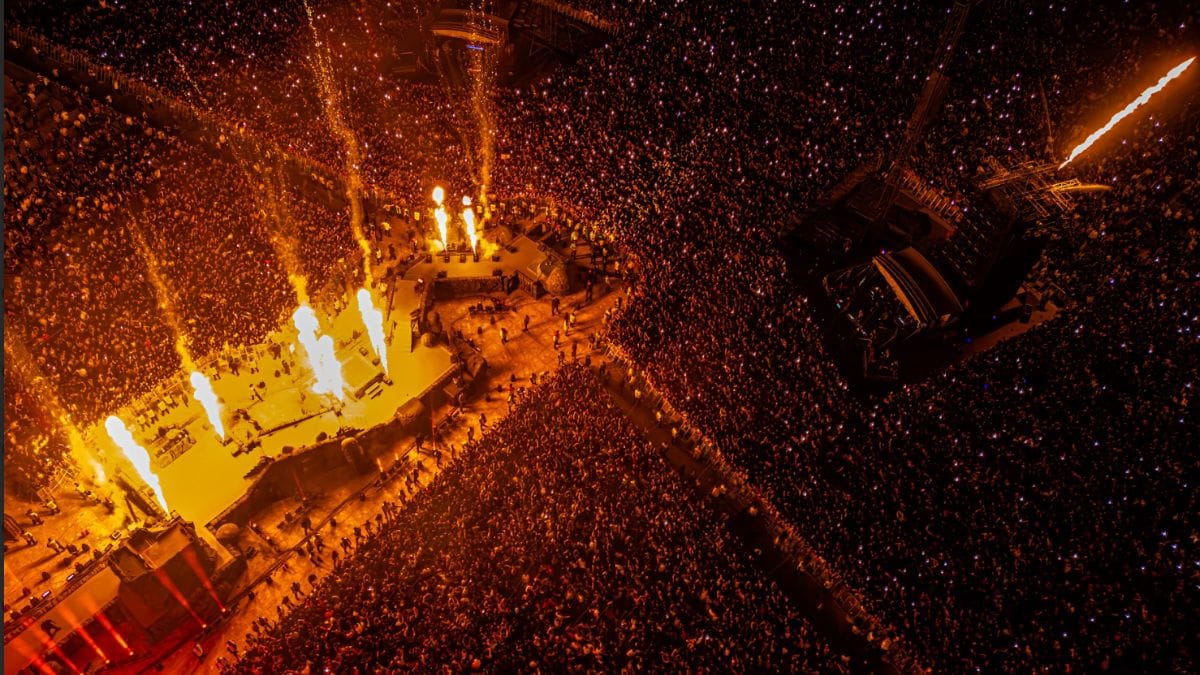
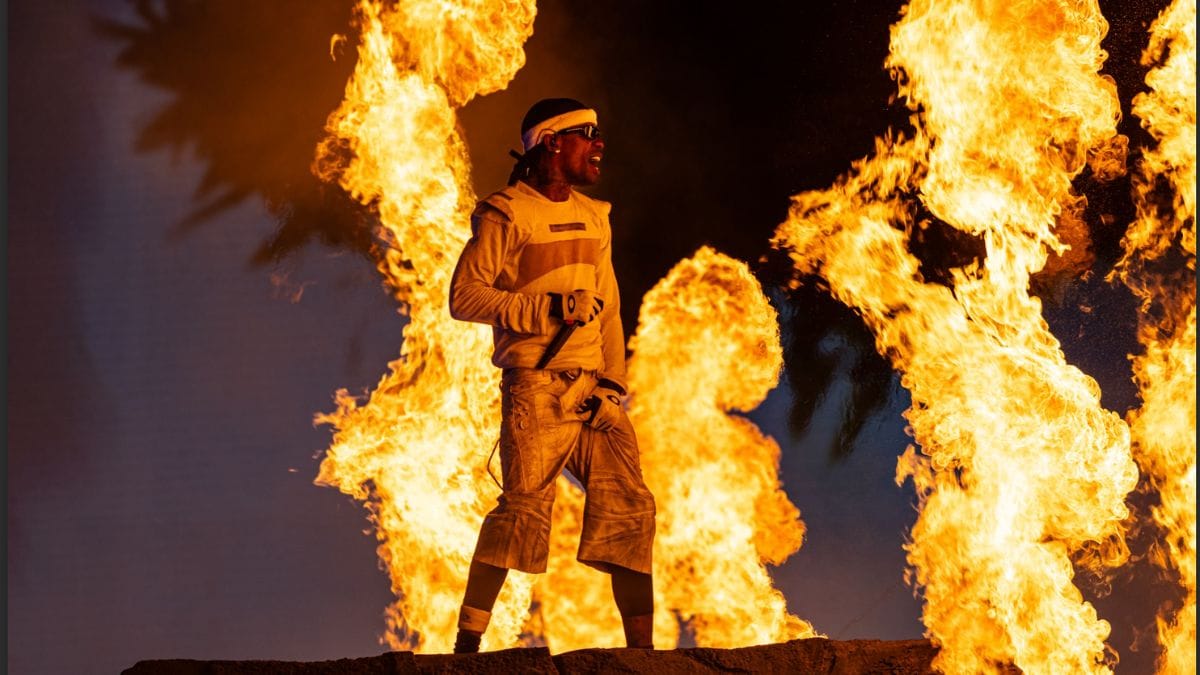
Travis Scott brought his Circus Maximus tour to India, which means that a blueprint used across the world needed to be replicated in Delhi and Mumbai—a tall order, given venue specifications and stage set-ups. To wield as much control as possible, platforms like District and BookMyShow are now also attempting to procure their own infrastructure, so they aren’t as dependent on governments and the authorities.
“At the moment, large-scale shows are held in stadiums meant for sport, which often creates logistical conflicts especially during cricket season,” said BookMyShow’s Pugalia, adding that the company is actively working with sports associations to change the norm.
Udupa, who also designed and ran the mainstage for Cherry Blossom, suggested the need for India to have a model akin to the US’ Live Nation, which after its merger with TicketMaster, presides over the world’s concerts. The company controls interests in 338 venues globally but has also received criticism for its “anti-competitive” practices.
Also read: Is Chennai’s Margazhi Carnatic fest losing sheen? Empty halls, ageing fans, unpaid artists
Who listens to what
Even within India’s tier-1 cities, where one would expect a certain degree of sameness, there are glaring differences and stark contradictions when it comes to concert-goers. Mumbai is known for endurance, where concert-goers are cosmopolitan; familiar with the artists, there for more than just a good time. In Delhi, there’s a perception that it takes an Indo-Canadian act like AP Dhillon or Karan Aujla to truly capture the crowd. Bengaluru, which was once known as India’s rock capital—where a culture came into fruition—appears to have now taken a backseat.
“There was a strong affinity toward Western music,” said Roshan Netalkar, founder of Echoes of Earth, a sustainable, circular music festival which takes place in the jungles of Karnataka, referring to Bengaluru. “We saw the way music was treated globally. I wanted to bring those eclectic sounds to the country,” he added.
According to Mohit Bijlani, founder of Team Innovation, an event management company that operates across India and UAE, it’s a confluence of cities and cultures that’s helping the global touring circuit.
“For major international acts, routing multiple cities within India has become both viable and strategically beneficial—something that was far less common a decade ago,” he said.
While festivals like Echoes and Sunburn, which have been carefully nurtured over years, continue to generate audiences, the manic energy with which concerts are being announced today was once unimaginable.
“We’ve never come under any pressure to bring any headliners, we’ve built a strong community,” Netalkar said.
This stands in opposition to the mainstream music scene. Yet, Echoes is contributing to the state’s tourism economy. Two editions ago, 200 festival attenders flew in from the UK. About 43 per cent of their audience is from outside Bengaluru—flying in from cities like Mumbai and Pune.
According to Netlakar, while every city comes with a distinct identity, what helps is having a “fluid product.”
“You need to be able to tweak your product. This can happen if you have a concept driven festival [like Echoes] which focuses on a particular genre,” he said. “It could work in Mumbai, in Goa, in the North East. But financially, it doesn’t necessarily make sense.”
Also read: Indian concerts are a masterclass in mismanagement—ticket mafia, overpriced water, bad network
Nostalgia economy
When last year’s Lollapalooza lineup was released, social media went into a mini tizzy. There was a strange, shared feeling—it seemed like someone’s big sister had curated the lineup. The evidence was all there, and it was a feeling that would only grow in proportion.
What do Green Day, Coldplay, Linkin Park, John Mayer, Akon and Enrique Iglesias have in common? To the rest of the world, they’re past their prime. But in India, they’re hot commodities. Concert curation in India has been chiseled to perfection—to ensure that India’s youth can relive the 2000s. It’s a nice nostalgia marketing spin to hand-me-down artists from the West.
“Booking agents have tried and tested the waters. These are artists that aren’t getting their ticket value globally,” said the insider quoted above. “Enrique would sell more way tickets here than he would in Spain.”
The Coldplay concert and the gold-rush to secure a ticket temporarily paralysed BookMyShow. The band was left with no option but to add a second show in Ahmedabad—which secured a nod of approval from the Prime Minister. Diljit Dosanjh’s Dill-Luminati tour opened up another can of worms; fraudulent, manufactured pricing and tickets being sold in the black market.
Ravdeep Dhingra, an industry professional, was confused by the hype. “Why was Gen-Z hooked on a millennial band’s nostalgia tour?” he asked.
Maybe they are just so starved for concerts. Or Reel-worthy global content.
But he’s still taking advantage of the boom. He’s soon going to be attending Bandland, a two-day rock festival in Bengaluru taking place in February 2026. Muse is headlining—the band he listened to in high school.
There’s an argument that listening culture, which has also suffered at the hands of streaming and algorithms, is yet to be built. At Rolling Loud, only 30-40 per cent of the audience was familiar with the music. But the tide turned when Karan Aujla came on stage. At the Travis Scott concert in Delhi, the rapper brought a fan on stage—only to realise that he didn’t know a single word of Goosebumps, arguably Scott’s most popular song.
But India’s numbers are staggering, filled with little worlds and subcultures. And the sheer size of the population gives it a leg-up.
“Everyone wants to come to India to get more streams, higher numbers,” said Udupa. “But once people are over the numbers, then what?”
(Edited by Theres Sudeep)
