
Jailed Myanmar leader Aung San Suu Kyi’s supporters rally in Sydney to protest junta elections
More than 100 supporters of jailed Myanmar leader Aung San Suu Kyi have rallied in Sydney, calling for the release of thousands of political prisoners and highlighting concerns about upcoming elections planned by the ruling junta.
Organisers said the protest at Martin Place on Saturday afternoon was part of recent gen Z demonstrations around the globe tied to popular Japanese manga and anime, One Piece.
It was led by Ms Suu Kyi’s son Kim Aris.
There was a similar protest in Melbourne, and another was planned for Perth later on Saturday.
Burmese Australian lawyer Koko Aung helped organise the Sydney rally and told the ABC there were similar demonstrations planned in Japan, Korea, the UK and US.
“It’s a global event and I’m sure that all the Burmese will turn up,” he said.
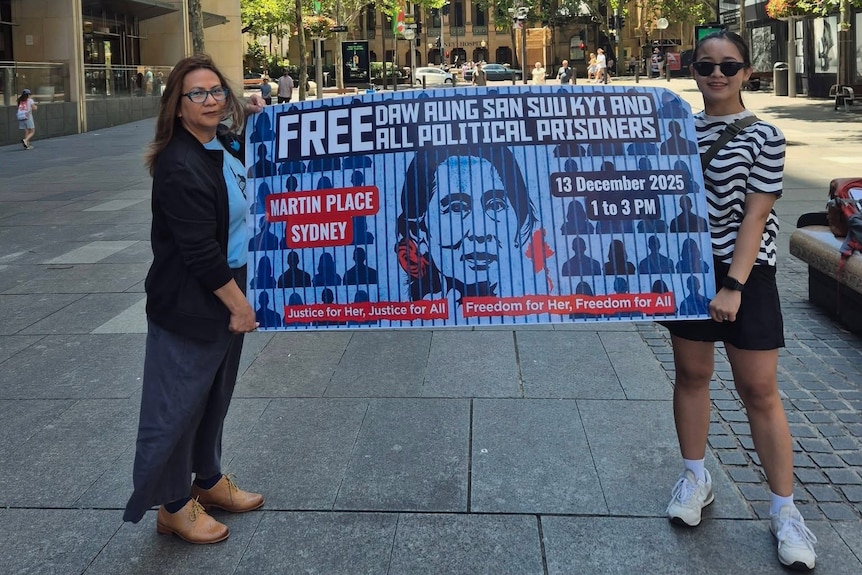
Aung San Suu Kyi has been in detention since the military seized power in a coup in February, 2021. (Supplied)
He said the movement was strongly supported across generations but for younger Burmese, particularly gen Z, there was a lot at stake.
“Especially with the military conscription,” he said.
Younger Burmese can be drafted and forced to fight for the military regime against their own people, Koko Aung said.
“It’s very unethical,” he said.
Politics, prisoners and solidarity
Koko Aung said the main aim of the rally was to demand the unconditional release of the more than 22,000 political prisoners in Myanmar, including Ms Suu Kyi and former president U Win Myint, who was also imprisoned after the goverment was overthrown in a coup in 2021.
He said political prisoners were treated extremely poorly by the junta.
“We don’t even know where they have locked up Aung San Suu Kyi and the president,” he told the ABC.
“We don’t even know if she is alive or not.“
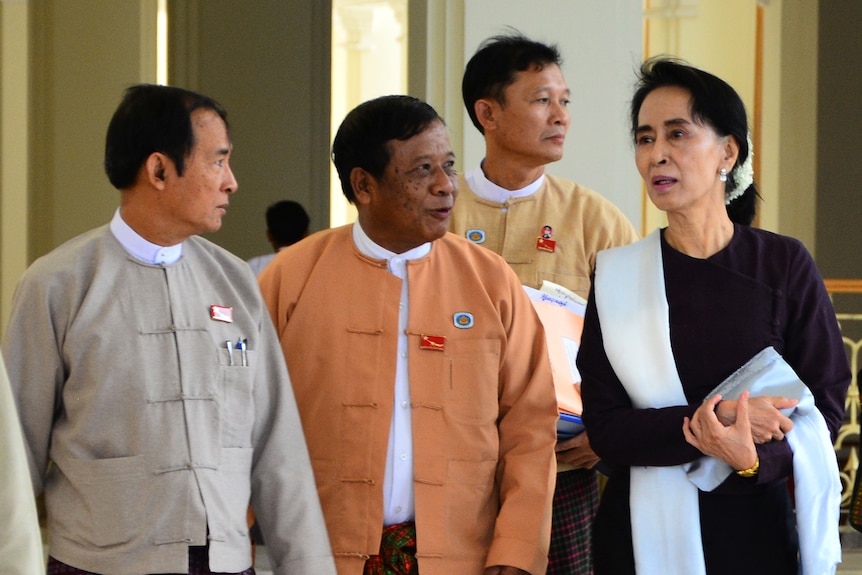
Aung San Suu Kyi and Win Myint (left) have both been in jail since the 2021 military coup. (AP: Aung Shine Oo/File)
The protesters also oppose elections announced by the junta, the first stage of which is due to be held on December 28.
Critics have said they are little more than a sham and an attempt by the junta to legitimise its rule.
“How can there be an election when they are still arresting people that were fairly elected by our own people four years ago,” Koko Aung said.
“This election is not being supported by the Burmese community inside the country or outside the country. We feel that it’s all a staged process.”
Koko Aung said some political prisoners and journalists had been released from jail ahead of the elections, but were being tracked by authorities and rearrested on different charges.
“Because they have raised their voice against the current regime,” he said.
Koko Aung said the Burmese community was more concerned about civil war, scam centres and deadly violence at border crossings than the elections, which he described as a “ploy”.
The Sydney demonstration comes days after opponents of military rule defied harsh legal penalties to stage a protest in Myanmar.
Protesters in Myanmar charged
The General Strike Coordination Body, the leading non-violent organisation opposing army rule, had urged people in Myanmar to join a “silent strike” on Wednesday, which was International Human Rights Day.
It called on the public to stay inside homes or workplaces from 10am to 3pm.
Images on social media showed uncrowded streets in Yangon, Myanmar’s largest city, and elsewhere.
Independent media in Myanmar reported that authorities had threatened to arrest shopkeepers if they closed to take part in the “silent strike”.
The tactic has been used before.
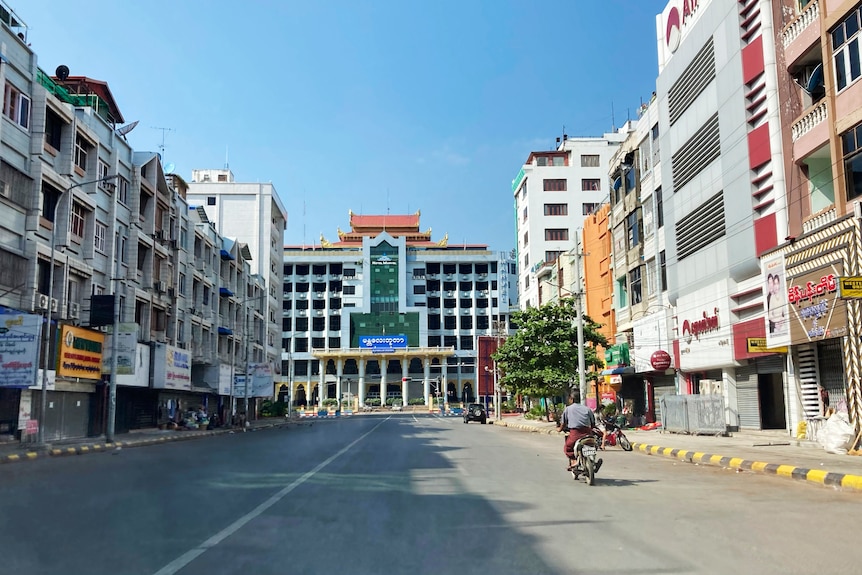
There have been other “silent strikes” in Myanmar, like the one shown here which was held in 2021. (AP)
Also on Wednesday, the state-run Myanma Alinn newspaper reported that authorities were seeking the arrest of 10 activists.
They have been charged with misleading the public by distributing leaflets against the election around a crowded morning market in Mandalay, Myanmar’s second-largest city, on December 3.
They also led a rally calling for the public to reject the planned elections, abolition of the military conscription law and the release of political prisoners.

Myanmar’s junta is ruled by Senior General Min Aung Hlaing. (Reuters: Stringer/File Photo)
Fears for Suu Kyi’s health
Not much has been seen or heard of Ms Suu Kyi since she was detained in February 2021 and charged with offences including election fraud and corruption.
After years in jail, she was moved in July 2023 to home detention after being pardoned for some of her many convictions.
She did not stay there for long and was reported to have been returned to prison a few months later.
Her son, Mr Aris, has for years been saying she required urgent medical attention and Myanmar’s exiled National Unity Government has called on the international community to pressure the junta into providing appropriate medical treatment.
In September, Mr Aris told the ABC he feared his mother could die in a “hellhole” prison.
Loading…
Ms Suu Kyi has spent long stints of her life in detention.
She was first held under house arrest in 1989.
In 1991 and still detained, she won the Nobel Peace Prize for campaigning for democracy.
It was not until almost 20 years later that Ms Suu Kyi was finally fully released from house arrest.
She went on to lead her party, the National League for Democracy, to an election win in 2015.
Under a constitution written by Myanmar’s military rulers, she was prevented from becoming president because her children have foreign citizenship.
To get around this, she assumed power via a new role — state counsellor.
She was also the country’s minister of foreign affairs and minister in the president’s office.
It was a long path to the top of politics for Ms Suu Kyi and her time there was not without controversy.
During her time as state counsellor there was a violent crackdown on the Rohingya community by the military.
It led to accusations of human rights abuses and war crimes — including genocide, mass rape, killings and torture.
Ms Suu Kyi denied her government had committed genocide, but she has been condemned for not doing more to prevent it.
After several convictions at multiple trials since 2021, Ms Suu Kyi was sentenced to 27 years’ jail for offences including incitement, corruption and election fraud.
She has long denied the charges on which she was convicted, which have been seen by her supporters as trumped up and used to remove her from politics.
Nicholas Coppel, who was Australia’s ambassador to Myanmar between 2015 and 2018, told the ABC in September that Ms Suu Kyi had a “phenomenal following” within Myanmar.
Her supporters are also making their voices heard around the world.
