Are they hiding under a rock?
Are they hiding under a rock? Amid the heated debate over Australia’s social media ban, one group has remained conspicuously silent: the tech titans who run the very platforms from which governments are now trying to shield young teenagers.
The Australian Government introduced the ban in response to widespread concerns: poor content monitoring following mass sackings of moderators and fact‑checkers, and the manipulative algorithms designed to keep users endlessly doomscrolling.
Australia is not alone. Other countries are moving in the same direction, with Spain, Denmark, Norway, Malaysia, Brazil, and several U.S. states either implementing similar restrictions or proposing age limits. Even the European Parliament has called for a ban on under‑16s.
French president Emmanuel Macron said recently: “You give the responsibility of your teenagers who spend, on average, 4 to 5 hours per day to social networks. You give the responsibility of the content they are exposed to, to US private providers, or big Chinese companies. And they design the content, they are in charge of the algorithm … and we decided de facto to give them this exclusivity.”
So should we be sheeting home responsibility for these bans more on the tech leaders and less on governments?
You might expect Mark Zuckerberg and the outspoken Elon Musk to defend their actions, but they remain uncharacteristically silent. They let the narrative play out of a brawl between Goliath, a supposedly oppressive national government, and David, represented by parents and teens. The tech leaders are out of the frame.
In reality, they are the true Goliaths, armed with massive power, huge wealth, and an ability to manipulate users with their secret algorithms. Platforms like Facebook and TikTok have billions of users they can influence, a significant proportion of whom are addicted to their content. The platforms are so powerful that nation states struggle to regulate them. Nations here are Davids.
The tech titans should not escape scrutiny. At the start of this year, Zuckerberg dismissed Meta’s remaining third‑party fact‑checkers and cut back content moderation teams across the very platforms now subject to Australia’s ban, Facebook, Instagram, and Threads, affecting some 3,600 employees. These moves followed even larger waves of sackings in 2022–23, when Meta eliminated 11,000 jobs in November 2022 and another 10,000 around March 2023, many of them in trust and safety, misinformation, hate speech, and harmful content roles.
Musk’s record is strikingly similar. In November 2022 he fired about half of Twitter’s workforce, then terminated outsourced moderators tasked with tackling child exploitation, hate speech, and abuse. Across 2022–23, cuts reduced X’s workforce by roughly 80 percent, sweeping away safety and moderation positions. Like Zuckerberg, Musk replaced professional oversight with crowdsourced “community notes” as a stand‑in for moderation. And that’s just two platforms.
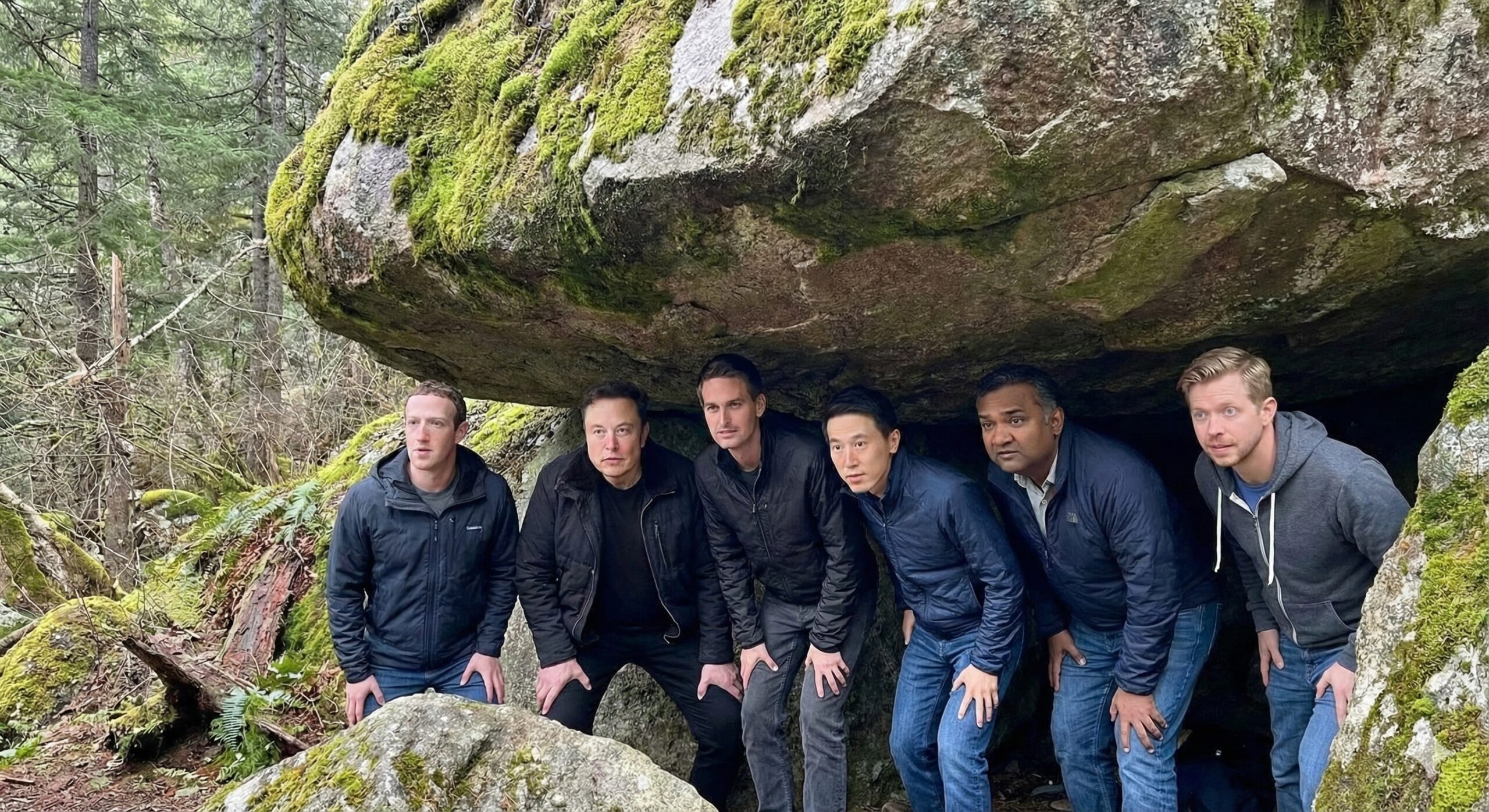
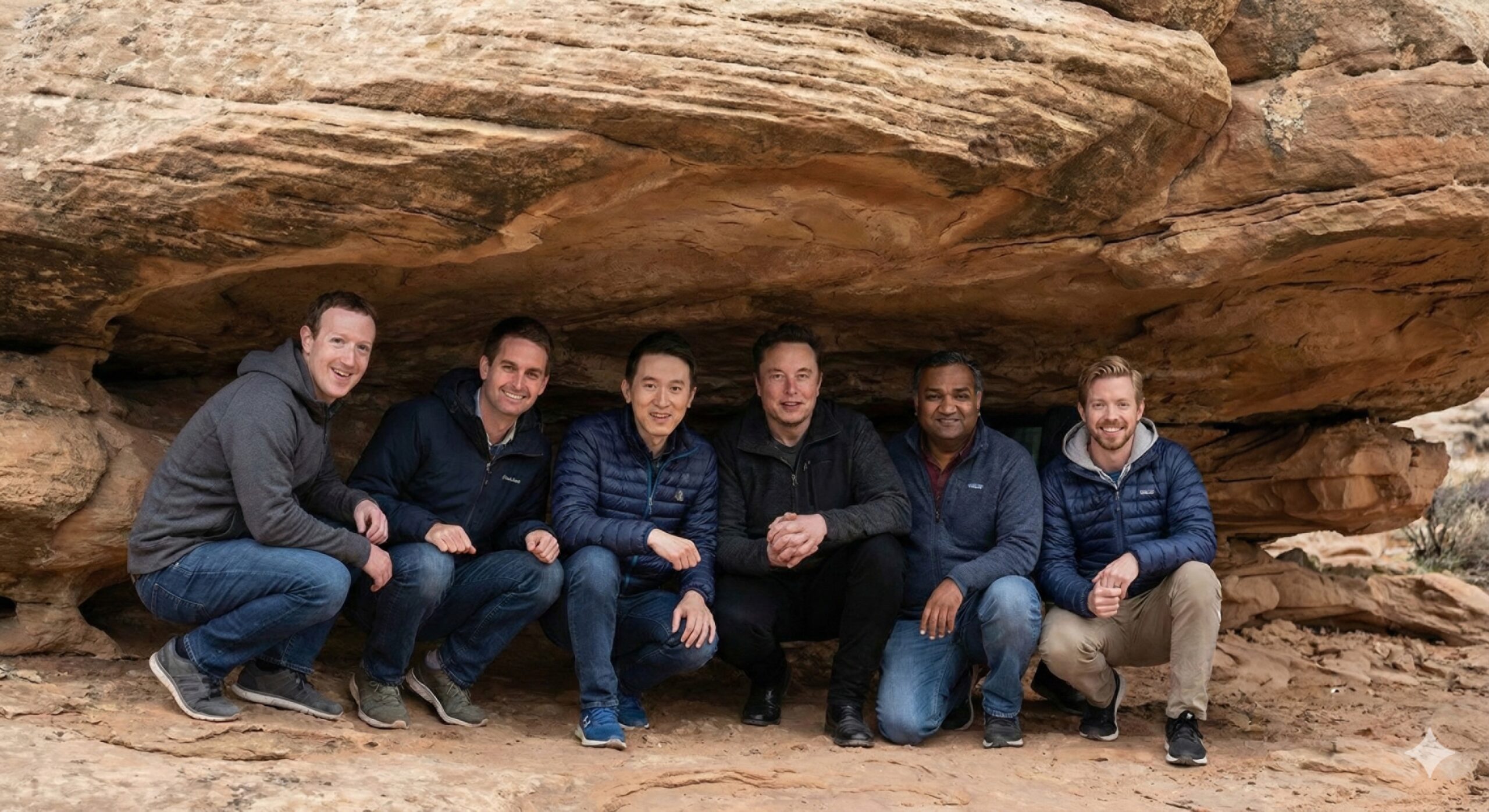
Image generated by Gemini’s Nano Banana Pro 3 “Thinking” mode.
Macron warns about the “free speech” maxim used by X and Facebook that everything should be okay online. “Please don’t believe one second, the so-called free speech agenda. We don’t speak about free speech when the algorithm is hidden and in the hands of very few players, and when they don’t implement the laws decided by the citizens of a country. This is the Wild West, not free speech.”
Griffith University adjunct associate professor in journalism John Cokley says he has long given up thinking tech titans will respond to any kind of moral coaching. “I think what the government has done is take a financial stick to them. We’ve ring fenced the product that they want, which is our children,” Dr Cokley says.
“In my research view, social media are essentially predators, and their aim is to drive revenue, and they do it however they can, using their engineered algorithms.
“From a business point of view, I’ve noticed that Zuckerberg and Musk feel no obligation to their customers. They only feel an obligation to their shareholders because their shareholders give them billions of dollars, which is a standard kind of company CEO approach.”
As Australia’s social media ban came into force, Musk and Zuckerberg were preoccupied with other battles. Musk was engaged on X, launching repeated attacks on the European Union and calling for its abolition after Brussels fined the platform around €120 million. The penalty targeted, among other issues, X’s blue checkmark verification system, which the EU deemed deceptive because anyone could purchase a badge without meaningful identity checks.
Meanwhile, Zuckerberg has been scaling back Meta’s investment in Reality Labs, cutting funding for VR headsets and Horizon Worlds. The metaverse has failed to deliver the lucrative returns he once promised, and significant job losses are expected to be announced in January.
Other platforms singled out by eSafety Commissioner, Julie Inman Grant, are rolling out the age‑verification measures required under the new law, though not with great enthusiasm. Some still are struggling with age verification technology, despite having had a year to implement it, and an age-verification trial overseen by independent evaluators.
Following the High Court challenge mounted by the Digital Freedom Project and two 15‑year‑olds, Reddit lodged its own case, seeking to have Australia’s ban declared unconstitutional.
Support from a majority of parents has ensured the ban’s introduction has been smoother than many anticipated. Yet among those opposed, relatively few have directed their angst at tech titans like Zuckerberg and Musk, despite their actions being pivotal in steering Australia down this path.
Chris Griffth’s personal website is here.
 |
