
Inside the first days of the new MI6 chief
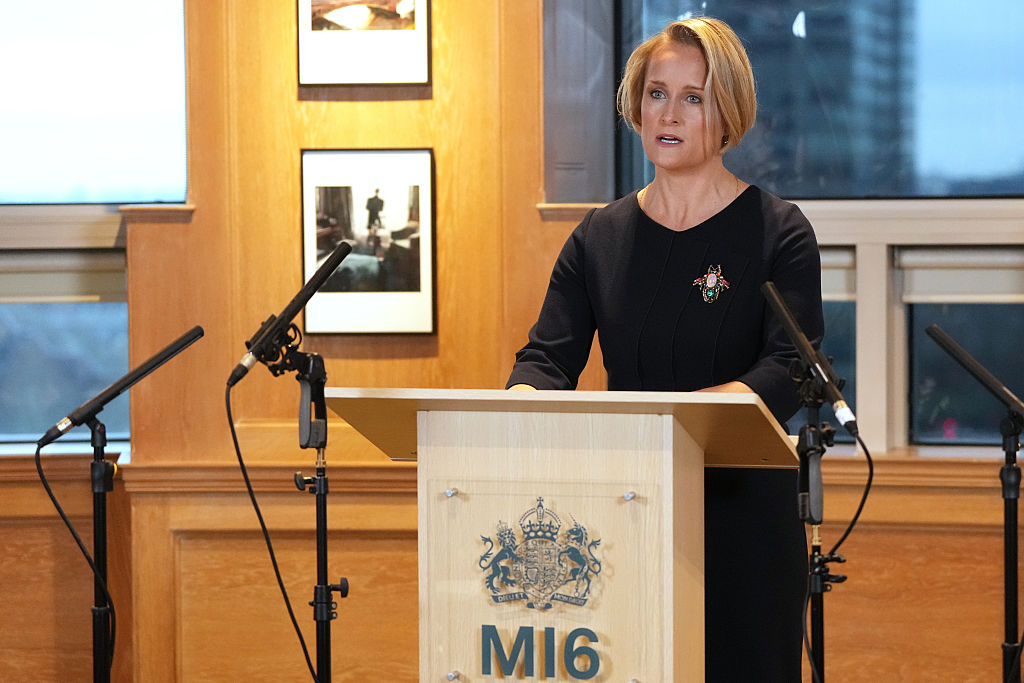
In MI6’s postmodern fortress HQ at Vauxhall Cross on London’s Embankment, Blaise Metreweli, the service’s new “C”, is settling in to an office vacated by her predecessor, Richard Moore. “All the Turkish stuff has gone,” says a colleague, missing the outgone chief’s propensity for Ottoman furnishings gathered when he was ambassador to Ankara from 2014 to 2017.
“It feels very bare,” sighs another colleague. The new C will get to decorate her office in a style that might reflect her own eclectic background – a childhood in Hong Kong, postings in the Middle East including Iraq during the war – and sign correspondence in the traditional green-ink fountain pen that comes with the job.
On 15 December, Metreweli gave her first speech at the MI6 lectern in Vauxhall Cross – but, to some raised eyebrows in the small “security corps” of journalists, didn’t take questions. Her team blamed diary clashes, but it marked a change from Moore, who clearly enjoyed a back and forth with the media. The following evening, however, at a year-end drinks shared with MI5, the domestic intelligence service, she appeared relaxed in jeans and flats, wearing a large jewelled brooch in the shape of an insect on her tailored navy jacket – a quirky referential present from her husband which she owns in different colours.
Intelligence services social mixers are odd affairs – the “principals” are trailed by a senior colleague from the small communications teams, also intelligence officers, keeping tabs on the conversations even as the supermarket wine is plentiful – cheerfully ensuring the bosses don’t get too pinned down.
This year’s festivities are a reminder that at MI6, when a “chief” is replaced, other jobs change fast too. The new boss reports to the prime minister, but has a free hand in running the service. From early January, there will be fresh faces in post at the Embankment and in key territories where the secret state recruits spies and informants.
That Metreweli, who was until now head of “Q Branch” – MI6’s science and technology directorate – won the coveted post was not a huge surprise. For one thing, Moore had worked hard on the diversity of his service and strongly promoted key women – he told me in one of two interviews in his tenure that it was a criterion on which he wanted to be judged and signalled it by tweeting “#NotJamesBond” in a post about MI6 offering supportive careers to women with families.
At the same time, the SIS (Secret Intelligence Service – the formal name for MI6) has a distinctive culture. Many senior people in the service will have joined shortly after university and spent most of their careers alternating foreign postings with jobs in the apparat in London. Metreweli, 48, is a good example, having worked in war zones and hostile territories.
She had also been well prepped by being “lent” to MI5 for a long stint from 2021 as “Agent K” to work on combatting serious foreign threats to the UK, ranging from assassination plots to attempts to steal the Covid vaccine during the pandemic.
As a younger recruit, one of her early jobs was to organise the delivery of “welcome” hampers to the homes of agents from Russia, with a note reading, “Welcome to your new home,” to show that they were on the security services’ radar. (Most of them disappeared shortly afterwards – with the hamper as scant consolation for a blown cover.)
One question for her media handlers is how high the new chief’s own profile will be. Clearly, she wants a different style to her predecessor – but today’s spy bosses are also in a constant battle to gain public support and offset conspiracy theories about their work. Communicating what they do, while keeping secret the necessary operational details, is the driving paradox of the role.
When I accompanied Moore to Prague in July 2023, he gave a speech actively encouraging Russians worried about being implicated in Putin’s war crimes to get in touch with MI6 – a call he repeated in his final public performance in Turkey last year. Internal assessments show this has worked pretty well. But that was the result of a punchy public profile. When I chaired a lengthy Q&A with Moore on stage in Prague, in front of fellow journalists (and quite a few spooks), he was forthcoming on most matters of geopolitics, from China and Iran to Russia.
Metreweli signalled in her first public comments that she is less keen on that loquacious approach. She laid out her own wider “theory of the case” for MI6: an academic-style treatise on the interlinked threats facing the UK. It had a clear digital focus – and even tilted at the disinformation flooding social media platforms as part of her pitch for greater public awareness of threat levels. It concluded: “The front line is everywhere.”
The treatise was markedly short on discussion of China, beyond a general mention of cyber-driven threats. Metreweli insisted that her own preference was not to give running commentaries on global affairs. That had, unintentionally, the effect of highlighting the relative dearth of mentions of China as a major espionage adversary – without giving us a reason the speech went so long on Moscow and short on Beijing. Doubtless, this was with an eye on avoiding any damaging clashes before Keir Starmer’s visit to China at the end of January – an event both personally and economically significant for a struggling PM. But leaves an awkward gap around what MI6’s assessment of the balance of threat and reward in dealing with China actually is. Perhaps she can tell us after that Beijing visit is safely over.
In person, Metreweli is quietly spoken and often wryly humorous. The more purple passages in her address about the service’s enduring values were clearly a reassurance from a high-flying case officer turned head of a bureaucracy – one other insider notes that the creep of HR tasks now takes up a large amount of senior staff time – that human intelligence (known as “Humint”), derived directly from personal contacts and recruitment, will remain highly valued in the service. A telling passage on how AI could not replace individual judgement clearly set out to calm nerves about artificial intelligence eating into the work of analysts and placate a new generation of recruits wondering if they will have the same prestigious career recruiting human sources as their elders. “In truth, a lot of what it means to be a spy is changing, very fast,” says one veteran of the service.
MI6 is well respected by adversaries – the former East German spymaster Markus Wolf once told me he regarded it as a “peer service” along with the US in terms of tradecraft, expertise and reliability in handling sources and recruiting agents for long-term relationships. Yet it needs to proffer a values proposition that’s attractive enough to encourage informants and double agents to risk their lives to work for it, beyond the lure of cold, hard cash. MI6 is also in a fight to stay an attractive “destination” in a crowded field of intelligence competition.
But trying to square that with the need to focus on technological change and AI threats and opportunities is uphill work. In truth, many officers in the field do worry about the way surveillance techniques limit their ability to recruit. It means that secondary territories become more important – so expect more espionage in the Balkans and “China-adjacent” countries in Asia, where a lot of recruitment and cultivation of contacts now occur, rather than the modern James Bonds racing around Moscow or Beijing. Facial and gait recognition are making the old business of personal contact far more risky – and in some places nigh-on impossible to sustain for long.
The greyest area is one which was addressed in the interview process: how should the running of the service now change? One persistent complaint I hear from officers is that the system is very good at gathering intelligence “product” – so much so that it can end up with too much of it sloshing around Whitehall and the “action points” become unclear or tangled.
This process caused the over-egging of intelligence in Iraq to prove a WMD threat under Saddam Hussein, which turned out to be exaggerated. As a result, there is now a tendency, as one insider puts it, “to serve up a lot of high-quality info about what we know will [make] the FS [Foreign Secretary] and PM say, ‘That’s interesting’ – but we don’t have a clear enough sense about what should happen next”. That is understood to be one of Metreweli’s intended action points.
The focus on cyber-espionage will certainly amp up under her leadership – getting access to devices and infrastructure and actively disrupting adversaries’ plans and supply chains, rather than conceiving of cyber-espionage as purely defensive. No wonder the service is desperate to lure more tech nerds (especially female tech nerds). As one cyber-analyst who has worked for GCHQ and MI6 directly puts it, “It’s less well-paid than AN Other tech job, but on a good day you get to play a big part in beating the country’s enemies.”
As the 18th – and first female – leader of the Secret Intelligence Service, Metreweli has already made history. Part of her arrival was, friends say, an unexpectedly “hard landing” when it emerged that her paternal grandfather, Constantine Dobrowolski, had been a senior Nazi informant in wartime Ukraine and was actively involved in a series of atrocities under the Nazi occupation. A Foreign Office spokesperson clarified that she “neither knew nor met her paternal grandfather”, her family having made its home in Britain in the postwar years.
The revelation appeared to come as news to the new spy chief herself when published by the Daily Mail after allegations circulated on pro-Kremlin information sites. It was not terribly hard information to track down, as other researchers soon found out: a German archive also shows Dobrowolski remained on a “wanted list” drawn up by the KGB, the Soviet Union’s spy agency, in the late 1960s.
All of this must have been a distressing family secret to discover. But using family background detail to prove that “Nazi” affiliations influence actions or anti-Kremlin ideology today is now a regular part of the Putin disinformation playbook against European adversaries. As such it is a detail which should have been anticipated and dealt with more proactively than via a deliberate Russian leak. It is a reminder that for many intelligence folk who have lived and worked in the shadows, the limelight can feel jarring. The role of MI6 boss is a mixture of preserving mystique and confidentiality and being the public face of the service. This might well test the limitations of Metreweli’s early commitment to say less on geopolitics, when a turbulent world is setting fresh challenges for MI6 and the democracy it serves.
Insiders are also curious as to how she will handle many of the “soft power” angles Moore relished talking about. His inclusivity drive included flying the Pride flag in Vauxhall Cross and announcing “solidarity with LGBTQ+” colleagues (which some MI6ers found, as one put it pithily, “a bit too Guardian for some of us”). One especially unimpressed observer was Nigel Farage, who responded: “Quite honestly, it really makes me angry. It’s not what our intelligence services are for.” – an early sign that the hitherto smooth relationship between MI6 and political masters of the main parties over decades might feel different if Reform UK ends up in power.
While Metreweli might well dial down the performative side of the service’s diversity challenges, she is a keen champion of promoting neurodiverse talent from her time at “Q Branch”. The service has also quietly amped up its internal ethics processes to give greater support to officers and staff who might struggle with the moral complexities of espionage activity.
A new C, as her arrival speech heralded, has pressing choices about how to allocate resources which are relatively generous, but not infinite, at a time when the range of adversaries and outright enemies of liberal democracies are on the march. Few doubt Metreweli’s professional chops for that job. Perhaps the biggest challenge for a C in 2026 is moving from announcing what she does not want to talk about to what she intends to say and do, now that the green-ink pen is finally hers to wield.
[Further reading: Should Alaa Abd El-Fattah’s tweets have legal consequences?]
<!–
googletag.cmd.push(function() { googletag.display(‘div-gpt-ad-3393934-1’); });
–>
