
China Takes A Hard Line On Obesity With ‘Fat Prisons’. Can India Afford To Ignore The Crisis?
Last Updated:January 09, 2026, 14:05 IST
More than half of Chinese adults are overweight or obese, expected to hit two-thirds by 2030, nearly 900 million. Can India tackle its obesity crisis as decisively?



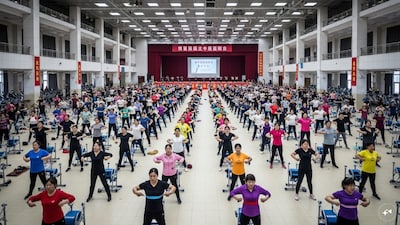
Participants complete multiple supervised sessions each day, totalling up to 72 classes over a 28-day stay. These include high-intensity interval training, spinning, boxing and endurance cardio (Image: Representational)
What if the fastest way to lose weight meant giving up your phone, your comfort and your choice to decide what and when you eat? As obesity rates rise across China, a growing number of overweight adults are voluntarily signing up for camps, known as “fat prisons”. These military-style boot camps promise rapid weight loss through strict diets, relentless daily exercise and constant surveillance designed to ensure participants do not leave or sneak in food.
Since 2000, the number of obese children in China has quadrupled, and official figures suggest more than half of Chinese adults are now overweight. For the many, this is no longer just a body-image concern but a health emergency. Similar to pollution, China’s response to obesity stands out because it treats excess weight as a governance issue, not a individual failing. When air quality worsened, China set centralised targets, measured outcomes and pressured institutions rather than relying on individual behaviour change.
Recommended Stories
“Getting back on track to meet the global targets for curbing obesity will take the work of governments and communities, supported by evidence-based policies from WHO and national public health agencies. Importantly, it requires the cooperation of the private sector, which must be accountable for the health impacts of their products,” said WHO director general Tedros Adhanom Ghebreyesus.
What Are The ‘Fat-Prisons’ In China?
Unlike your typical beach holidays in Thailand or shopping trips in Europe you sign up for a break that involves fences, regimented morning roll calls and guards ensuring no snacks make it back to the dormitories. For a growing number of people in China, the fight against excess weight has taken an extreme turn, fuelling the rise of closed, ‘isolated camps’ that promise dramatic physical transformation in exchange for the temporary surrender of personal freedom for an entire month.
Many people who are have tried losing weight would understand that a certain degree of discipline is needed to shed those extra kilos and many in China align with this sentiment that conventional routes to weight loss feel too slow or ineffective. Gym memberships are abandoned. Diet plans fail. Weight loss medications surged in popularity because they promised speed, but growing concerns around side effects, long-term dependency and cost have dulled their appeal.
Fat camps offer something different: certainty. In exchange for control, participants are relieved of decision-making. There is no wondering what to eat, whether to work out or how hard to push. The structure is absolute, and for some, deeply reassuring.
What Happens Inside A Chinese ‘Fat Prison’?
Chinese ‘fat-camp’ facilities resemble military boot camps more than health clubs. Days begin early, often with roll calls and weigh-ins. Phones are restricted or confiscated. Rooms are shared. Surveillance is constant.
Exercise dominates the schedule. Participants complete multiple supervised sessions each day, totalling up to 72 classes over a 28-day stay. These include high-intensity interval training, spinning, boxing and endurance cardio. Professional trainers monitor form, pace and attendance.
Meals are served at fixed times and portioned by staff. Contrary to assumptions, the food is not liquid shakes or imported diet products. Menus often feature traditional Chinese dishes prepared with less oil and sugar. Second helpings may be allowed, but snacking outside meal times is strictly forbidden.
Participants are weighed twice daily, once in the morning and again in the evening. Progress is tracked publicly, reinforcing both motivation and pressure.
How Do China’s ‘Fat Prisons’ Work?
One of the most surprising aspects of these camps is their cost. Social media creator Egg Eats, who documented her month-long stay in what she openly called a Chinese fat prison, paid roughly $1,500 for the entire programme, including accommodation, food and training.
In many Western cities, that sum would barely cover a few weeks of boutique fitness classes. The relative affordability has helped drive demand, particularly among middle-class urban residents who see the camps as a practical investment rather than a luxury.
Both private operators and state-backed facilities are involved, reflecting a broader alignment between commercial interests and government health priorities.
How Has Obesity Become A National Crisis For China?
More than half of Chinese adults are overweight or obese, a figure expected to hit two-thirds by 2030 which means nearly 900 million people. On March 9, 2025, during the 2025 National People’s Congress and Chinese People’s Political Consultative Conference, National Health Commission (NHC) Director Lei Haichao announced a national 3-year ‘Year of Weight Management’ campaign to signal a shift from individual-centred approaches towards systemic, government-led, national interventions.
Lancet study from 2025 indicated that 57% of adults had overweight or obesity in 2023, rising from 51% in 2018 and 46% in 2013. Without effective actions, prevalence of overweight and obesity among Chinese adults could reach 65% by 2030, and obesity-related health-care expenditure could be approximately 418 billion yuan, accounting for 22% of China’s total health-care costs.
Are The Fat Camps Effective in Losing Weight?
Social media user Eggeats filmed the high concrete walls, iron gates and electric fences surrounding the camp, with security guards stationed at entrances to prevent escapes or food smuggling. The experience, however, is not entirely bleak. From 7:40 pm every evening, participants are allowed free time, and Sundays are treated as rest days, albeit with a mandatory spinning class still scheduled in the evening. The programme fee covers shared accommodation with desks and personal lockers, along with strong showers and basic restroom facilities. Most toilets are traditional squat-style, a small but significant adjustment for Western participants unfamiliar with them.
Staff members are generally described as warm and approachable, often eager to practise their English with the international participants who arrive from different parts of the world.
The results, at least in the short term, are hard to ignore. Egg Eats reported losing 2.25 kilograms in her first week, and a total of four kilograms by the end of the second. Despite the physical pain, the fences and the relentless routine, she ultimately recommended the experience to anyone seeking an extreme, no-compromise challenge.
Why India Needs to Pay Attention?
India’s obesity crisis is serious and rising fast, and there are lessons to be learned from China’s disciplined approach even if fat camps aren’t the answer. More than half of Chinese adults are already overweight or obese, a figure expected to hit two-thirds by 2030, affecting nearly 900 million people. In India, a 2025 Global Burden of Disease (GBD) study, published in The Lancet predicts over 440 million adults could be overweight or obese by 2050, with women slightly outnumbering men.
The scale of the problem demands systemic action rather than piecemeal lifestyle advice. Public health initiatives could benefit from centralised targets, measurable outcomes, and accountability across schools, workplaces, and urban planning. Public-private partnerships could standardise community-based interventions, making healthy living accessible. But the question remains, can India adapt China’s discipline-driven approach while respecting individual freedom and cultural diversity?
January 09, 2026, 14:05 IST
Loading comments…

Stay Ahead, Read Faster
Scan the QR code to download the News18 app and enjoy a seamless news experience anytime, anywhere.