
When Too Many Tourists Become A Problem: What Japan’s Cherry Blossom Festival Cancellation Signals
Last Updated:February 06, 2026, 13:01 IST
Mount Fuji festival cancellation is not a cultural decision; it is a symbolic turning point in global tourism, where destinations are beginning to scale back rather than scale up




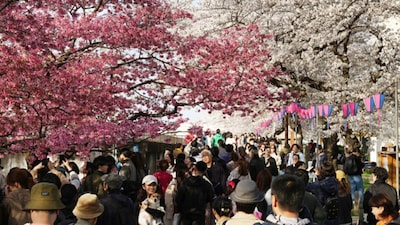
Japanese people have complained that many foreign visitors were littering, blocking pavements, and parking illegally while chasing the perfect photograph. (Getty Images)
Japan has cancelled its most popular cherry blossom festival near Mount Fuji, citing overtourism as a major factor. The move has surprised many tourists but resonated deeply with residents who have long been grappling with congested roads, sanitation strain, and safety concerns caused by swelling visitor numbers. During peak blossom weeks, as many as 10,000 people arrive daily in the small town of Fujiyoshida, according to official statements.
Recommended Stories
“To protect the dignity and living environment of our citizens, we have decided to bring the curtain down on the 10-year-old festival,” Fujiyoshida Mayor Shigeru Horiuchi announced on Tuesday.
The cancellation is not merely a cultural decision; it marks a symbolic turning point in global tourism, where destinations are beginning to scale back rather than scale up. The cherry blossom festival, or hanami, reportedly generated about $9 billion in Japan in 2025, compared to $7.7 billion in 2024, according to The Japan Times. In 2021, during the COVID-19 pandemic, the economic impact of hanami fell to roughly $1.15 billion, with nearly 97.5% of participants being locals.
Festivals and events are typically economic engines for small towns, bringing in revenue for hotels, food vendors, and local artisans. To cancel such an event is to acknowledge that the social and environmental costs have begun to outweigh the financial benefits.
For many observers, the decision is a warning sign that overtourism — once discussed mainly in European cities like Venice or Barcelona — is no longer confined to a handful of famous locations. It is now a structural challenge facing destinations worldwide.
What Overtourism Really Means
Overtourism is often simplified as “too many tourists,” but the reality is more complex. It is not just about numbers; it is about the relationship between visitor volume, local infrastructure, and community tolerance. A town can host thousands of visitors comfortably if it has efficient transport, waste management, crowd control, and behavioural guidelines. Problems arise when growth outpaces planning.
In India, places such as Goa, Shimla and Manali in Himachal Pradesh, Nanital and Mussorie in Uttarakhand, Leh-Ladakh, Jaipur and Udaipur in Rajasthan, Agra and Varanasi in Uttar Pradesh, are struggling with overtourism.
Goa, a tiny state in India with a population of 1.6 million, received around 10 million domestic tourists last year. Domestic tourism has shown consistent growth, with 5.18 million visitors in just the first half of 2025, highlighting its position as a top year-round destination for Indian travellers, according to the Goa Tourism Department.
The acceleration of overtourism is tied to several modern forces. Low-cost air travel has made international trips more affordable than ever. Social-media platforms amplify travel trends overnight, turning once-quiet spots into viral destinations within weeks. Currency fluctuations can suddenly make certain countries cheaper for foreign travellers, while flexible remote-work schedules have increased weekend and short-trip travel.
A record 315,100 Indian tourists visited Japan in 2025, according to the Japan National Tourism Organization — the first time the number crossed 300,000. This marked a 35% rise over 2024 and nearly an 80% increase compared to 2019. Direct flights, a weaker yen, and expanding interest beyond Tokyo, Kyoto, and Osaka have broadened travel patterns. While this growth benefits airlines and hospitality sectors, it also concentrates footfall in scenic towns unprepared for such volumes.
How Locals Pay For Overtourism
Japan’s authorities said the decision to cancel the festival followed repeated complaints about unruly tourist behaviour in the city, located west of Tokyo. Officials reported incidents ranging from visitors opening the doors of private homes without permission to use restrooms to cases of trespassing and littering. In some instances, tourists were even found relieving themselves in residential yards and creating disturbances when confronted by locals, the city administration noted.
For locals, overtourism is rarely about hostility towards visitors; it is about the erosion of daily life. Although tourism could improve the local quality of life and drive economic advancement, it leads to congested streets, littered public spaces, noise pollution, and rising rental prices.
Moreover, local transport systems designed for modest populations become overwhelmed, emergency services face delays, and cultural sites suffer physical wear.
In a country like India, increased footfall has caused stampedes. The Banke Bihari Temple in Vrindavan has faced severe overcrowding, leading to several tragic incidents and fatalities, particularly during festivals over the last four years.
Economic benefits of tourism do exist. It generates employment and stimulates local businesses. The tourism industry contributes about 16.43% to Goa’s GDP (Rs 1.39 lakh crore) and employs around 35% of the population, including both direct and indirect, hospitality-related jobs. In Uttarakhand, tourism employs around 1 million people. The state is driven by religious, adventure, and eco-tourism, with women making up at least 30% of the tourism workforce. The tourism and hospitality sector contributes 7.78% to Himachal Pradesh’s GDP, as of the 2024-25 economic survey.
However, these gains often come with uneven distribution. While hotels and tour operators profit, residents may shoulder the civic costs in the form of higher living expenses, overcrowded public facilities, and environmental degradation. The distinction between economic benefit and civic burden is at the heart of the overtourism debate.
Behaviour also plays a role. Instances of tourists blocking narrow streets for photographs, trespassing into private areas for social media content, or disregarding local customs add friction. According to Gomantak Times, one Aloo Gomez Pereira got into an altercation with tourists shooting videos outside his “brightly coloured” home in October 2024, though it bears a sign ‘No Photography Allowed’. The new prohibitory orders in Lonavala ban activities such as swimming in fast-flowing waters, sitting under waterfalls, or venturing to cliffs for selfies, photographs, or videos.
Why Environment Cannot Be Ignored
Tourism has destroyed critical wildlife habitats such as mangroves and turtle nesting beaches. Tulum, once a quiet coastal town in Mexico, has reinvented itself as a trendy, eco-luxury getaway. Behind the branding, however, many beachfront resorts still rely on diesel generators for power, while untreated sewage has been reported to leak into underground cenotes and waterways, threatening nearby marine ecosystems, including the world’s second-largest reef system.
A similar warning emerged in Thailand, where heavy tourist footfall and pollution severely damaged coral reefs at the famous Maya Bay, forcing authorities to shut the beach for nearly two years to allow ecological recovery.
The 2013 Uttarakhand disaster report by the Ministry of Home Affairs flagged several human-driven risk factors such as deforestation, road and tunnel construction through fragile mountains, hydropower projects, tourism-related buildings on floodplains and hillsides, and sand mining in riverbeds. Despite these warnings, large stretches of mountains have continued to be cut for road expansion, increasing vulnerability and putting local communities at greater risk.
How Tourism Is Being Tackled Across The World
Globally, overtourism has entered what many analysts call the “backlash phase.” Cities that once celebrated record visitor numbers are experimenting with entry fees, visitor caps, and restricted zones.
Machu Picchu, a 15th-century United Nations World Heritage Site situated in the Andes, sees an annual footfall of 1.5 million tourists. To manage the Inca Trail, the authorities have capped 5,600 visitors per day. There is also a time slot entry and a limited duration of stay. Then there are zoned circuits to disperse visitors. Ticketing is available only online, and walk-ins are not permitted.
Venice, which receives 25-30 million visitors annually, limits tourism through a mandatory €5 fee for day-trippers entering historic places during peak periods in May/July and on the weekend. As of August 1, 2024, tourist groups are limited to a maximum of 25 people, which is half the size of previous typical tour groups. The use of loudspeakers is prohibited, and large cruise ships are also banned to protect the ecosystem.
Italian authorities now charge tourists a €2 fee to access the viewing area of Rome’s iconic Trevi Fountain, which had previously been free to visit. Authorities say the fee will go towards helping to manage the number of tourists and raise funds for the monument’s upkeep.
Mount Fuji’s festival cancellation fits squarely into this phase. This is not the first time Japanese authorities have stepped in to manage crowds drawn by photography hotspots. In 2024, officials in Fujikawaguchiko erected a large black barrier at one of the country’s most iconic Mount Fuji viewing points in an effort to discourage unruly tourist behaviour. Locals had complained that many foreign visitors were littering, blocking pavements, and parking illegally while chasing the perfect photograph.
What India Can Do To Check Tourism
Officials say most major tourist sites in Madhya Pradesh have been developed with basic amenities, tourist police, statewide signages and several new hotels built by both the government and private sector. Capacity to handle visitors has increased, yet cities like Ujjain remain crowded despite the Mahakal corridor’s expansion. The challenge, they argue, is rising travel demand driven by higher disposable incomes, which cannot easily be restricted. Instead of focusing only on overtourism, the priority should be expanding infrastructure, creating new destinations, and dispersing tourists so that pressure on a few hotspots is reduced, Ashwini Lohani, former CEO of Air India, had said during a panel discussion in November 2025 on ‘Overtourism in India’.
The tourism ministry provides financial assistance to states and Union Territories to develop tourism infrastructure and visitor facilities across destinations through schemes such as Swadesh Darshan, the National Mission on Pilgrimage Rejuvenation and Spiritual Heritage Augmentation Drive (PRASHAD), and the Assistance to Central Agencies for Tourism Infrastructure Development programme.
The ministry has also revamped the Swadesh Darshan initiative into Swadesh Darshan 2.0, shifting the focus towards sustainable and responsible tourism through a destination-centric development model rather than scattered project funding.
Separately, under the Centre’s Scheme for Special Assistance to States/Union Territories for Capital Investment (SASCI), the government has recently approved 40 projects nationwide with a total outlay of Rs 3,295 crore.
Strictly monitoring crowd in real-time through digital ticketing systems, redirecting or dispersing visitors to less crowded zones, promoting off-season travel, diversifying tourism, and community involvement in tourism planning can be some of the ways by which tourism can be checked in India.
Expanding sanitation facilities, improving last-mile transport, and enforcing behavioural guidelines are some of the other ways to reduce friction. Education campaigns encouraging responsible travel, from waste disposal to respectful photography, are equally important.
With domestic and international tourism both rising, the choices made now will determine whether destinations flourish sustainably or face the same difficult decisions now unfolding elsewhere.
February 06, 2026, 12:57 IST
Loading comments…

Stay Ahead, Read Faster
Scan the QR code to download the News18 app and enjoy a seamless news experience anytime, anywhere.