
US envoy visit to Indian Army command near Pakistan border controversy
A heavily publicised visit by the US envoy and the US Indo-Pacific commander to the Army’s Western Command near the Pakistan border has generated considerable buzz in political circles. The opposition has portrayed it as the government pandering to American interests. However, such visits, though rare, are not unprecedented. It comes as India and the US look to deepen their defence ties after a reset in relations following the trade deal. But, behind the optics, lies a broader message. Stay with us, and we will explain the significance of the visit.
advertisement
Now, why is the Western Command so crucial? The command, whose headquarter is located in Chandigarh, deals with border areas with Pakistan — encompassing Akhnoor in J&K to Fazilka in Punjab. Significantly, the command, which oversees 200 bases, was in the thick of things during Operation Sindoor last year as the military pounded terror camps and air bases in Pakistan. Against this backdrop, the visit by US envoy Sergio Gor and the US’s Admiral Samuel J Paparo held much significance and garnered attention.
WHY US ENVOY VISITED ARMY COMMAND?
This was the first such visit by any foreign delegation after the three-day India-Pakistan hostilities last year. While finer details of the meeting were not revealed, the Army said Gor, Donald Trump’s close aide, and Admiral Paparo were briefed on the Western Front perspective — a reference to the volatile Pakistan border — as well as the execution of Operation Sindoor.
“The delegation was comprehensively briefed on the Western Front perspective, including operational preparedness, distinguished legacy, execution of Op Sindoor and the pivotal role being played by the Indian Army in nation-building and strengthening regional stability,” the Western Command tweeted.
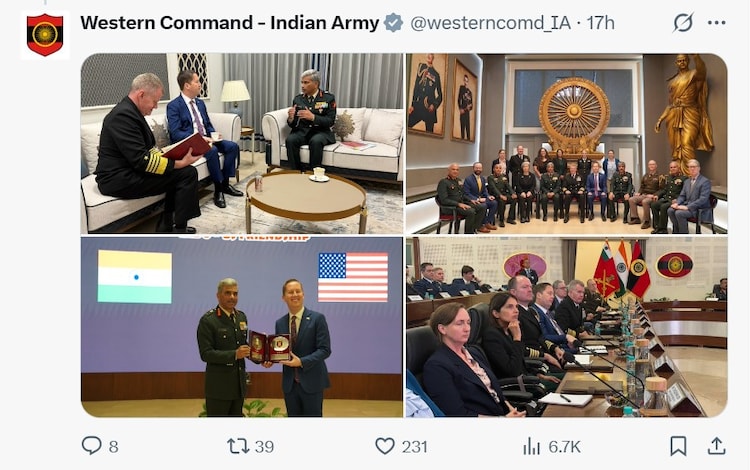
The visit came a day after Admiral Paparo, speaking to journalists, praised the “tactical execution” of the Indian military operations against Pakistan during Operation Sindoor.
However, visuals of the US delegation visiting the Western Command and holding talks with Lt. Gen. Manoj Kumar Katiyar invited sharp reactions from the opposition. Notably, Gor also serves as the US special envoy for South and Central Asian countries, which includes Pakistan.
OPPOSITION QUESTIONS VISIT
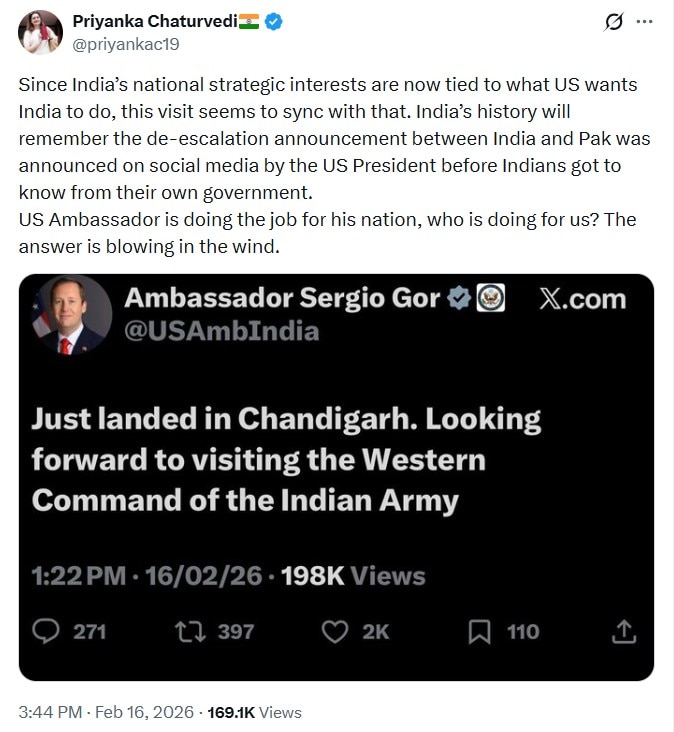
Expressing concern, Rajya Sabha MP Priyanka Chaturvedi alleged that India’s strategic interests were being increasingly tied to US expectations.
A case in point that Chaturvedi referred to was Trump taking credit for the India-Pakistan ceasefire last year and announcing it first on social media before Delhi or Islamabad. India has, however, maintained that the truce was reached through direct talks.
“Since India’s national strategic interests are now tied to what the US wants India to do, this visit seems to sync with that… The US Ambassador is doing the job for his nation, who is doing for us? The answer is blowing in the wind,” the MP said.
The Congress also questioned the access being given to the US officials in sensitive military zones. “We have already seen Pakistan’s ISI getting access to Pathankot Airbase with this government’s blessings,” it tweeted.
However, beyond the politics, such visits, though rare, are not anything unusual. The visit is part of a structured military-to-military exchange between India and the US. Previously, too, diplomats from foreign countries have visited command headquarters. Similarly, Indian envoys have also been to the US Pentagon office and the CIA headquarters in Langley.
WHAT IS THE MESSAGE BEHIND THE VISIT?
Beyond the optics lies a broader message — of the US’s bid to deepen its defence partnership with India. Subsequent US administrations have built warm ties with India, seen as a counterbalance to China in Asia and in the Indo-Pacific region.
Trump initially seemed to disregard it as he went about attacking India on tariffs and trade, and warmed up to Pakistan, which left no stone unturned in massaging his ego.
But, he seems now to have got a reality check, and India is back again in his good books. For the US, Pakistan offers limited strategic value relative to India. This was reflected in the Trump administration’s newly released National Security Strategy (NSS), which left out Pakistan (another toilet paper moment?).
On Monday, Admiral Paparo underscored that the US-India defence relationship was on a “steeply upward trajectory”. Even US envoy Sergio Gor said the defence partnership “continues to grow stronger”.
This comes as the US looks to wean India away from Russia, which has long been Delhi’s biggest source of weapons. The US is India’s third-largest arms supplier after France, with whom Delhi will sign a Rs 3.25 lakh crore deal for Rafale fighter jets.
While the visit of the US envoy and a top US commander to one of India’s most sensitive military zones may have generated much buzz, it also speaks much about the growing military-to-military engagement between the countries. For the US, India’s significance is unparalleled in countering China. Thus, these visits reflect a broader messaging and deepening trust between the US and India.
– Ends
Tune In
Must Watch
