

Proposed RTS Link fare of $5 to $7 ‘affordable’ for many Malaysians, but may still be steep for some
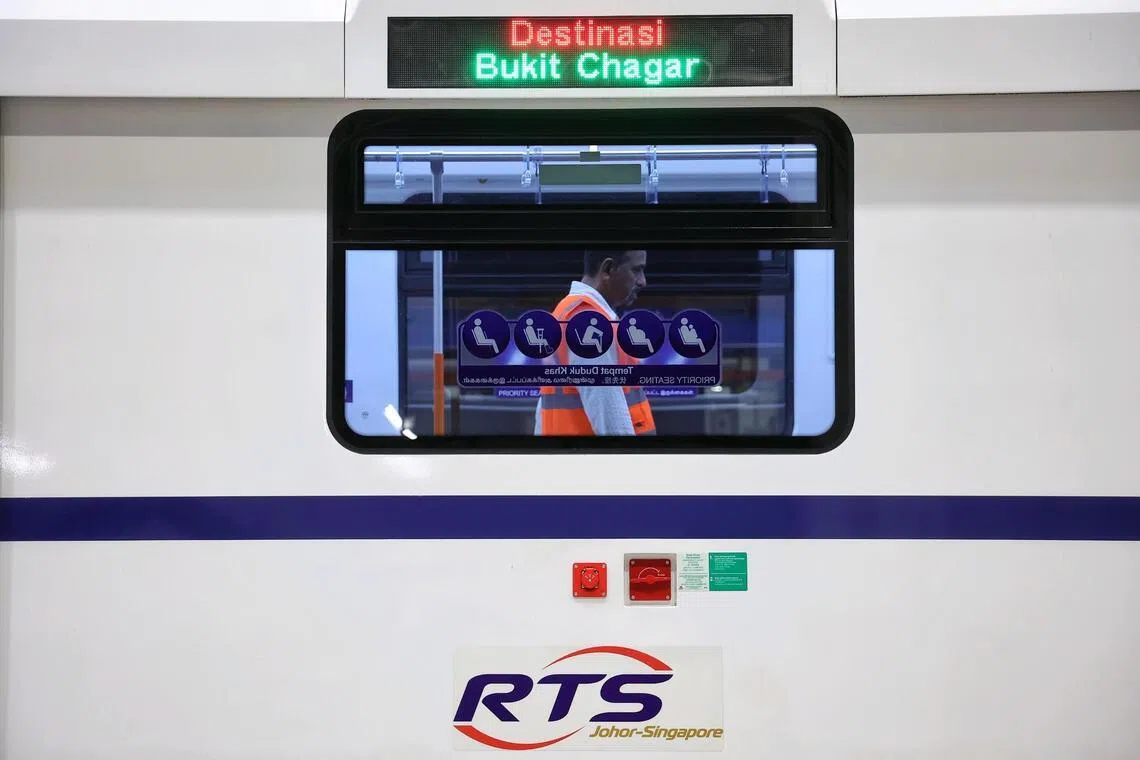
JOHOR BAHRU – The $5 to $7 proposed fare range for the upcoming
Johor Bahru-Singapore Rapid Transit System (RTS) Link
is likely affordable for Malaysian office workers.
But it may be costly for those used to taking the bus or riding motorcycles to make trips across the Causeway, workers told The Straits Times.
The proposed range of fares was revealed by Malaysian Transport Minister Anthony Loke in a Sin Chew Daily report on Feb 13.
RTS Link, slated to
begin operations by the end of 2026,
will provide a direct, five-minute connection from Bukit Chagar in downtown Johor Bahru to Singapore’s Woodlands North MRT station. Fares are expected to be announced in the second half of 2026.
To Mr Loo Yong Tat, a Malaysian tour executive working in Singapore, the fare range mentioned is comfortable, given that it is almost on a par with current train fares to cross the Causeway on the Shuttle Tebrau operated by Keretapi Tanah Melayu (KTM).
A train ticket from Woodlands to Johor Bahru costs $5 (RM15.40), and RM5 for a trip the other way.
“For me, a return trip costing $10 is okay, but more than that would be costly,” said Mr Loo, 37, who currently rents a shared room in Singapore but is planning to move into a condominium in Johor Bahru in 2027.
Depending on the fares, he told ST, RTS Link could encourage Singapore-based Malaysian workers to live in Johor Bahru instead, noting that “significant savings could be made”.
His monthly transport costs could amount to about $300 with the proposed fare range, which is lower than the $500 he now spends on rent.
“So long as the cost of taking the RTS daily is cheaper than paying the rent in Singapore, it is okay. But if my monthly expenses for the RTS cost more than renting in Singapore, then I’d rather stay in Singapore, where I can have more rest instead of commuting across the border daily,” he added.
However, Mr Saiful Abdullah, 37, is likely to think twice about using RTS Link for daily commute. He rides a motorcycle every day from his home in Taman Suria, Johor Bahru, to Changi Airport, where he works as a customer service assistant.
The 42km trip one way costs around $7, including parking, petrol and the $4 Vehicle Entry Permit (VEP) fee for foreign-registered motorcycles.
“I was contemplating switching to the RTS because it would spare me from congestion at the border. But at $5 to $7 each trip, I feel it’s quite expensive compared with taking the bus or the MRT,” he said. “More expensive than what I’m spending using my motorbike.”
He added that his commute JB to Changi Airport currently takes 40 minutes, whereas taking the MRT from Woodlands to Changi Airport alone would take around two hours.
In the Sin Chew article, Mr Loke explained that RTS Link fares are unlikely to be “as cheap as taking public transport in Kuala Lumpur”.
“But overall it is still more cost-effective than crossing the border into Singapore on your own,” he said.
He added that fares are determined “based on commercial principles” by RTS Operations – a joint venture between Malaysia’s Prasarana and Singapore’s SMRT Corporation – and that it “will not be easy” to provide preferential measures such as subsidised monthly passes.
“The Singapore government will not provide subsidies, so the operating model must ensure sustainable development,” Mr Loke told Sin Chew.
ST has contacted RTS Operations for comments on the potential fare range.
Reactions to the proposed fare range are mixed from members in the Malaysia-Singapore Border Crossers Facebook page – a group comprising mostly Malaysians working in Singapore.
Some say that the $5 to $7 range is high compared with taking a bus, which offers more stop options in Singapore. Others said it is necessary to control demand and compete with alternatives, such as the cost to enter Singapore using personal vehicles.
Such costs are set to rise, especially with
higher VEP rates for foreign-registered vehicles from Jan 1, 2027
.
Singaporean father of two Iqbal Mohamed, 41, said a fare of $5 to $7 is “fair”, given the convenience RTS Link offers.
The Punggol resident usually takes the Shuttle Tebrau on weekend trips to Johor Bahru as crossing the border by bus is a hassle, especially with children.
“But it’s hard to get a train especially when you travel during peak hours,” said the e-commerce marketer. “With the RTS being more frequent than the current train, it’s a fair price if the service is what it is hyped up to be.”
Singapore University of Social Sciences transport economist Walter Theseira told ST that the proposed fares are “clearly” affordable for Singaporeans but it is not so for “a good chunk of Malaysian workers in Singapore”.
He added that it is likely affordable for workers on S Pass and Employment Pass – those who earn at least $3,300 and $5,600 a month respectively – but not necessarily so for lower-income workers.
“While Singapore’s connectivity to public transport is good, they (Malaysians) do have to factor in the additional cost of another ride, and on the Malaysian side, there is poor connectivity to public transport, in general, so they still have to deal with how to get to the RTS station and back home,” said Associate Professor Theseira.
Mr Wan Agyl Wan Hassan, founder and chief executive of Malaysian transport think-tank MY Mobility Vision, said the proposed ticket price range is fair considering that commuters gain both “certainty” and “time” with RTS Link.
“It is also important to recognise that the RTS Link is structured as a commercially sustainable cross-border system rather than a heavily subsidised domestic rail service,” he said.
“The (proposed) fare level supports frequent service and ensures that the system can operate efficiently without creating long-term fiscal pressure on the governments.”
RTS Link, when completed, can serve up to 10,000 commuters every hour in each direction during peak periods.
On Feb 12, the Malaysian Parliament passed the RTS Link Bill, which includes a single immigration clearance concept that can reduce travel time from JB to Singapore to just five minutes.
