
Trump issues directive imposing ‘import surcharge’, ends ‘certain tariff actions’: What they mean
US President Donald Trump signed an executive order ending “certain tariff actions” and a proclamation to impose a “temporary import surcharge” after the country’s Supreme Court struck down his sweeping tariffs, terming them “illegal”. The temporary 10 per cent import duty will take effect on February 24 at 12:01 am Eastern Standard Time.
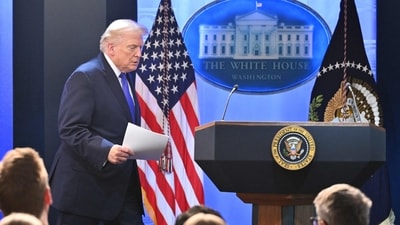
On Friday, the Supreme Court issued a strong rebuke of his use of tariffs, which he imposed on countries, often in an arbitrary manner, through simple orders posted on social media to gain leverage in diplomatic matters that were at times completely unrelated to trade. Follow live updates here.
ALSO READ | Tariffs killed, 10% duties in comeback move: What next for Trump after Supreme Court ruling?
Trump signs proclamation imposing “import surcharge”: What it means
After removing certain tariffs, the US president signed a proclamation imposing a 10 per cent “temporary import surcharge” as “ad valorem duties” on goods entering the American market.
The document said that the president was told by his advisers that the United States is facing serious international payment issues. These include a large trade deficit, a weak balance of payments position, and financial risks.
“…I, DONALD J. TRUMP, President of the United States of America, by the authority vested in me by the Constitution and the laws of the United States, including section 122, section 301 of title 3, United States Code, and section 604, do hereby proclaim as follows: (1) Except as otherwise provided in this proclamation, as set forth in Annexes I and II to this proclamation, all articles imported into the United States shall be subject to a 10 percent ad valorem duty rate,” the order read.
However, it also states that some imports will be exempt from this order, including certain critical minerals, metals used in currency and bullion, energy and energy products, pharmaceuticals, certain aerospace products, and more.
The surcharge will take effect at 12:01am Eastern Standard Time on February 24, 2026. It will remain in effect for up to 150 days, ending on July 24, 2026, unless terminated earlier or extended by Congress.
ALSO READ | A toy company behind the lawsuit that upended Trump’s tariff plan
Inside Trump’s executive order ending “certain tariff actions”
Issued on Friday (February 20), Trump’s latest executive order on tariffs came after the landmark Supreme Court ruling that trashed some of his sweeping tariffs and said they violated federal law.
This order cancels certain additional import tariffs that the US had imposed using emergency powers. These extra duties had earlier been brought in through several executive orders declaring national emergencies tied to national security, foreign policy, or economic threats involving multiple countries.
“In light of recent events, the additional ad valorem duties imposed pursuant to IEEPA (International Emergency Economic Powers Act)” issued through previous executive orders “shall no longer be in effect and, as soon as practicable, shall no longer be collected,” the White House said in an executive order.
However, it clarifies that the order does not impact any other duties, including those imposed under section 232 of the Trade Expansion Act of 1962, as amended, 19 U.S.C. 1862, and section 301 of the Trade Act of 1974, as amended, 19 U.S.C. 2411.
Section 232 (Trade Expansion Act of 1962): Allows tariffs or quotas on imports that threaten national security. Trump used it earlier to impose 25% tariffs on steel and 10% on aluminium in 2018, affecting Canada, Mexico, the EU, and others. These remain in place after the recent Supreme Court rulings because they are separate from emergency powers.
Section 301 (Trade Act of 1974): Permits tariffs in response to unfair foreign trade practices such as intellectual property theft, forced technology transfers, or discriminatory measures. Trump used it against China, placing tariffs of up to 25% on hundreds of billions of dollars worth of goods, targeting what he described as anti-competitive conduct.
