
Robodogs is our Word of the Week: The innovation that came to bite Indian university at AI summit
This week, it was all about Artificial Intelligence. India’s capital, New Delhi, hosted the Global South’s biggest AI summit, the India AI Impact Summit. The five-day gathering saw the who’s who of the AI world hobnobbing with India’s top leadership and tech titans.
Who can forget that epic photograph of Prime Minister Narendra Modi inviting the leaders of some of the top AI companies on stage and that awkward moment between OpenAI’s Sam Altman and Anthropic’s Dario Amodei?
The India AI Impact Summit was also embroiled in a controversy when Galgotias University, a Noida-based institute, tried to pass off a Chinese-made robot dog as its own. What came next: outrage and the eventual removal of the university from the expo.
As we sit back and relax this weekend, here’s a lookback at the entire drama that unfolded as part of our ‘Word of the Week’ series.
A robodog, explained
At the heart of the controversy surrounding Galgotias University is the robot dog, also known as a robodog, that the institute tried to pass off as its own.
But what exactly is a robot dog, and when did this come into being?
As the name suggests, a robot dog is an autonomous or semi-autonomous robot that mimics the four-legged locomotion of dogs. While they mimic the mobility of canines, they are equipped with advanced sensors, articulation, and computation systems.
The purposes of robot dogs are innumerable. They can be used in research initiatives, hazardous rescue missions, industrial inspections, and more. In recent times, robodogs have been found to be helpful in providing surveillance in hostage crises, defusing bombs, and even navigating through rugged topography to save stranded individuals from natural disasters.
Editor’s Picks
The evolution of robodogs
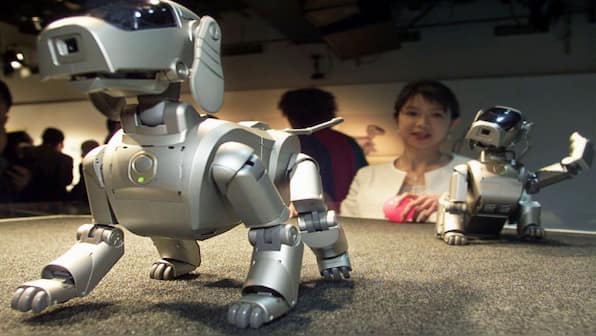
The world first saw a robot dog in 1999 when Sony’s AIBO hit the market. While the AIBO (Artificial Intelligence RoBOt) was constructed for entertainment purposes, its machinery was highly complex.
Developed with touch, hearing, sight, and balancing capabilities, AIBO responds to voice commands, shakes hands, walks, and chases a ball. It can also express six “emotions”: happiness, sadness, fear, anger, dislike, and surprise. Its emotional state is expressed through tail wagging, eye colour changes, and body movements, as well as through a series of sounds including barks, whines, and growls.
Since then, robot dogs have come a long way. Today, many countries have also developed robot dogs for their militaries. For instance, in 2024,
China unveiled a robot dog armed with a rifle. And last week, at the World Defence Show 2026 in Riyadh, a Chinese state-linked defence manufacturer unveiled a quadruped combat robot carrying four anti-tank guided missiles on its back.
Even the
Indian Army has its own robodogs, named Sanjay. These Multi Utility Legged Equipment (Mule) were first displayed in January 2025 during the Republic Day parade in Kolkata. As per the Indian Army, the robodogs can be deployed in scenarios requiring explosives detection and disposal, surveillance, perimeter security, and asset protection. The robot dogs are also equipped to handle operations in chemical, biological, and nuclear warfare environments.
Robodog row at India AI Impact Summit
But it’s the recent robodog fiasco at the India AI Impact Summit that has generated much interest in this technological marvel.
On February 17, it all began at the India AI Impact Summit, where a staff member of the
Galgotias University showed off a robodog, named
Orion, which she claimed was developed at their Centre of Excellence.
“This is Orion. This has been developed by the Centre of Excellence at the Galgotias University,” said Professor Neha Singh, adding that Galgotias was the “first private university investing more than Rs 350 crore in Artificial Intelligence”, with a dedicated “data science and AI block on the campus”.
Everyone seemed impressed with Orion. People posted videos, praising the technological innovation.
However, the university was soon embroiled in controversy when eagle-eyed observers noticed that the robodog that Galgotias was trying to pass off as their own was, in fact, made by a Chinese firm, Unitree Robotics, and was commercially available for $2,800.
Following the backlash the university received, with many accusing it of being dishonest, Galgotias University was asked to
vacate its stall at the summit. The Ministry of Electronics and Information Technology (MeitY) also reacted to the incident, with Secretary S Krishnan stating that the summit was a platform for “genuine and actual work”, not a marketplace for misrepresented technology. He emphasised that plagiarism and misinformation would not be tolerated at an event intended to showcase national pride.
Facing a barrage of criticism, Galgotias University then issued a series of clarifications. In its first statement, the Noida-based university first said on X, “It is not merely a machine on display — it is a classroom in motion. Our students are experimenting with it, testing its limits, and in the process, expanding their own knowledge.
“Let us be clear — Galgotias has not built this robodog, neither have we claimed. But what we are building are minds that will soon design, engineer and manufacture such technologies right here in Bharat,” it added.
It later seemed to push the blame onto its staff member,
Professor Neha Singh, stating, “We at Galgotias University, wish to apologise profusely for the confusion created at the recent AI Summit. One of our representatives, manning the pavilion, was ill-informed. She was not aware of the technical origins of the product and in her enthusiasm of being on camera, gave factually incorrect information even though she was not authorised to speak to the press.”
While it is to be seen if Galgotias University can bounce back from this fiasco, robot dogs seem to have caught the imagination of the masses.
End of Article
