

Singapore to resume crow shooting operations from second half of March
SINGAPORE – Crows will be back in the crosshairs after a six-year hiatus, as the authorities plan to resume shooting the birds after
alternative control methods have been inadequate
, and there has been a rise in reports of the birds’ attacks.
Minister for National Development Chee Hong Tat announced the decision to resume the shooting of crows from the second half of March in a Facebook post on Feb 23.
Crow shooting operations began as early as 1973. The Ministry of National Development (MND) discontinued it
in 2020
, due to incidents of pellets striking nearby residences. Such cases were caused by human errors, including non-compliance with safety protocols, and enforcement action was taken against those involved, Mr Chee said.
But he noted the number of reports about crows, as well as
incidents involving crows clashing with people,
has risen since then.
In 2025 alone, the Municipal Services Office received about 15,000 reports on crow-related issues, three times more than in 2020, when there were nearly 5,000 reports, according to Mr Chee. These include reports about noise, feeding and soiling.
Complaints about crow attacks also surged to over 2,000 cases in 2025, compared with more than 460 in 2020.
Said Mr Chee: “If the crow population continues to grow, it will affect the safety of our residents as there will be more and more crow-related attacks.
“We should not wait for this to happen before we take action. I have therefore asked NParks to bring back shooting as one of the measures to reduce the crow population in Singapore.”
In Singapore, house crows are deemed an invasive species that pose a threat to native biodiversity. The highly intelligent species is protective of its young and can attack upon sensing threats.
The birds’ droppings are known to create unsanitary conditions where they gather and roost, especially near residential areas.
Mr Chee noted that while the National Parks Board (NParks) has worked with other agencies to manage crows through different measures since shooting operations were stopped in 2020, these efforts have “not been adequate to keep the crow population under control”.
Such alternatives include trapping crows to cull them, removing crow nests, and stepping up efforts to reduce human sources of food, he said.
NParks said in a statement that it had intensified its crow management efforts following the cessation of crow shooting in 2020.
These included removing close to 9,000 crow nests islandwide in 2025, up from over 600 in 2021. The number of crows trapped and removed by NParks also rose from more than 1,800 in 2021 to over 13,000 in 2025.
“Despite these stepped-up efforts, the crow population has increased over the years. Crows are highly adaptable to urban environments and can easily become trap-shy, making it necessary to complement population control with other sustainable ways to reduce crow populations,” said NParks.
House crows commonly thrive in cities and towns. They often appear at food centres and rubbish bins to scavenge for leftover food.
Fieldwork has been done by NParks to monitor their behaviour and to test solutions.
Between 2023 and 2024, for instance,
cages were set up in areas
including Toa Payoh, Bishan and Siglap, with food placed inside as bait, to trap the birds and euthanise them.
In 2025, NParks also rolled out a trial where plastic effigies of crows were placed on trees to prevent large murders of crows from gathering.
Such effigies have been tested overseas in places such as the US with some success.
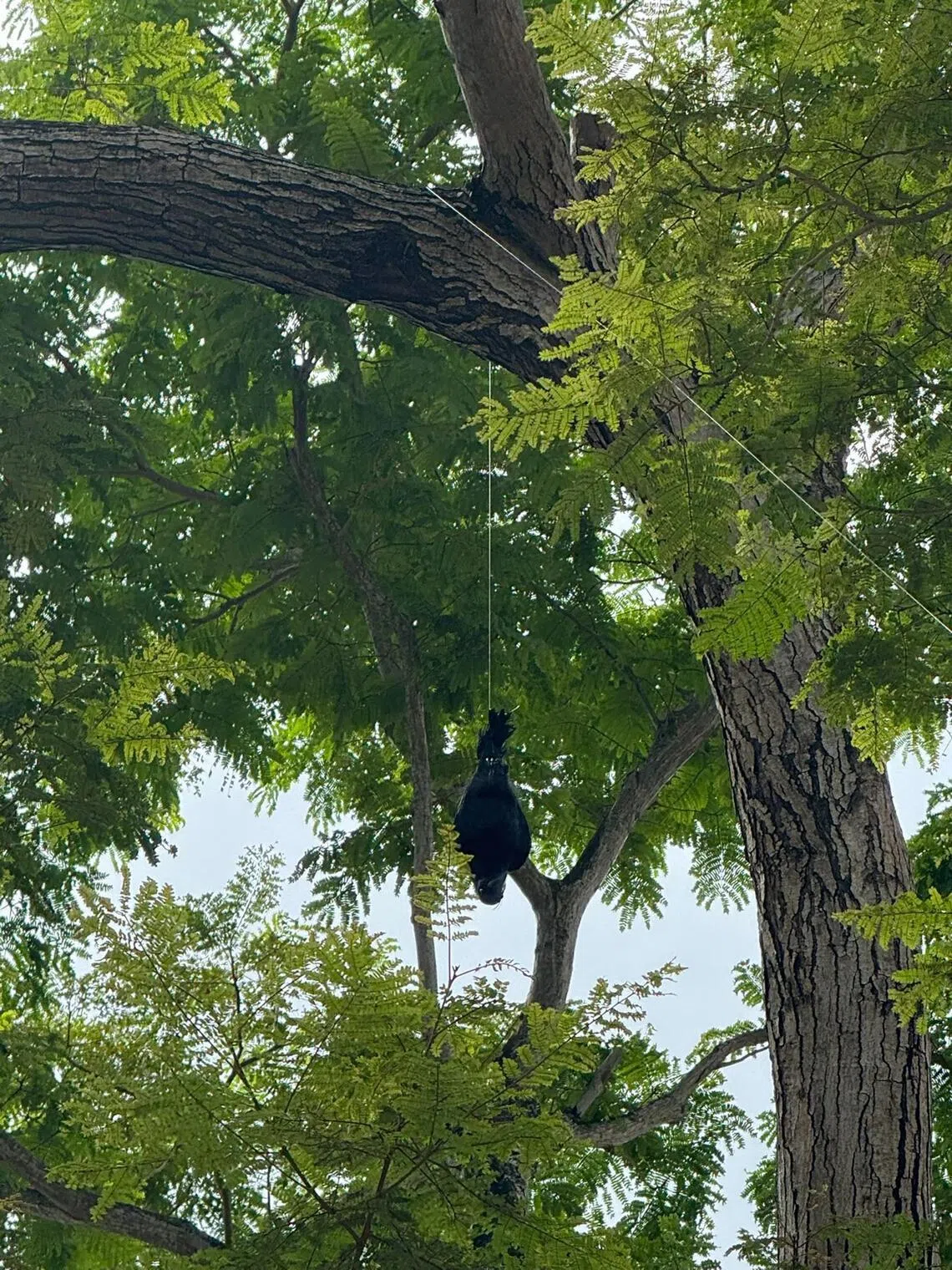
A plastic effigy of a crow is strung from a tree to disperse large murders of house crows, as part of a trial in 2025 by the National Parks Board.
PHOTO: NATIONAL PARKS BOARD
In September 2025, Aljunied MP Kenneth Tiong had asked in Parliament how MND was managing crow-related public nuisance and safety threats in residential estates.
In response, MND said then that it had been working closely with the Singapore Police Force, together with NParks, over a few months to resume the shooting of crows as part of efforts to bring down the crow population.
In his Feb 23 post, Mr Chee also noted that the resumption of crow shooting operations will carry some risk.
But he added that the ministry will carefully manage the danger posed with “enhanced safety measures”.
Shooters will undergo training and are required to observe strict safety controls, which include shooting upwards to ensure that the trajectory of the shotgun pellets is always directed upwards.
Shooting zones will also be cordoned off with clear signage and safety personnel deployed to prevent unauthorised access during the shooting operations.
The crow shooting operations will be carried out by licensed wildlife management contractors who are certified in the handling of firearms, according to NParks.
Said Mr Chee: “Together with the other ongoing measures such as trapping and nest removal, I hope that the resumption of shooting can help to bring down the crow population in different parts of Singapore, and provide a safer environment for our residents.”
To make a report about crows, contact NParks’ Animal and Veterinary Service on 1800-476-1600 or at this
website
.
The public can help to limit the population growth of crows by not feeding them and ensuring that food scraps are disposed of properly.
-
Avoid feeding crows. Under the Wildlife Act, offenders can be fined up to $5,000 for their first offence of feeding any wild animal, including crows, and up to $10,000 for subsequent offences.
-
Fruits in trees planted at landed property should be harvested or covered with opaque materials. This is because crows are omnivores that also feed on insects, fruits and vegetables.
-
Those living in houses near hot spots where crows roost should remove water sources in their yards, as they could present a stable drinking source for the birds.
-
Pet owners should remove unfinished food and spills if they feed their pets outdoors.
-
Residents of landed property can consider playing recordings of crow distress calls multiple times a day, or stringing up shiny metal pieces, such as CDs, to reflect sunlight and disperse roosting crows. However, this method may not be effective for long, as crows are intelligent birds.
