
Infant formula recall: Is trying to copy breastmilk increasing risk of contamination?
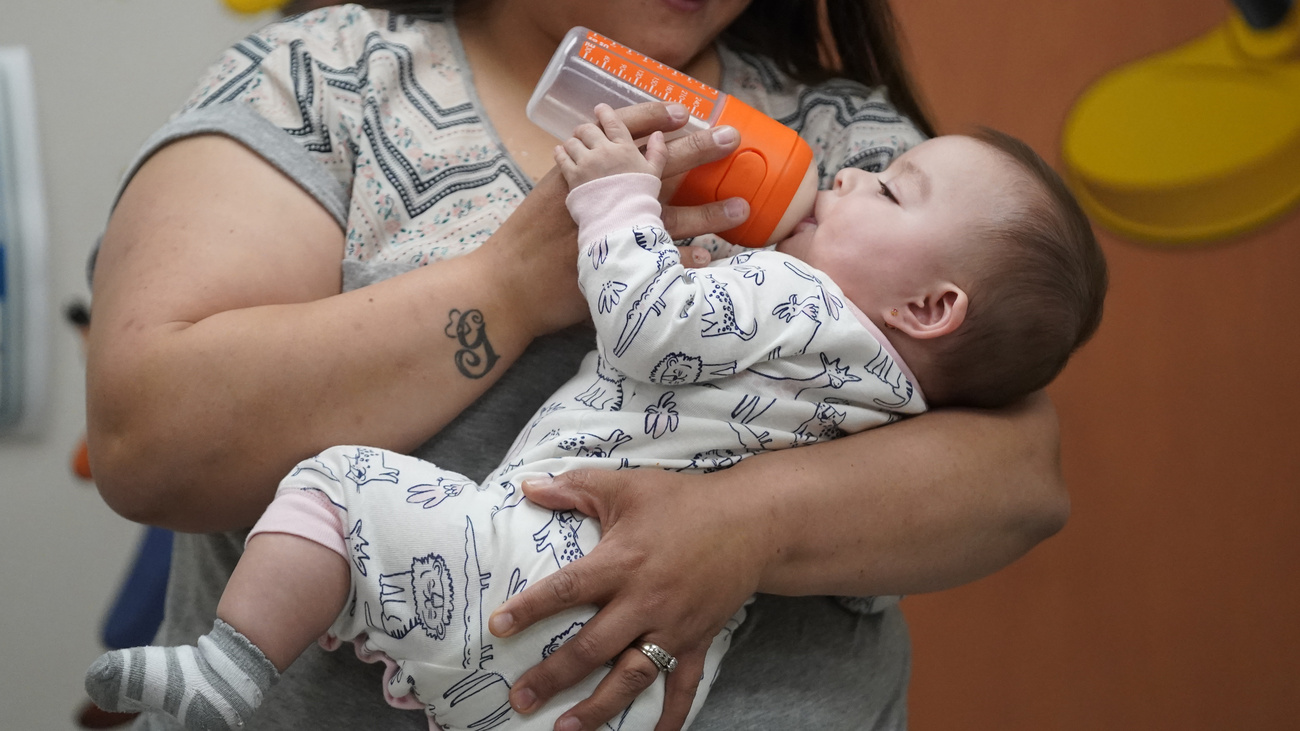
There have been reports of hospitalisation of infants who were fed the recalled formula.
Copyright 2022 The Associated Press. All Rights Reserved
A contaminated additive found naturally in breastmilk is responsible for the recent recall of infant formula worldwide.

An unprecedented spate of recalls worldwide of infant formula produced by food companies like Nestlé, Danone, Lactalis and others have set alarm bells ringing. The cause of the recall is the detection of cereulide – a toxin produced by the bacteria Bacillus cereus. Cereulide ingestion can cause vomiting and stomach cramps.
Some 60 countries are affected and an estimated 100 children in Europe (up to 36 in Switzerland alone) have shown symptoms consistent with cereulide contamination. The toxin was found in a supplement called arachidonic acid (ARA) oil commonly added to infant formula. The French agriculture ministry has identified Chinese company Cabio Biotech as the supplier of the contaminated ARA oil used by several infant formula manufacturers.
On February 9, the Swiss Federal Food Safety and Veterinary Office stated that batches of infant formula of the brands BEBA, Alfamino, Bimbosan, Aptamil, and Babybio brands sold by Nestle, Hochdorf Swiss Nutrition, Rossmann, Danone, and local supermarket Migros were affected.
Nestlé claims that the cost of the global recall will be below 0.5% of revenue but analysts from US investment bank Jeffries forecast the impact at 1.3% of revenue (around CHF1.2 billion, or $1.54 billion) while Barclays pegs it at between 0.8% to 1.5%. Shares of the Swiss company have fallen by as much as 4.6% since the recall was announced.
The recall comes as manufacturers have been adding ingredients to infant formula in a bid to better imitate breast milk. International guidelines and health regulators like the US Food and Drug Administration now list around 30 required ingredients in infant formula. As the supply chain becomes more complex, is it harder for companies to keep it safe?
What is ARA and why is it added to infant formula?
ARA is naturally found in breastmilk, but infant formulas add a synthesised version produced from a soil fungus. The long-chain polyunsaturated fatty acid (a member of the omega-6 fatty acid family) plays an important role in brain development in infants and is usually paired in formulas with docosahexaenoic acid (DHA) that is made from fish oil.
Research has shown that breast-fed infants had higher levels of ARA and DHA in their blood than those fed by formula. This is because infant formulas of the past did not have ARA or DHA in them. They were fortified with the two essential fatty acids linoleic acid and α-linolenic acid that the body then transforms into ARA and DHA respectively. However, this conversion is not optimal in infants. This is why infant formula manufacturers have been adding ARA and DHA since 2001 in the US and much earlier in Europe. Both ARA and DHA are listed as optional ingredients for infant formula in the Codex Alimentarius, a set of international guidelines aimed at harmonising food safety regulations around the globe. However, the European Union made it mandatory to include DHA in infant formula from February 2020, but the addition of ARA is still optional. This also applies to Switzerland.
How was the infant formula contamination detected?
Food giant Nestlé claims it was the first manufacturer to identify the contamination and make the information public. According to the Swiss multinational, very low levels of cereulide was detected in early November 2025 in samples during routine checks following the installation of new equipment in its Netherlands factory.
The company said it halted production immediately and sent samples for in-depth laboratory analysis. The test results obtained in early December 2025 confirmed traces of cereulide in batches of infant formula.
Just before Christmas, Nestlé was able to link cereulide to an oil blend containing ARA that was used to produce infant formula in several of its factories. Nestlé informed the rest of the industry on December 30, 2025 via trade associations given that many companies making infant formula relied on ARA from the same supplier.
Nestlé has discontinued sourcing ARA from Wuhan-based Cabio Biotech.
“Our suppliers are continuously audited and certified by independent third-party bodies that assess their manufacturing practices and food safety management systems in place. At ingredient level, we also conduct specific laboratory analysis at Nestlé to ensure the ingredients comply with the level established in the regulation,” a Nestlé spokesperson told Swissinfo.
More
More
Consumers are still buying food which makes them sick. How come?
Nov 11, 2023
European consumer advocacy group Foodwatch disputes Nestlé’s version of events. In a criminal complaint filed at the end of January, Foodwatch, an NGO, blames the companies and authorities for warning the public too late and taking weeks before large-scale public recalls were issued.
How many factories and countries are affected?
According to Nestlé, at least 25 batches of infant formula produced in 16 European countries were recalled. Danone has recalled one batch produced in Thailand and Lactalis has recalled six batches produced in France. In total, it is estimated that consumers in around 60 countries are affected by the recall.
Who else manufactures and supplies ARA oil for infant formula and are their products affected by the contamination?
Swiss-Dutch firm dsm-firmenich held a quasi-monopoly for ARA for infant formula until Cabio Biotech was able to step up to meet global demand. The expiry of dsm-firmenich’s main patents for ARA in 2023 enabled Cabio Biotech to capture international market share.
When contacted, dsm-firmenich claimed its ARA has not been contaminated.
“We are aware of this issue, however, none of our products are affected by this matter. We fully own and control the entire production chain of our microbial ARASCO® and life’s®ARA products – from fermentation through to the finished oil,” a spokesperson told Swissinfo.
Have children fallen ill from consuming contaminated formula?
There have been reports of hospitalisation of infants who were fed the recalled formula in France and Spain. Switzerland, the United Kingdom and the Netherlands are also investigating a possible link between infant formula contaminated with cereulide and symptoms of illnesses that have appeared in babies in recent weeks.
Only Belgium has confirmed the presence of cereulide in faecal samples taken from ill infants.
Have companies been held accountable and food safety regulations tightened?
On February 13, the Public Health Division of the Paris Judicial Court announced that it had launched investigations against five firms – Nestlé, Lactalis, Danone, Babybio, and La Marque en moins – over the cereulide contamination. The charge of “deceiving consumers over goods that pose a danger to health” carries a fine of €3.75 million.
More

More
Toxic cocoa beans: how much cadmium is in your chocolate?
Aug 5, 2023
Following the recall, the European Food Safety Authority (EFSA) announced a new maximum safe daily intake level for cereulide on February 2. It set the “acute reference dose” for infants under 16 weeks at 0.014 micrograms per kilogram of body weight per day. France has already updated its legislation to this threshold.
On February 12, China’s State Administration for Market Regulation announced a directive requiring infant formula manufacturers to test their products for cereulide.
On February 5, the Food and Agriculture Organization (FAO) of the United Nations and the World Health Organization (WHO) issued a worldwide call for experts and data to contribute to the risk assessment of infant formula. The risk assessment will ultimately help update the Codex Alimentarius standards for powdered formula.
Is adding more “supplements” to replicate the benefits of breast milk making infant formula more vulnerable to contamination?
Not really, according to experts.
“Increased complexity in a mixture inherently raises the risk of contamination or error. That practical constraint must be balanced against whether an ingredient is essential for proper infant development,” says Tom Brenna, professor of paediatrics, chemistry, and human nutrition at the University of Texas at Austin.
More

More
Food companies are making treats unhealthier to win over Gen Z
Sep 3, 2025
According to him, ARA oil has been added to formulas for over 25 years with few, if any, attributed problems. Considering that human milk contains a consistent amount of ARA, Brenna feels it would be amiss to not have it in infant formula.
“We must consider that pre-1990s formulas – lacking ARA and DHA – were unprecedented departures from the biological standard of nutrition that existed for millennia prior to industrialisation,” says Brenna.
Despite the cereulide contamination recall, the professor does not believe that the food safety system followed by the industry is broken.
“Companies rely on suppliers for ingredients, but the gold standard – and the expectation – is that they routinely test their own facilities for contaminants. I have every reason to believe this protocol is being followed; the rarity of contamination incidents, combined with the high visibility of those that do occur, suggests the system of oversight is functional,” he says.
Join the debate:
External Content
Edited by Virginie Mangin/dos
