

Malaysian workers in Singapore: Cross-border jobs
IPOH, Perak – “A Singaporean comes to work here (Malaysia)? You think I’m stupid?” Malaysian security guard Ah Beng protests to Singaporean grandma Liang Po Po inside an interrogation room.
This comedic exchange is from Ah Beng Vs Liang Po Po, a Chinese New Year movie featuring the popular grandma character as a maid working for a wealthy Malaysian family.
The Chinese-language film boasts a mixed Singaporean and Malaysian cast, with Singapore’s Jack Neo in the role of Liang Po Po and Malaysian actor Jack Lim playing Ah Beng. It premiered on Feb 17, and topped the box office on both sides of the Causeway, grossing over RM8.1 million (S$2.63 million) in Malaysia and $1 million in Singapore as at Feb 26.

Actor Jack Neo (left), who plays Singaporean grandma Liang Po Po, with Jack Lim as Malaysian security guard Ah Beng in Ah Beng Vs Liang Po Po.
PHOTO: GOLDEN VILLAGE
The amusing scene pokes fun at a comment by Malaysia’s Housing and Local Government Minister Nga Kor Ming, who has made controversial remarks about Singapore-Malaysia ties.
For example, he had said, while on the campaign trail for the Democratic Action Party in October 2022, that Singaporeans should work in Malaysia as labourers instead of the other way around.
Malaysians working in Singapore, he added, should not have to endure exhausting daily commutes, some of which have led to deaths. In the most recent accident, a Malaysian bus driver working in Singapore died in the wee hours of Jan 13 after losing control of his motorcycle while heading home from work.
Faced with a backlash for these remarks, Mr Nga was forced to clarify that his words had been “taken out of context” and that he had no intention of offending Singaporeans.
Fast forward to January, when he reposted the controversial comments on his social media after the ringgit strengthened to 3.11 against the Singapore dollar, compared with 3.31 in February 2025.
The short clip went viral, garnering more than 1.2 million views as of Feb 26.
Although made the butt of jokes, Mr Nga appeared chuffed at being remembered for his remark to “ask Singaporeans to be labourers in Malaysia”. At a recent Chinese New Year (CNY) event, he said he believed the ringgit could strengthen to 2.50 in the next 10 years under the current administration.
By then, more Malaysians would return from working in Singapore, he added.
Yet, the viral narrative contrasts with reality.
While over 1.18 million Malaysians worked in Singapore in 2023, including up to 400,000 daily commuters from Johor, far fewer Singaporeans work in Malaysia, with the latest estimate in 2019 being 90,000, mostly as expatriates rather than cross-border commuters.
Perak, Mr Nga’s home state, has a significant diaspora in Singapore. More than 10 of my relatives from Perak have worked in the Republic, in jobs ranging from bus drivers to executives. As illustrated by Ah Beng telling Liang Po Po, “we (Malaysians) have contributed to the Singaporean economy”.
As the CNY celebrations began to wind down on Feb 20, Ipoh, the capital of Perak, saw its transport hub swarmed with Malaysians rushing back to work in Singapore.
The normally quiet airport was teeming with passengers, with six flights that day – four to Singapore and two to Johor Bahru – creating scenes rarely seen on a typical day.
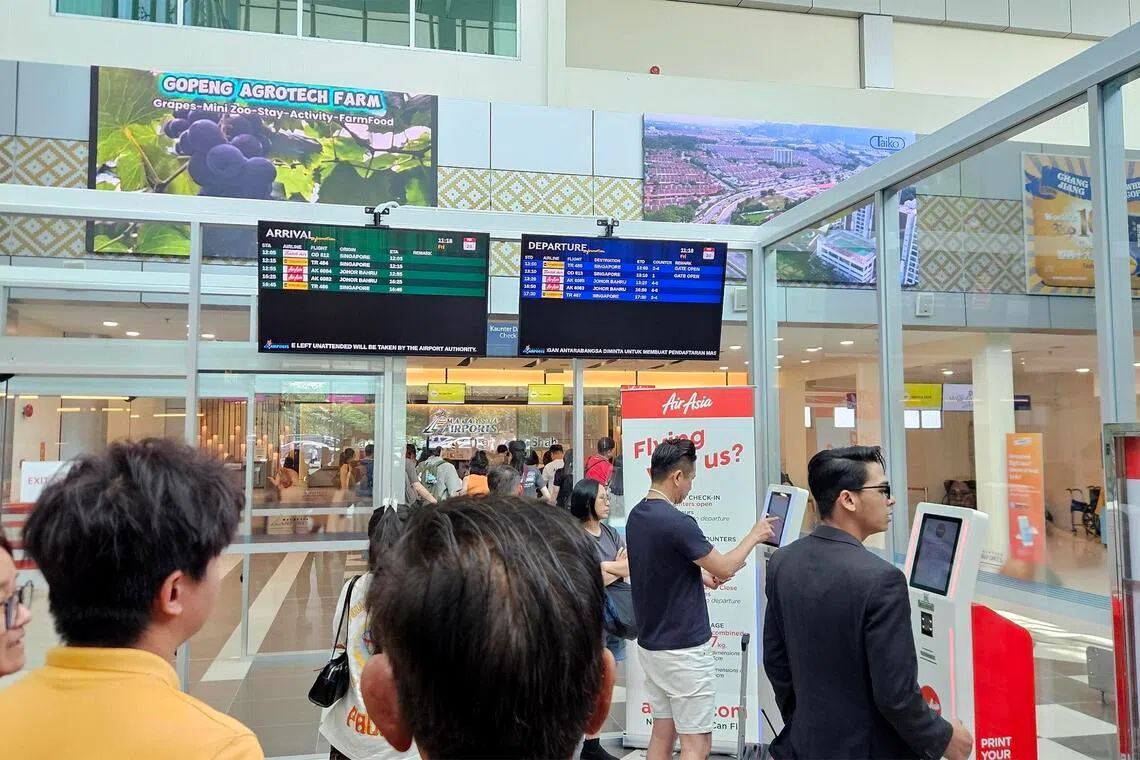
Normally quiet on weekdays, Ipoh Airport was crowded with Malaysians preparing to return to work after the CNY holidays.
ST PHOTO: LU WEI HOONG
A check on Sri Maju, one of the most popular bus service companies, showed that all Singapore and Johor Bahru bound tickets were sold out.
While waiting for his bus, Mr Kok Zu Cheng, 27, told The Straits Times he and his siblings were alighting at Johor Bahru – after a seven-hour journey – to take an SMRT-operated bus back to Singapore, where they live.
This helps to save about $15 per person, compared with taking a bus directly from Ipoh to Singapore.
An account executive, Mr Kok said working in Singapore allowed him to save, compared with living from paycheck to paycheck in Ipoh two years ago.
“It’s difficult to survive in Ipoh on a monthly salary of RM2,400 to RM2,500,” he said. His younger brother, Mr Kok Wei Li, 25, nodded, adding: “On the ringgit-to-dollar comparison, I can eat $2.50 chicken rice in Ang Mo Kio, but not RM2.50 in Ipoh.”
For reference, a plate of chicken rice that I had a day before the interview cost RM8.
Mr Kok Zu Cheng said he did not think Malaysians would return in large numbers as Mr Nga envisaged. “It’s unlikely to happen in the near future. The cost of living in Malaysia remains high, barely matched by local salaries.”
Ms Low Wai Yee, 42, has worked in Singapore for 15 years as a marine logistics executive. A daily commuter via the Tuas Second Link from Johor Bahru, she said the diverse and fast-paced work culture in the Republic keeps her engaged.
“Client complaints drive us,” said Ms Low, who was in Ipoh visiting her in-laws for CNY. “In Malaysia, fewer complaints mean slower progress. Buses are hardly on time, for example.”
But even so, Malaysia has other draws for youth who choose to stay.
Journalism lecturer Teh Boon Teck at Universiti Tunku Abdul Rahman observed that some of his students have returned to start their own businesses after working for a while in Singapore.
The operating costs for early-stage businesses and freelancers are lower in Malaysia than in Singapore.
“The students told me they dislike the high-pressure working culture in Singapore,” he said, noting that work-life balance may outweigh the appeal of a favourable exchange rate for the younger generation.
The rise of the digital economy also enables young people to work remotely, earning Singapore dollars while staying in Malaysia, he added.
Still, Mr Teh believes that more Malaysians would consider returning only if the ringgit
remains at 3.0 or below against the Singdollar
for a prolonged period.
“Otherwise, Mr Nga may just be bragging about Singaporeans coming to Malaysia to work as labourers,” he added.
He said: “The latest strengthening of the ringgit is mainly credited to external factors such as the weakening US dollar and US trade policy uncertainty. It is hardly sustainable for SGD/MYR to be below 3.0 in the long run.”
Although a stronger ringgit is welcome, Mr Nga’s remarks about Singaporeans moving to Malaysia to work have continued to draw criticism as many Malaysians have yet to feel tangible benefits from the ringgit’s rise, such as a lower cost of living. His comments were also ridiculed by journalists at the recent Chinese New Year events I attended.
Perhaps a scenario involving a Singaporean maid working in Malaysia, like the Liang Po Po character, could one day become reality, but Malaysia must first put in greater effort to build a better economy.
-
Sign up for our weekly
Asian Insider Malaysia Edition
newsletter to make sense of the big stories in Malaysia.
