
India will chart its own rise, Jaishankar pushes back against US official’s remarks
New Delhi: Days after a senior American official said that the US will not allow India to become an economic rival like China, external affairs minister S Jaishankar pushed back on Saturday by saying that India’s rise is “unstoppable” and the country alone will determine the trajectory of its growth on the basis of its strengths.
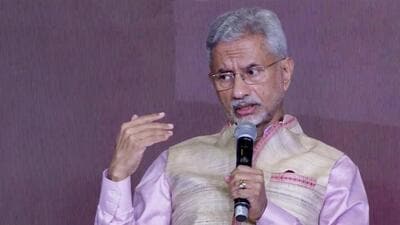
Jaishankar made the remarks during a discussion at the Raisina Dialogue, two days after US deputy secretary of state Christopher Landau said at the same forum that his country will not repeat the mistake of providing India the same type of economic advantages it gave China, allowing Beijing to emerge as a key competitor.
“When we speak today about the rise of countries…the rise of countries is determined by the countries. The rise of India will be determined by India,” Jaishankar said while participating in the discussion on cooperation among countries of the Indian Ocean region.
“It will be determined by our strength, not by the mistakes of others,” he said without directly naming any country or individual, though it was apparent he was referring to Landau’s comments at a conversation on India-US relations.
Jaishankar noted that the Indian Ocean is the only ocean named after a country because India is “right in the middle of it”, and India’s rise is a “lifting tide” that will benefit other countries of the Indian Ocean. “Those who work with us obviously will get more benefits…I’m not saying there are no challenges to India’s rise, there are. But the direction of India’s rise is very clear. In a way, it’s unstoppable,” he said.
Landau, a lawyer who has served as an envoy in both terms of US President Donald Trump, had highlighted the American leader’s vision for an “America First” foreign policy that emphasised the US is not a “charity organisation”.
While backing the trade deal that Washington and New Delhi are finalising, Landau said: “But again, India should understand that we are not going to make the same mistakes with India that we made with China 20 years ago in terms of saying, we are going to let you develop all these markets, and then, the next thing we know, you are beating us in a lot of commercial things.”
He added, “We are going to make sure that whatever we do is fair to our people. Because ultimately, we have to be accountable to our own people, just as the government of India has to be accountable to its people.”
The government has also faced criticism in recent days after US treasury secretary Scott Bessent’s announcement on Friday of a temporary 30-day waiver from American sanctions to “allow” Indian refiners to purchase Russian oil. The opposition Congress party, in particular, has accused the government of allowing the US to dictate the country’s foreign and economic policies.
Bessent followed up on his announcement by telling the media on Saturday that the US treasury department is letting India to start buying Russian oil as part of Trump’s policy of “American energy dominance”.
“The Indians had been very good actors. We had asked them to stop buying sanctioned Russian oil this fall, they did. They were going to substitute it with US oil. But to ease the temporary gap of oil around the world, we have given them permission to accept the Russian oil,” Bessent told Fox News.
The Indian side has maintained that the country’s energy purchases are guided solely by market conditions and international dynamics to ensure energy security. India has also not confirmed or denied the Trump administration’s assertion that New Delhi has made a commitment to stop buying Russian oil as part of efforts to strike a bilateral trade deal, and the government has only said that energy purchases are being diversified.
Former foreign secretary Kanwal Sibal was among those who criticised Bessent’s remarks, saying India has never been among the US’s “allies” and describing terms such as “good actors” and the US permitting India to buy Russian oil as “patronising”.
“Telling us it is [a] temporary reprieve and that they will revert to strong arming us. It is like a prisoner on parole. They should understand that such condescension and talking down to other countries leave long time diplomatic scars,” Sibal wrote on social media.
