
How Switzerland could shape the chip industry’s power balance
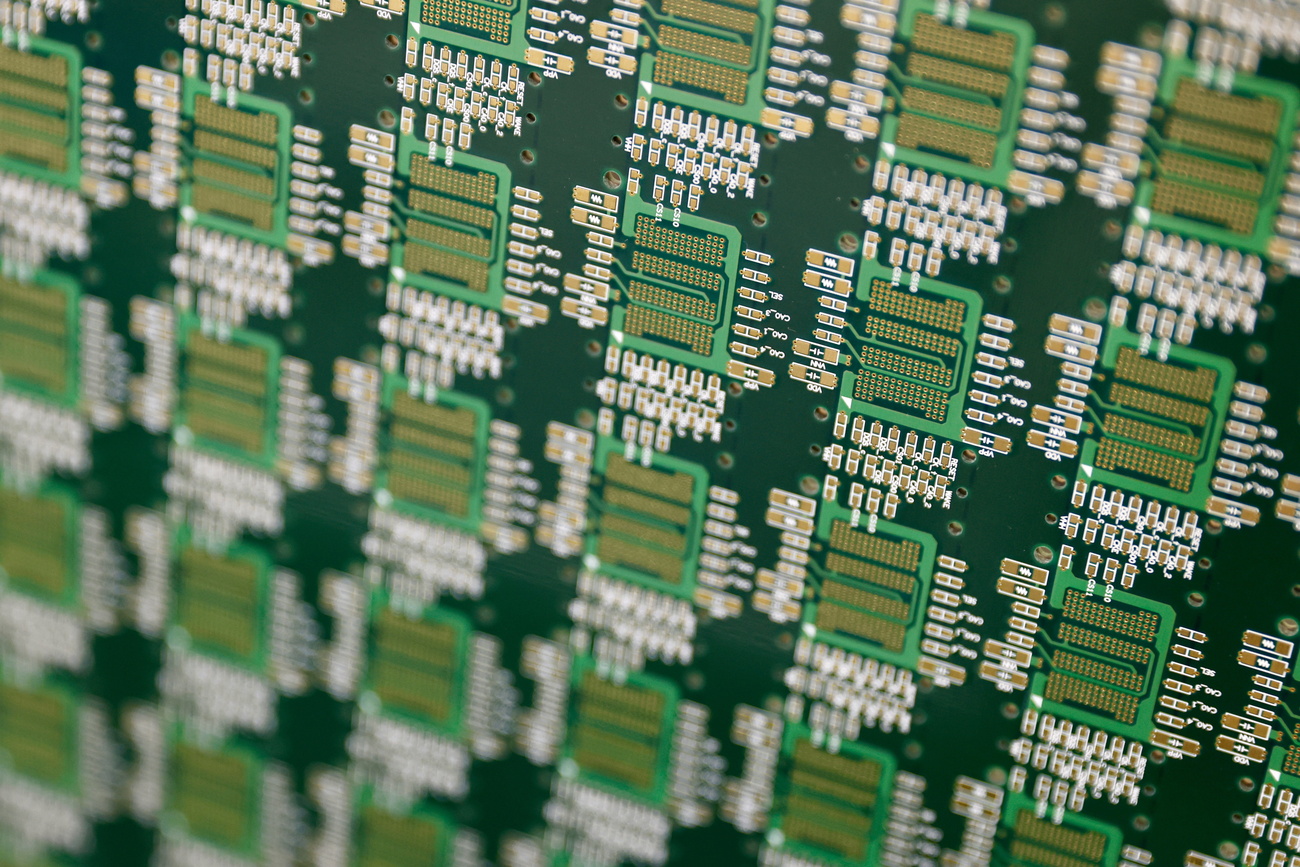
AI has increased global appetite for semiconductors
Keystone
The race for semiconductor supremacy is fuelling geopolitical tensions between the world’s superpowers. But a Swiss-based open-source technology aims to prevent a few dominant countries and companies from holding all the chips.
+ Get the most important news from Switzerland in your inbox
Just as the open-source Linux operating system has long challenged software market leaders such as Microsoft, the RISC-V (pronounced ‘Risk Five’) movement is on a mission to disrupt monopolies in hardware.
The RISC-V International Association has sat in relative obscurity in Zurich for the last six years. The non-profit is the guardian of the RISC-V open-source “Instruction Set Architecture” (ISA), a piece of technology that could grant smaller companies greater freedom in what kind of computerised tools they can build.
ISAs form a critical bridge between software and hardware. They translate complex computer code into operational instructions for chips. Every computerised device needs one. Without ISAs, computers and smartphones would be rendered dormant, AI could not exist and cars would lose cutting-edge digital features.
Most digital systems worldwide are dependent on just two versions of ISA, one from United States giant Intel and the other from British manufacturer ARM. The firms generate hefty fees by licensing access to their ISAs under restrictive operating conditions.
+ Chip-making factory aims to boost Swiss semiconductors
This burdens companies with extra costs and reduces the options for customising hardware for specific use cases. This is particularly important for start-ups designing the next generation of semiconductor chips to meet the evolving demands of technologies such as artificial intelligence (AI).
Scope to innovate
The limited options for ISAs also give the United States and British governments tighter control over the global chip market. An open-source standard like RISC-V affords hardware designers greater scope to innovate on a smaller budget.
More
More
How semiconductors are made
Aug 4, 2025
“We can leverage RISC-V to differentiate and showcase our technology for free,” says Alessandro Aimar, founder and chief technology officer of the Swiss startup Synthara, which works with manufacturers to improve the performance of edge and data centre AI chips.
Encouraging a host of small companies around the world to enter the semiconductor industry has stimulated the entire market, Aimar adds. “The silicon sector is at its most dynamic since the early 1990s,” he said. “The two main contributors are artificial intelligence and RISC-V.”
RISC-V was founded at the University of California, Berkeley in 2010. Like the World Wide Web, RISC-V started as an academic project to spur innovation.
More
More
Swiss chip industry fuelled by research, not cash windfalls
Jul 15, 2025
But in recent years, the RISC-V association has quietly orchestrated a global membership base of more than 4,500 academics, start-ups and larger commercial partners. US heavyweights like Nvidia, Microsoft and Google sit side-by-side with Chinese giants Huawei, Tencent and Alibaba.
Trade tensions
The lure is the promise of the open-source ISA to steer a neutral path through trade tensions, realize cost benefits, boost chip research and increase competition.
Big firms already incorporate RISC-V components, known as cores, microprocessors and accelerators, into their products. Nvidia alone shipped more than a billion RISC-V cores in its chips in 2024.
RISC-V components are present in vehicles, wearables, data centres and supercomputers and are used in the cosmos by the US and European space agencies.
The RISC-V International Association’s Swiss address is proving to be a valuable asset. The entity was originally set up in Delaware in 2015, but with countries threatening to restrict the sale and trade of semiconductors, RISC-V moved to Zurich in 2020 to escape potential political interference.
“From around the world, we’ve heard that ‘If the incorporation was not in the US, we would be a lot more comfortable’”, then RISC-V CEO Calista Redmond told Reuters at the time.
The association’s new CEO, Andrea Gallo, strikes a softer tone. The association maintains the ISA’s standards and development but does not seek to influence who uses it and for what purpose.
“We are respectful and fully compliant with trade regulations in every country,” Gallo told Swissinfo. “Being in Switzerland is testament to our neutrality across all time zones, geographies and cultures.”
Chip sovereignty
Companies like the Swiss start-up Synthara recognise the freedoms offered by an open-source ISA hardware instruction manual, known in industry circles as an architecture.
“There is no longer a need to remain dependent on an architecture whose supply the US could restrict, leaving you unable to obtain compatible processors,” said Aimar. “Companies are no longer tied to the British government for permission to use ARM technology.”
The US Congress has sounded alarm bells about Chinese use of RISC-V to boost its semiconductor capabilities. Media reports from last year spoke of China adopting RISC-V adoption to reduce reliance on Western technology.
More
More
Switzerland hosts ‘CERN of semiconductor research’
Mar 12, 2026
In 2023 the US Congress Select Committee on China wrote to the Department of Commerce to raise concerns of “national security risks” connected with China’s use of RISC-V “with the explicit purpose of undermining US export controls and leapfrogging our technological leadership in chip design”.
The Department of Commerce did not respond to Swissinfo’s request for comment.
But the open-source alternative to Intel and ARM still has a way to go before it can challenge the industry leaders, explains Frank Gürkaynak, director of the Microelectronics Design Centre at the Swiss federal technology institute ETH Zurich.
Next level
“Companies invest hundreds of millions of dollars to make the most sophisticated chips,” he told Swissinfo. “They will not consider using an open standard like RISC-V if they are not convinced that it is governed properly and will remain stable for the long-term.”
“They want evidence of proper governance, something tangible and usable. Big companies want to be part of the discussion, to ensure future development stays within a comfortable range.”
Moves are underway to take RISC-V to a new level. The association is collaborating with Linux to create an open-source trinity of software, ISA and hardware.
Aligning all three elements, along with reliable development and support activities, is crucial to competing at the top table.
“Making a new processor is not that difficult,” said Gürkaynak. “Making the entire software ecosystem connect with the hardware is very difficult. It takes hundreds of years of combined working hours to make a laptop function.”
The RISC-V International Association has a clear future ambition as it levels the playing field for smaller chip designers around the world. “Our vision is for RISC-V to become the standard ISA of choice”, said Gallo.
But this doesn’t necessarily mean putting today’s dominant companies out of business. “The market is so large, and is growing so fast, there is room for everyone,” Gallo added.
Edited by Gabe Bullard/VdV
