
F1 Q&A: Lewis Hamilton, Ferrari’s starts, rule changes and will McLaren and Red Bull benefit from month-long break?
 Getty Images
-
1 hour ago
Mercedes’ Kimi Antonelli converted pole position to win his first Formula 1 race at the Chinese Grand Prix.
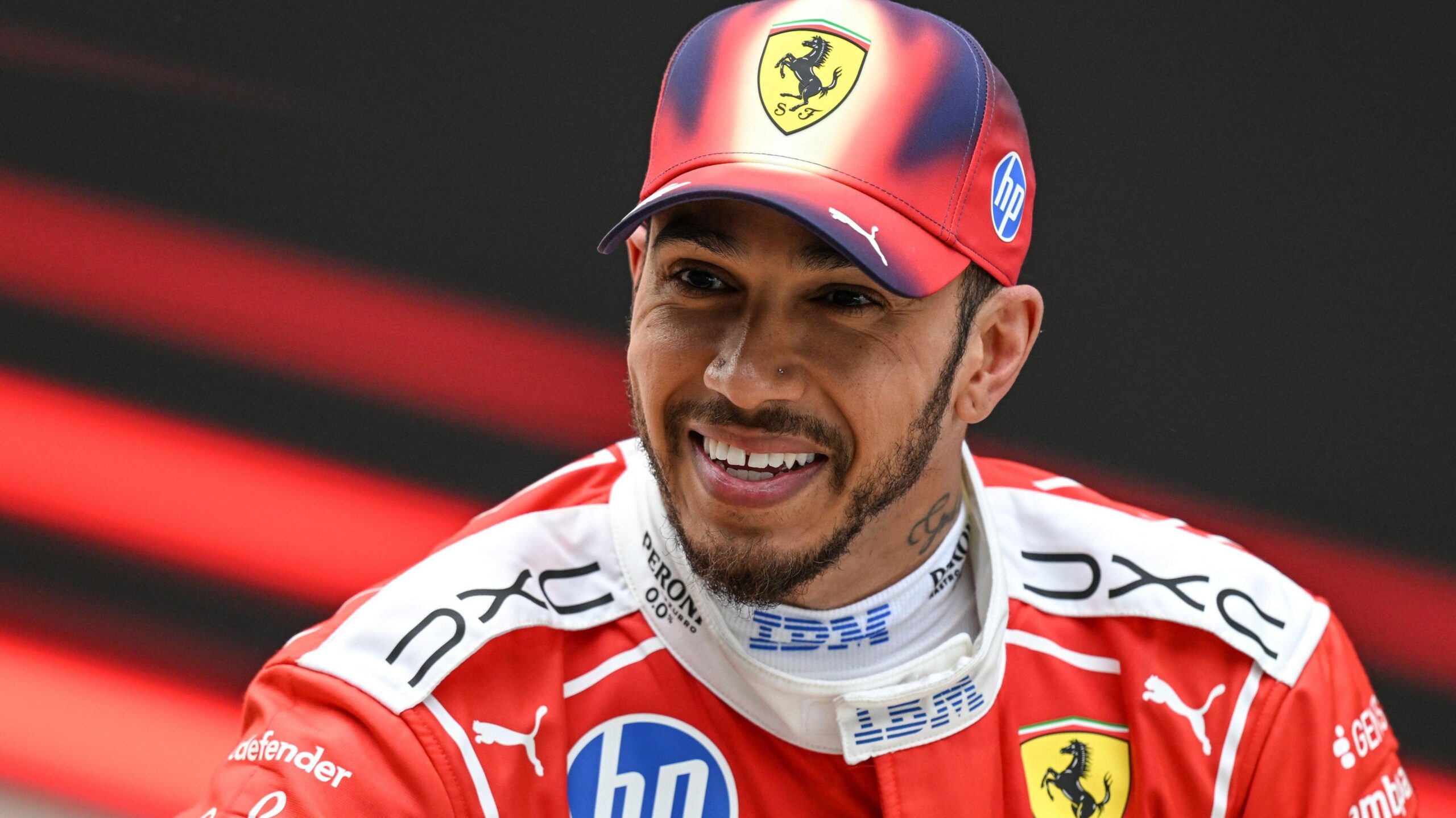
His team-mate George Russell finished second while Lewis Hamilton got his first podium finish with Ferrari.
McLaren duo Lando Norris and Oscar Piastri did not start the race after issues with their power units.
BBC F1 correspondent Andrew Benson answers your questions after the second race of the season.
Lewis Hamilton appears to be noticeably quicker this season than last. Is there something in the structure or balance of this year’s car that suits his driving style better than last year’s, or is the improvement coming from somewhere else? – Arjun
Lewis Hamilton definitely looks in better shape after two races this season than he did for most of 2025.
Last year was something of an annus horribilis for 41-year-old Hamilton, who was comprehensively outperformed by team-mate Charles Leclerc in his debut season at Ferrari, and seemed at times in a very dark place as he contemplated his performances in public.
This year, the seven-time champion gives the impression of being rejuvenated, and after the Chinese Grand Prix on Sunday he said: “I definitely feel like I’m back to my best, both mentally and physically, yes. I still think there’s room to improve.
“Training this winter has been the heaviest and the most intense that I’ve ever had, and that probably comes hand in hand with being older. It takes longer to recover.
“I just decided on Christmas Day how I was going to start this season. I decided what I was going to do mentally and I’m going to continue to tweak that. I do think there’s more to come. I think I can still eke out more performance from this car. I’m still learning about it as I go.”
Hamilton clearly went away for the winter realising he needed to reset. But it’s highly likely that there is something else going on here, too.
He was never fully comfortable with the previous era of cars. They required a corner-entry style very different from Hamilton’s natural approach, which has always been to brake late and use the pitch change of the car to help with rotation as he turns in.
For some reason, he was never able to adapt to the smoother, less aggressive style required by the ground-effect cars.
In many ways, this was a surprise, as Hamilton has always been famed for his adaptability to changing requirements of the car and, particularly, grip levels.
Many ex-drivers believe that age had something to do with this. That he had been driving in the same way for so long that when he needed to change style at a time when inevitably synapses take longer to form new pathways, he was simply not able to do so as effectively as he might have done a decade and more ago.
The new cars have a very similar aerodynamic philosophy to those before 2022, so Hamilton is back able to drive the car in a way with which he is more familiar and comfortable.
So he can rely on his old instincts, and he’s back looking like the Hamilton of old.
To play this video you need to enable JavaScript in your browser.
This video can not be played
Why is it that Ferrari get such better starts than Mercedes? – Ozan
No one knows the answer to this for sure, but it will be related to engine design.
Starts are much more difficult this year because it is much harder to get the turbo spinning at the optimum speed.
Last year, the MGU-H – the motor generator unit on the turbo shaft – was used to spool up the turbo to aid performance in a number of ways, including at the starts.
This year, the MGU-H has been removed, and the rules forbid the MGU-K – the motor generator unit on the rear axle – from being used to assist at starts until the car reaches a certain speed.
So the turbo has to be spooled up manually, by running the engine against the MGU-K on the grid – hence the extra time that has been added before the light process to allow the drivers to rev up their engines.
Ferrari are believed to have a smaller turbo than the other manufacturers. A smaller turbo has less ultimate performance at high rpm. But it is more responsive at lower speeds, so gives an advantage on immediate corner exit and, in this case, at the start.
Amid the debate over the new rules, what is more important, the entertainment spectacle or driver satisfaction? And with changes being considered, what sort of things are likely to be changed? – Kevin and Tim
For this answer, I have combined two separate questions that came in. I hope Kevin and Tim don’t mind.
F1 is a sport first and entertainment second. The hope is that it should be entertaining, and effort is made to make sure that’s the case, but sport can’t be entertaining all the time. You get 0-0 draws in football as much as 5-4 thrillers. Not all rugby matches are as compelling as that between France and England on Saturday evening.
Most of the stakeholders in F1 recognise that as a truism.
The new rules were not arrived at from an entertainment-first standpoint, at least not initially. The engine rules were changed to attract new manufacturers – successfully – and only afterwards was it realised that the chassis rules would be problematic.
Primarily, issues revolve around the fact that with such powerful electrical systems, a nominal 50-50 split between internal combustion and electrical power, batteries of the current size, and front-axle recovery not allowed, the cars are energy starved.
It’s fair to say that many people in F1 recognise the chassis rules are a mish-mash of compromises arrived at as a sticking plaster for the engine rules, while at the same time trying to align a series of competing political positions.
It’s hardly a surprise that, in those circumstances, the rules are less than perfect, to say the least.
The fundamentals of the rules won’t change, but it’s recognised that some areas could be tweaked to reduce some of the bigger compromises.
It’s clear from some remarks Mercedes team boss Toto Wolff made after the race in China that certain changes that have come with the new rules are considered welcome.
“From an entertainment perspective, what we’ve seen today between Ferrari and Mercedes was good racing,” Wolff said.
“Many overtakes. We were all part of Formula 1 where there was no overtake, literally. Sometimes we’re too nostalgic about the good old years. But I think the product is good in itself. We saw quite some racing in the midfield also. And that is, I think, the positive.
“Qualifying flat-out would be nice. But when you look at the fans and the excitement that is there, live, the cheering when there’s overtakes and also on social media, the younger fans, the vast majority, through all the demographics, like the sport at the moment.
“We can always look at how we’re improving it. But at the moment, all the indicators say and all the data say people love it. And I spoke with Stefano (Domenicali, the F1 president). He says that, too. So, it is driving the car that, for some, is not most pleasant.”
That sounds a bit like Wolff is saying the drivers can lump it if they don’t like it.
That being said, there is widespread unease at the way the need for energy management has compromised the purity of not only the driving experience but also the essence of the sport – especially in qualifying, and especially in fast corners, many of which some drivers say are now being used for energy recovery and are no longer taken at the limit of grip.
At the moment, there are two levels of energy recovery. When flat out, a maximum of 250kw, in what is known in F1 jargon as ‘super-clipping’. But 350kw once the driver has lifted and/or braked.
One obvious change would be to allow the cars to super-clip – the most efficient way of recovery – at 350kw. That feels like it could happen pretty soon, perhaps even for the Miami Grand Prix in early May.
Another proposal has been to reduce the power from the electrical components from the current 350kw, to 300kw or 250kw. Then deployment would last longer.
More extensive changes, such as changing the split between internal combustion and electrical power so it was more in favour of the engine, or increasing the fuel-energy limit, would require significant changes to the power-units. So that could not happen before next year at the earliest.
It remains to be seen whether there is appetite for that – especially as people are already beginning to wonder what the next engine regulations will be, and exactly when they will come in.
To play this video you need to enable JavaScript in your browser.
This video can not be played
How much of a blessing in disguise is this month-long break to some of the engine manufacturers to fix the very clear issues some of them have (Honda and Red Bull-Ford specifically) and for teams like McLaren and Williams to sort their cars out? Could this in the end make the next 20 races even better? – David
McLaren team principal Andrea Stella addressed this question in China at the weekend.
“When it comes instead to the development of the car,” he said, “I don’t think it changes very much, because we are trying to develop the car as fast as possible in every single area.
“Having run at the test, and then in the start of the season, we have learned even more what we need to improve based on looking at our own data, and we have taken definitely inspiration by looking at the other cars.
“So we are merging now this important amount of information that we have gained, and we are designing the new parts. And this is relatively independent of the fact that you go to race four and five, because you anyhow try to go as fast as possible.
“And in fairness, we didn’t have big projects that were targeting Bahrain and Saudi. In fact, we were targeting for later than those two events. So our path of development is not much affected.”
Every team will have a different programme, but Stella’s point fundamentally stands for all – teams plan upgrades months in advance, so the cancellation of one race or another won’t change that.
What it does mean is that struggling teams have two fewer races in which to lose points to their rivals in this initial stage of the season. Whether that makes a difference depends on whether any team can make progress relative to their rivals, of course.
Get in touch
Send us your question for F1 correspondent Andrew Benson
To play this video you need to enable JavaScript in your browser.
This video can not be played
The Chequered Flag podcast
Chinese Grand Prix review: Antonelli stars and Ferrari’s gripping battle
