

Not just a young person’s game: Meet the late bloomers carving a niche in Singapore’s beauty scene
SINGAPORE – The beauty industry is often seen as a young person’s game, but a growing number of late bloomers in Singapore are proving otherwise.
Leveraging social media to showcase their craft, these middle-agers and septuagenarians have reached new audiences and built loyal followings – something that might once have been thought impossible outside traditional beauty circles.
The Straits Times meets four Singaporean entrepreneurs who are carving a niche in the scene.
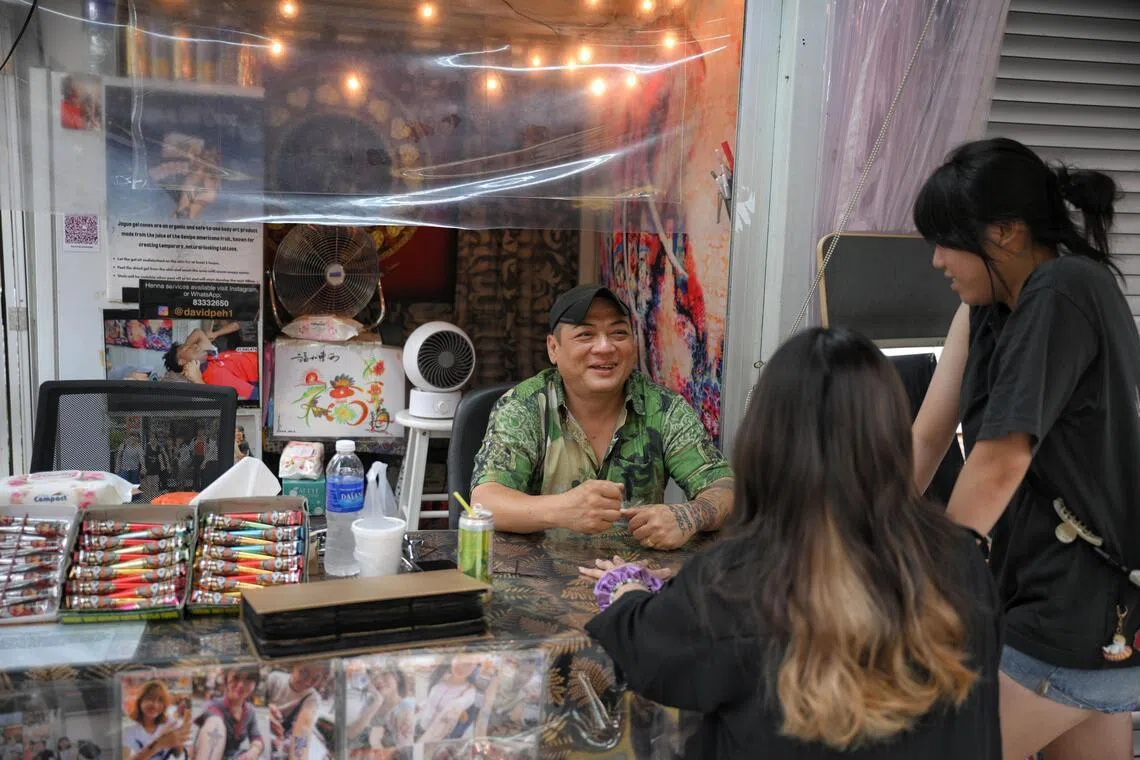
Mr David Peh chats with customers at his jagua and henna stall in Chinatown.
ST PHOTO: MARK CHEONG
The design begins as a thin, glossy line of dark dye.
Seated at a small table in the bustling Chinatown Street Market, 52-year-old David Peh steadies a customer’s wrist with one hand while guiding a fine-tipped cone of jagua ink across her forearm with the other.
What unfolds on the skin often takes the shape of delicate florals – Mr Peh’s personal favourite – though butterflies, stars, sea creatures and ornamental vines are also popular requests.
Some customers ask for small, palm-size pieces tucked neatly along the wrist, while others opt for longer designs that stretch across the forearm like trailing ivy.
Mr Peh, who typically operates daily from 11am to 11pm, spends most of the day with his head down, inking one design after another.
“I enjoy drawing,” says the jagua and henna artist. “To me, being able to draw every day is already a good life.”
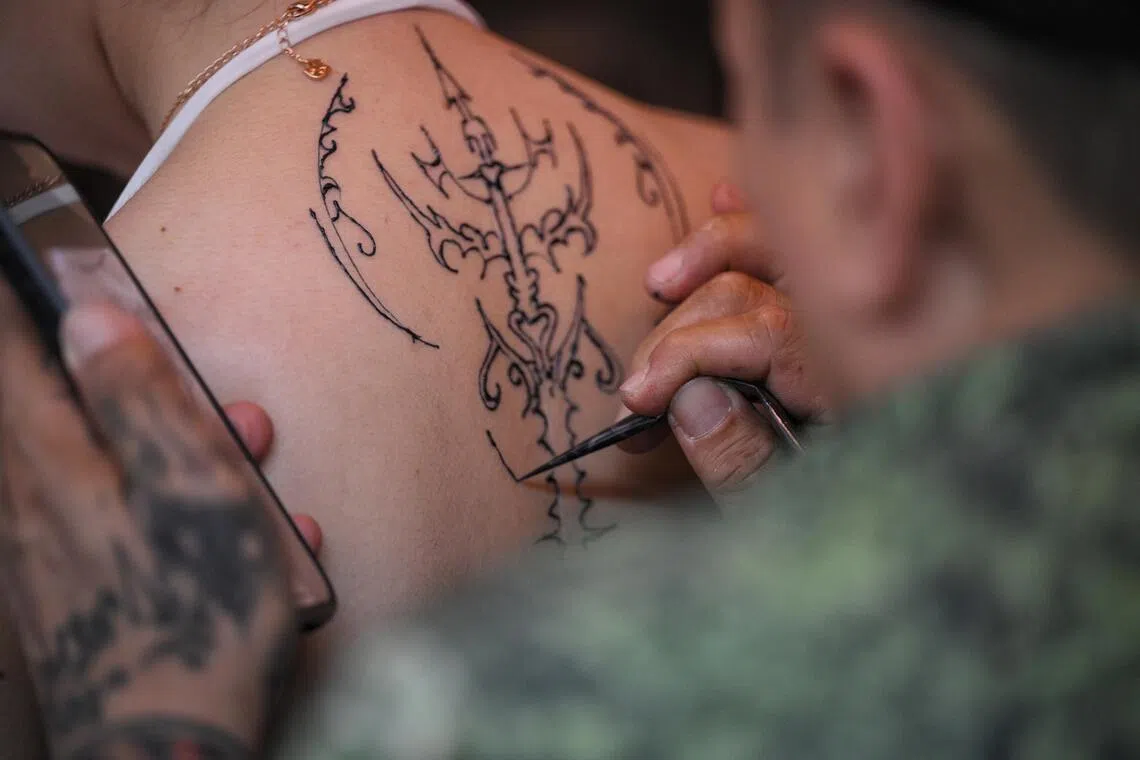
Mr David Peh draws a jagua tattoo, featuring a symmetrical ornamental motif, on the back of a customer.
ST PHOTO: MARK CHEONG
In April 2025, after his 23-year-old son – who is doing his national service – encouraged him to go on TikTok to showcase his jagua and henna designs, the single father set up his account (@davidpeh1331) on the social media platform.
His posts were simple – short collages of the final designs he had drawn on customers that day.
Within months, his account gained traction. One post uploaded in May 2025 garnered 135,000 views, and his account has since grown to more than 2,000 followers.
“Business became very good,” Mr Peh says with a laugh. “Sometimes, people can wait for two hours.”
Before he got onto TikTok, most of his customers were tourists wandering through Chinatown who stopped by his stall on impulse. Now, his clientele looks very different.
These days, he says, about 90 per cent of his customers are local teenagers – many of them girls – who discover him on TikTok before making their way to his stall.
Among them is Singapore Polytechnic student Yeo Shi Rui, 17, who came across Mr Peh’s work while scrolling through TikTok.
“While David does the jaguas, he chats with us and gives life advice sometimes,” she says. “It’s heartwarming that there’s an intergenerational connection going on.”
Rather than feeling out of place, Mr Peh says he has come to enjoy the Gen Z energy.
“I feel happy when they recognise my work,” he says. “Even though I’m older than them, I can tell they appreciate what I draw.”
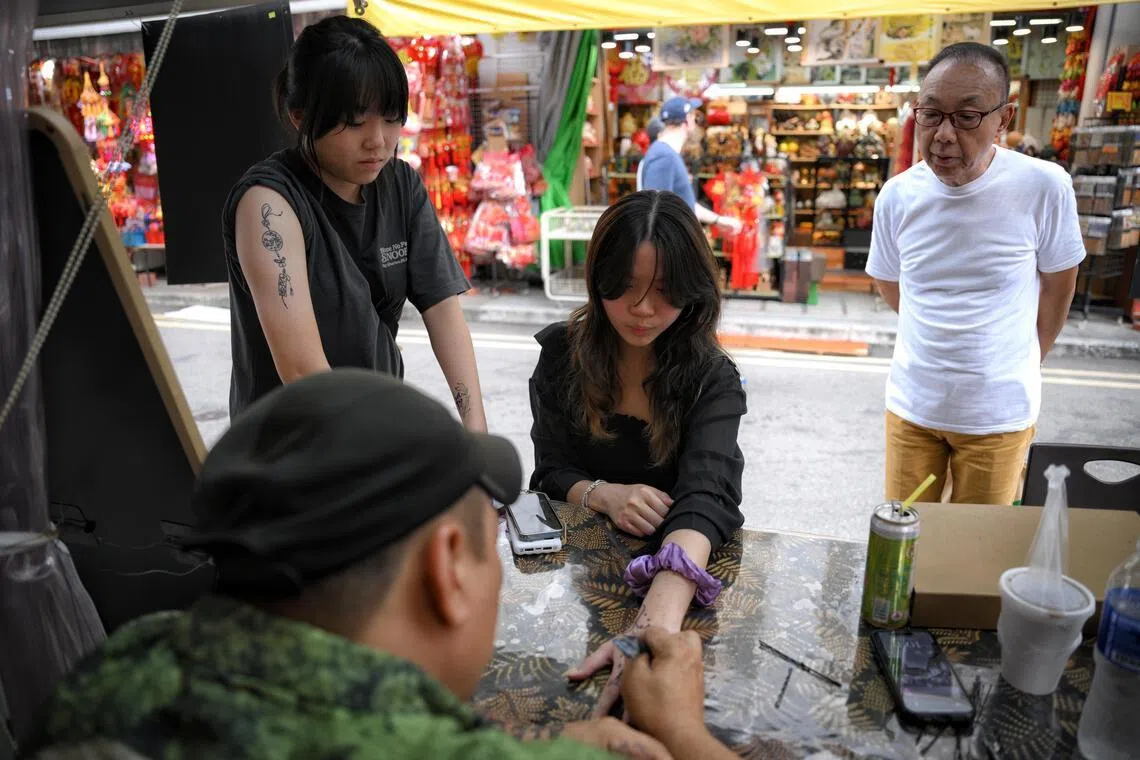
Mr David Peh says interacting with customers is one of the most enjoyable parts of his job.
ST PHOTO: MARK CHEONG
The appeal lies not only in his designs, but also in the dye he uses.
About 85 per cent of his customers opt for jagua, a plant-based dye extracted from the fruit of the Genipa americana tree. Unlike traditional henna, which leaves a reddish-brown stain on the skin, jagua develops into a deeper blue-black colour.
Henna usually lasts about seven to 10 days, while jagua can remain visible for 10 to 30 days, depending on one’s skin.
“The colour of jagua looks more like real tattoos, which is why it’s more popular,” Mr Peh says.
Prices vary depending on the size and complexity of the design, but Mr Peh keeps his services affordable – particularly for students who form the bulk of his clientele.
He says: “They don’t have much money, so I don’t want to charge them too much.”
So, for students, designs typically range between $10 and $35. A small palm-size piece might cost $10 to $25, while larger or more intricate floral patterns can go up to $30 or $35. Adult customers pay from $10, with larger pieces reaching about $100, depending on the design.
Whether his customers choose jagua or henna, he charges the same price – even though many other artists typically charge more for jagua.
This concession comes at a cost. A 30g cone of henna dye costs him about $2, while jagua ink costs roughly $10 for about 8g to 12g.

Photographs of Mr Peh’s past designs are displayed around his booth to help customers choose their tattoos.
ST PHOTO: MARK CHEONG
His TikTok presence has changed the pace of his business, he says.
In the past, he might see between one and 20 customers a day, depending largely on tourist traffic and the weather. These days, the numbers are steadier, and on busy days, he serves between 20 and 40 customers.
Running the stall is not cheap. The booth he rents costs between $2,000 and $3,000 a month. Mr Peh says he does not receive government subsidies, which means rent and other operating costs come directly out of his earnings.
Although he declines to reveal his exact income, he says the business began to feel noticeably better only after he gained traction on social media. Even after paying rent and giving his son an allowance, he says he can live comfortably.
“It’s a good salary for a full-time job. I can still survive,” Mr Peh adds.
The journey to this point, however, has been far from straightforward.
Before turning to body art as a full-time career in 2024, Mr Peh had spent 10 years selling costume jewellery – first in Bugis and Clarke Quay, then in Liang Court, and later in Chinatown.
But over time, the business became harder to sustain as shoppers increasingly turned to online platforms.
One day in 2008, he noticed a fellow vendor in Chinatown offering henna tattoos from a much simpler set-up.
“I saw the guy doing henna with just a table and two chairs,” Mr Peh recalls. “I had so many things displayed, but still not as many customers as him.”
Curious, he bought some henna and began practising at home.
In 2010, he began working as a henna artist in Chinatown’s Sago Lane, alongside his costume jewellery business.
For about a decade, he drew designs for customers passing through the area. But when the Covid-19 pandemic hit and tourism ground to a halt, business dried up.
Mr Peh eventually stepped away from the stall and took up a job as a hostel manager, a position he held for about four years.
In mid-2024, his elder brother encouraged him to return to the craft – after which he set up shop at Chinatown Street Market.
“He told me I had nothing to lose and I should go back to doing something I love,” Mr Peh recalls.
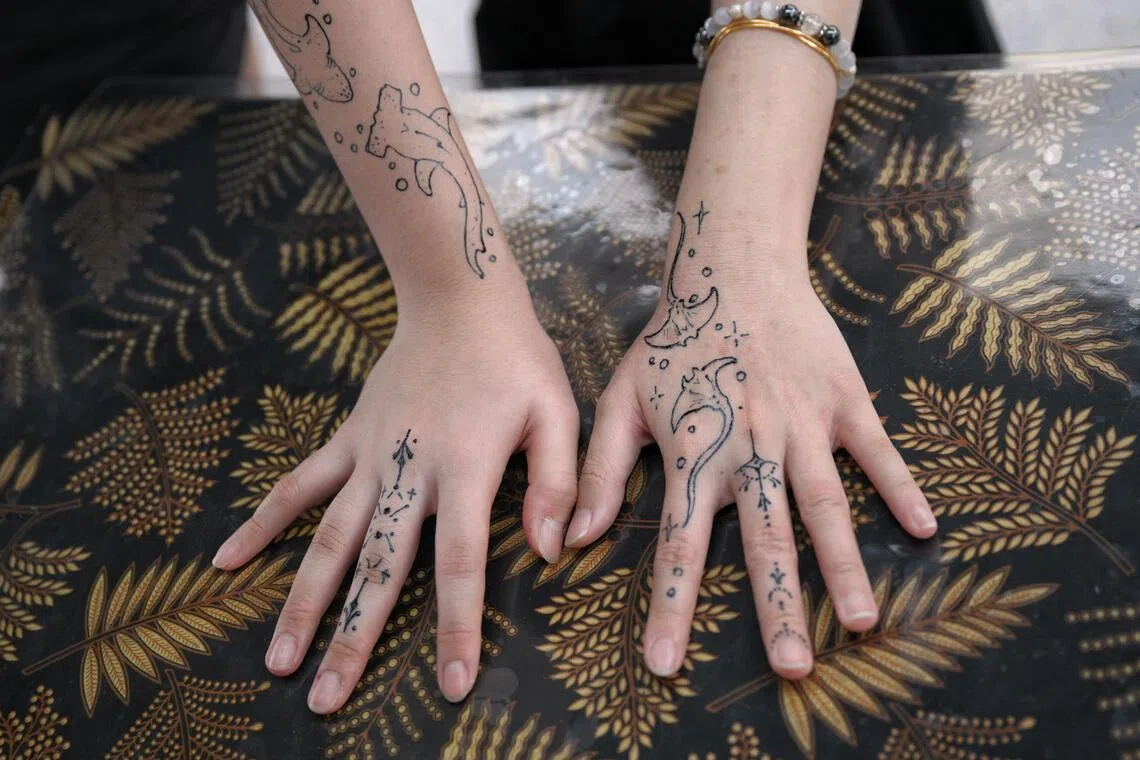
A finished design featuring sharks and stingrays drawn by Mr David Peh.
ST PHOTO: MARK CHEONG
“Sometimes, life can feel lonely,” he adds. “I like this job as I get to interact with customers.”
Years of repetition have sharpened his craft. He estimates he has memorised thousands of tattoo patterns – particularly floral designs, after drawing them again and again.
“If I draw a design three or five times, I can remember it,” Mr Peh says.
Simple tattoos can take one to three minutes, while more detailed designs may take three to 10 minutes.
The growing attention around his work has led to new opportunities. On April 11, he will conduct a jagua and henna workshop organised by the Chinatown Business Association, with two classes of 15 to 20 participants each, priced at $28.80 a person.
“I just want to share my jagua and henna knowledge with people,” he says. “I think it’s an underrepresented art form.”
For all the attention TikTok has brought him, Mr Peh keeps his focus on the craft.
“When someone sits down and trusts you to draw on his or her skin, you must do your best.”
Info: 335B Smith Street, 11am to 11pm daily, walk-ins available; go to @davidpeh1 on Instagram
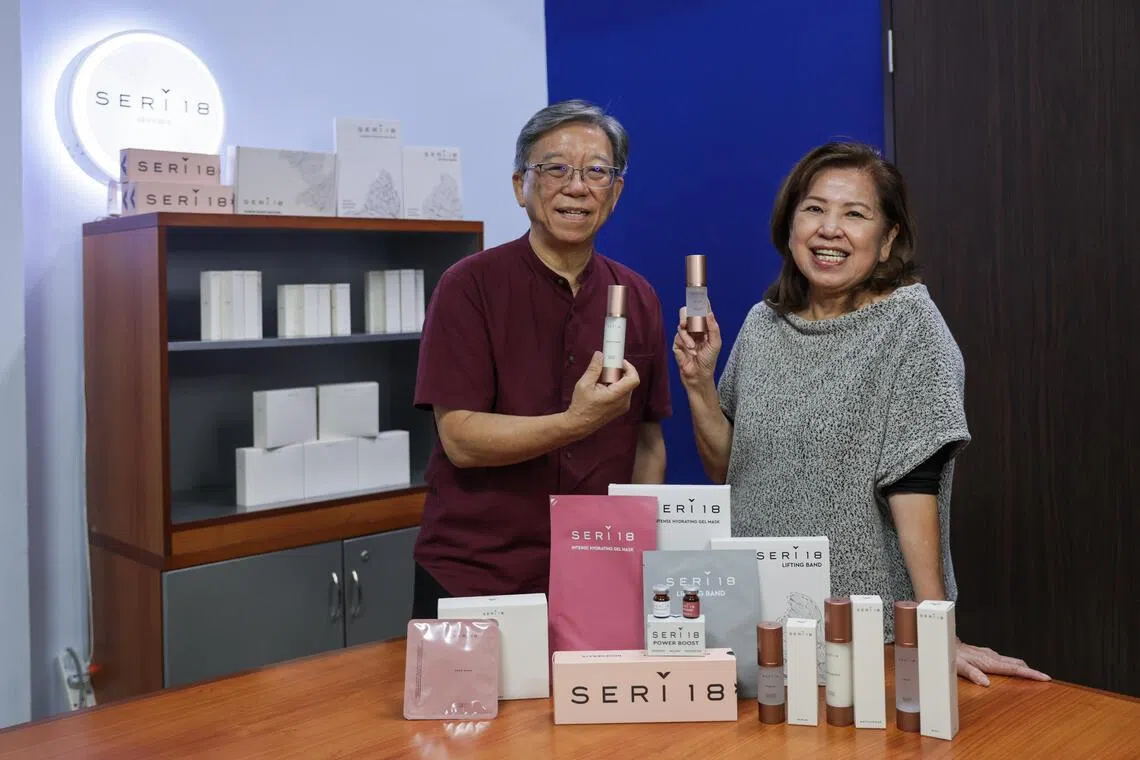
ST PHOTO: GIN TAY
For months, Mrs Monica Goh and her husband, Professor James Goh, found themselves facing the same problem: They had a product, they had a story to tell, but they had no way of getting anyone to stop and listen.
Despite launching their skincare brand Seri18 in early 2024 and spending around six months trying to make headway through digital marketing, alternative online platforms and pop-up booths, the couple struggled to stand out in an already-saturated beauty market where new brands were constantly competing for attention.
Says Mrs Goh, 70: “We just couldn’t get people’s attention.”
That changed when they turned to TikTok.
Encouraged by their three children, the couple began posting on the platform in April 2025.
Their 10-year-old granddaughter suggested they share their story in a more personal and direct way, and would often offer ideas on how to present their videos – from the tone of their delivery to the type of content that might resonate with viewers.
At the same time, they hired an external agency to help them navigate TikTok and set up their presence on TikTok Shop, while their children continued to provide feedback and direction.
At first, Mrs Goh was sceptical. “I didn’t think people would be interested in watching two old people,” she admits.
Today, their TikTok account @seri18skincare has grown to more than 5,000 followers, with videos crossing 200,000-view mark – including their brand story post that has reached nearly 550,000 views.
In it, the pair speak candidly about how they started Seri18, why they believed in their products and the risks they had taken, including funding the venture with their own savings that amounted to a low six-figure sum.
Seri18 itself is rooted in their decades of experience in science, engineering and healthcare.
Mrs Goh previously ran BES Technology, a company that supplies medical equipment and rehabilitation technology, working with systems ranging from orthopaedic rehabilitation tools to physiotherapy equipment.
Her 40-year-old son has since taken over the business, while she continues to support it in a smaller capacity.
Meanwhile, Prof Goh, 70, worked in the Department of Biomedical Engineering at the National University of Singapore, specialising in research on tissue repair, wound healing and regenerative materials.
Although he officially retired four years ago, he continues to teach and contribute to the department as an emeritus professor.
The foundation of Seri18 lies in the couple’s work with silk peptides, a material derived from silk that contains 18 amino acids, each of which plays a role in repair and regeneration.
Through Prof Goh’s research, he was able to process these proteins into a form small enough to be applied effectively to the skin – a step he describes as critical, as it allows the compounds to penetrate the skin’s surface.
He began testing the formulations on friends and relatives, particularly those in their own age group who were dealing with concerns such as dryness, ageing and skin sensitivity.
“They used it and told us it was better than what they were using,” says Prof Goh. “That’s when we decided to bring it to the market.”

Seri18’s skincare range includes a serum, moisturiser, facial mist and face masks.
ST PHOTO: GIN TAY
Seri18’s product line-up includes a serum ($78, 30ml) designed for overnight repair and regeneration, a moisturiser ($59, 50ml) that is deliberately lightweight to avoid clogging pores, and a sheet mask set ($64 for four pieces) aimed at hydration and brightening – along with a facial mist ($49, 50ml) that has proven especially popular for all-day use.
Across the products, the formulations are oil-, alcohol-, paraben- and silicone-free, which the Gohs say makes them suitable for a wide range of skin types, including users who may be more sensitive to heavier formulations.
Initially, they expected their target audience to be women aged 40 to 60, reflecting their own concerns over mature skin, but discovered that younger people were buying them to use too.
Today, their customer base spans roughly those aged 30 to 50 and includes both men and women.

Seri18’s pop-up booth at Suntec City in December 2025, which offered a skin analysis and promotional deals.
PHOTO: SERI18
Pop-ups, which had been part of their initial strategy but yielded little success then, gained a new momentum after their TikTok traction grew.
In the past, people would walk by their booth without stopping, unaware of what Seri18 was about.
Now, those who have seen their videos online come specifically to look for them, often already familiar with the brand and its story.
“One woman came looking for me,” Mrs Goh recalls about their Suntec City pop-up in December 2025. The customer had been dealing with eczema and said the moisturiser improved her condition, even showing Mrs Goh her before-and-after photos.
“That kind of feedback is very meaningful,” Mrs Goh says. “It gives us a lot of satisfaction.”
The couple divide responsibilities based on their strengths. Mrs Goh handles the commercial and business aspects, while Prof Goh focuses on research, development and product formulation.
Their 46-year-old daughter is part of the management team, overseeing marketing, while external partners are engaged for video production, content creation and administrative work.
Currently, Seri18 is available only on its website and TikTok Shop.
While profitability matters, Mrs Goh stresses it has never been the main driver.
“We are not doing this just to make money,” she says. “Of course, it must be sustainable, but what is more important is that we are able to do something meaningful, something that can help people.”
Seri18 generates a five-figure monthly revenue, a milestone that reflects a growing demand for its products in the local skincare market.
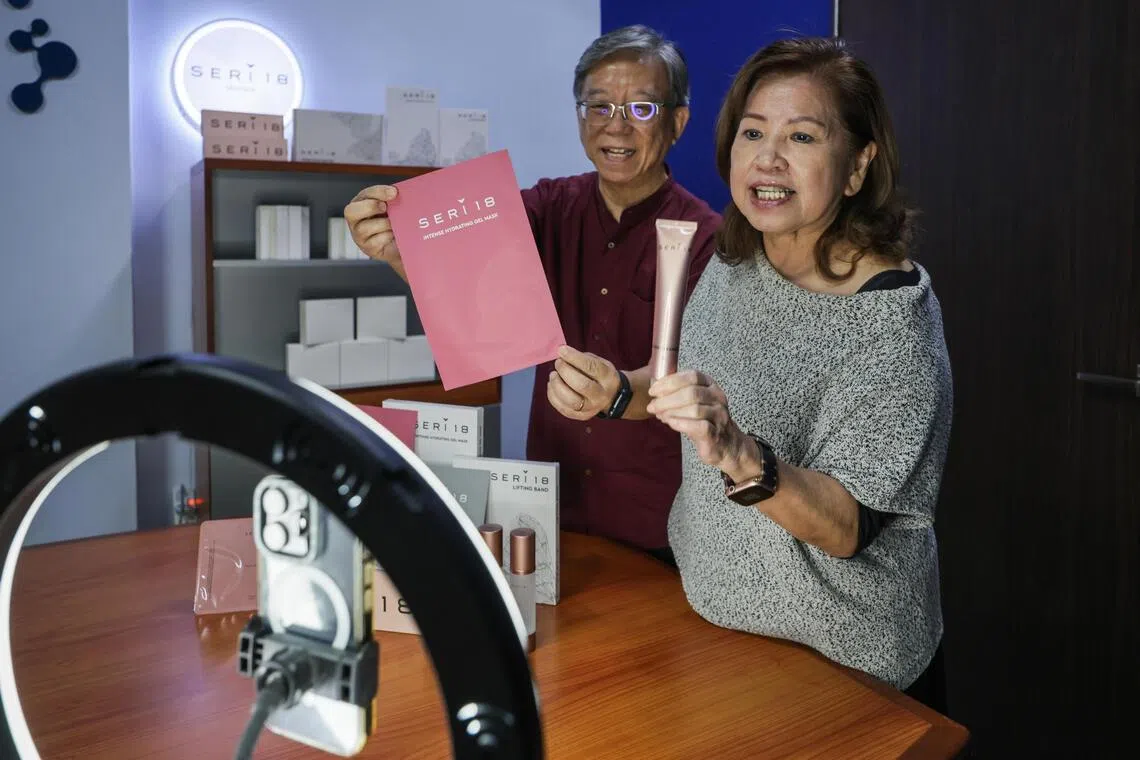
Professor James Goh and Mrs Monica Goh creating TikTok content as social media has become a key part of how they market and grow Seri18.
ST PHOTO: GIN TAY
Running a business in their 70s, they say, has changed the way they think about risk, success and what they are trying to achieve.
“When you are older, you are more stable,” says Prof Goh. “You are not so anxious, and you are not under the same pressure as younger people to make things work very quickly.”
At the same time, they recognise that age can have its own limitations – particularly when it comes to adapting to new platforms and ways of working.
“We can be quite conventional, so we need help,” Mrs Goh admits.
That is where their wider network comes in. Friends and collaborators from related fields – along with external partners – have supported them in areas such as research, product development and content production, helping them navigate a space they were initially unfamiliar with.
“We are very blessed that a lot of people have helped us along the way,” she adds.
For the couple, starting Seri18 was not about reinventing themselves, but about continuing to apply their existing knowledge in a new context.
If anything, they say, beginning later in life has made the journey clearer rather than more uncertain.
“You understand better what you are doing, and why you are doing it,” Prof Goh says.
“It’s never too late,” Mrs Goh adds. “In fact, when you are older, you should do it – because you don’t want to miss the opportunity.”
Info: For more information, go to seri18.com
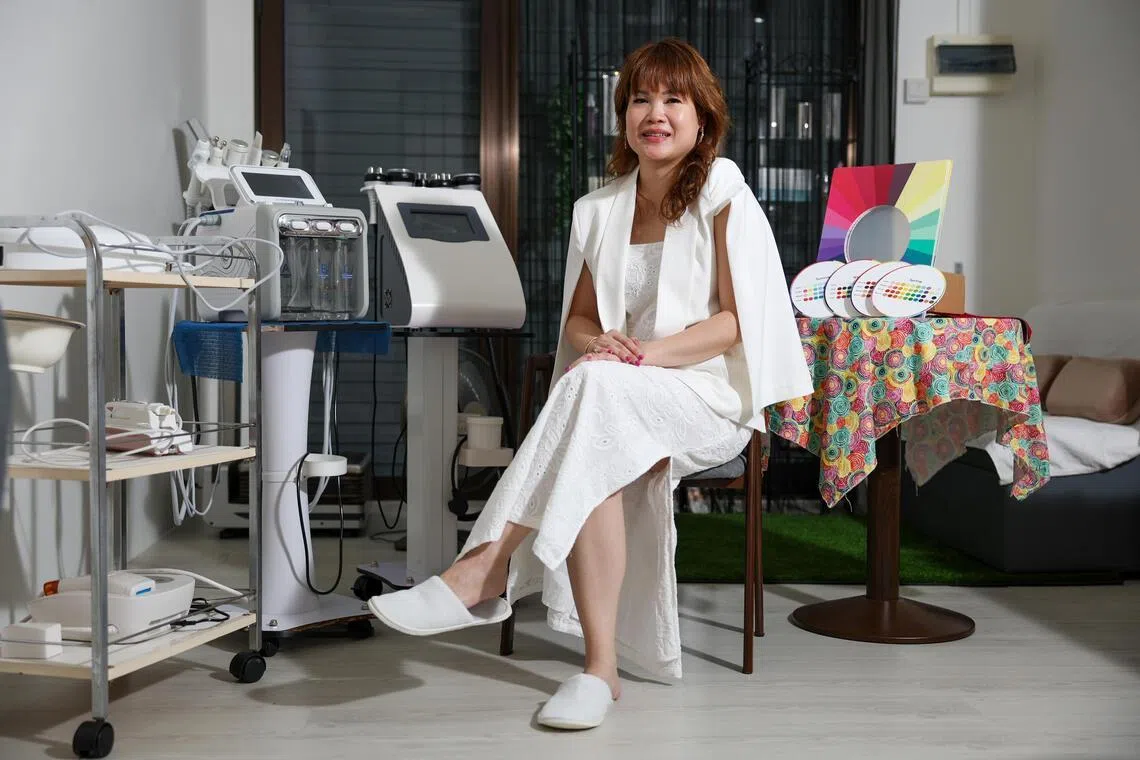
Former accountant Diana Lai left the corporate life to start Bunny Lashes, a lash studio she has since expanded to include other beauty services.
ST PHOTO: JASEL POH
Ms Diana Lai’s decision to leave the corporate world did not come from a sudden passion for the beauty industry.
The 43-year-old’s turning point came when she was juggling her career and raising two young sons, then aged four and two – a balancing act that became unsustainable. Her husband, who works in the finance sector, supported her decision to make the switch.
“I realised I was always rushing from work to childcare,” she says. “I started thinking maybe I should build something of my own instead.”
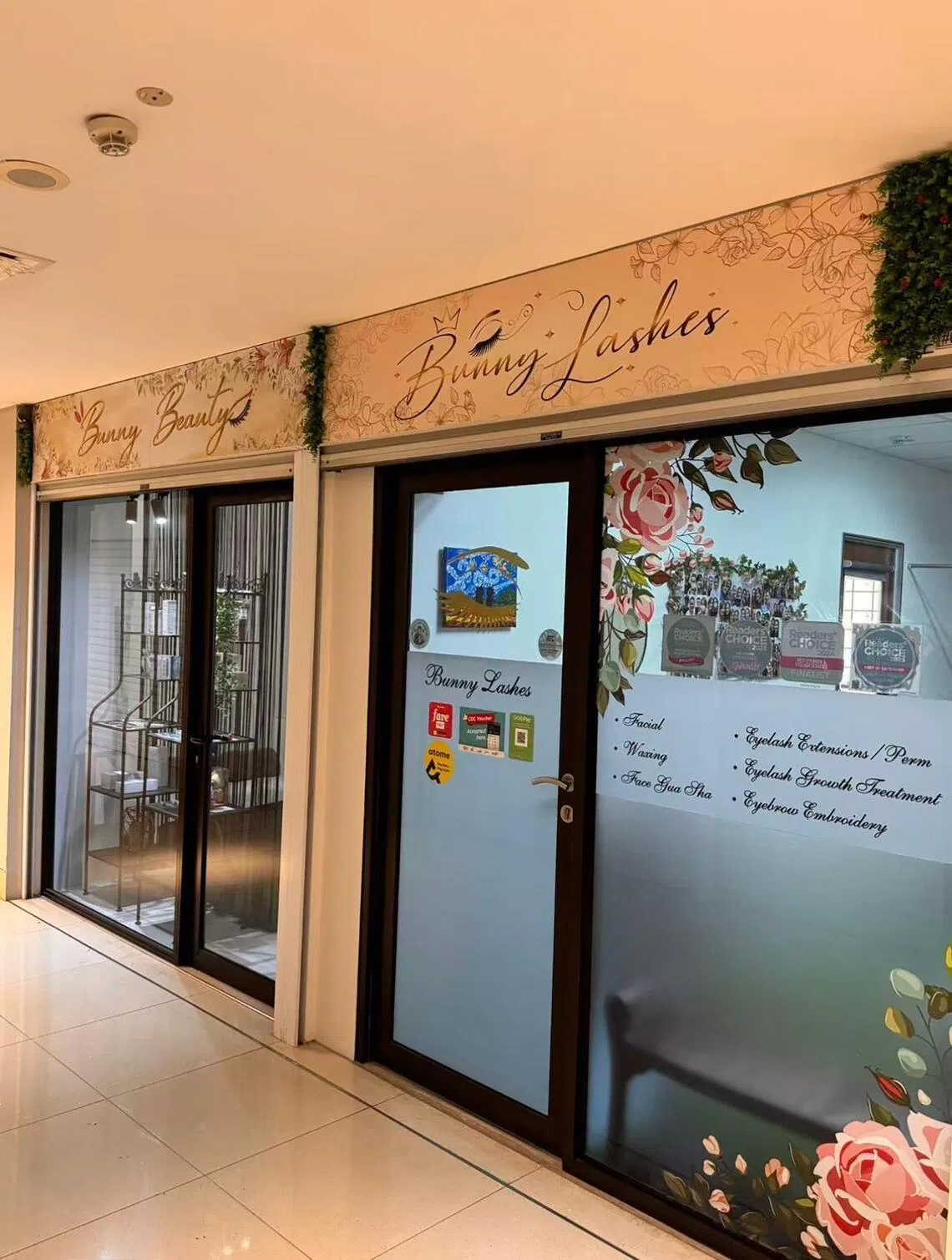
Bunny Lashes, Ms Diana Lai’s beauty studio, is in Kitchener Complex.
PHOTO: DIANA LAI
So, at 34, after more than 10 years working in finance and accounting, she enrolled in a lash extension course in 2016.
What began as a weekend side hustle has since grown into Bunny Lashes, a beauty business that occupies a more than 400 sq ft space in Kitchener Complex. The studio offers services ranging from lash lifts and facials to body treatments and colour analysis, and includes a training academy that has taught about 300 students since 2023.
At Bunny Lashes, a lash lift and tint costs about $88, while facials range from about $150 for acne, anti-ageing or sensitive skin to $188 for a BB Glow treatment. More specialised treatments such as high-intensity focused ultrasound (HIFU) and eyelash or eyebrow growth treatments are priced at about $350, while body sculpting treatments start at $180 for each targeted area.
If there is one quality that defines Ms Lai’s approach to business, it is an unwillingness to stand still.
“I try new things after hearing enough feedback from my customers,” says the founder. “If their needs evolve, then I must also evolve to meet them.”
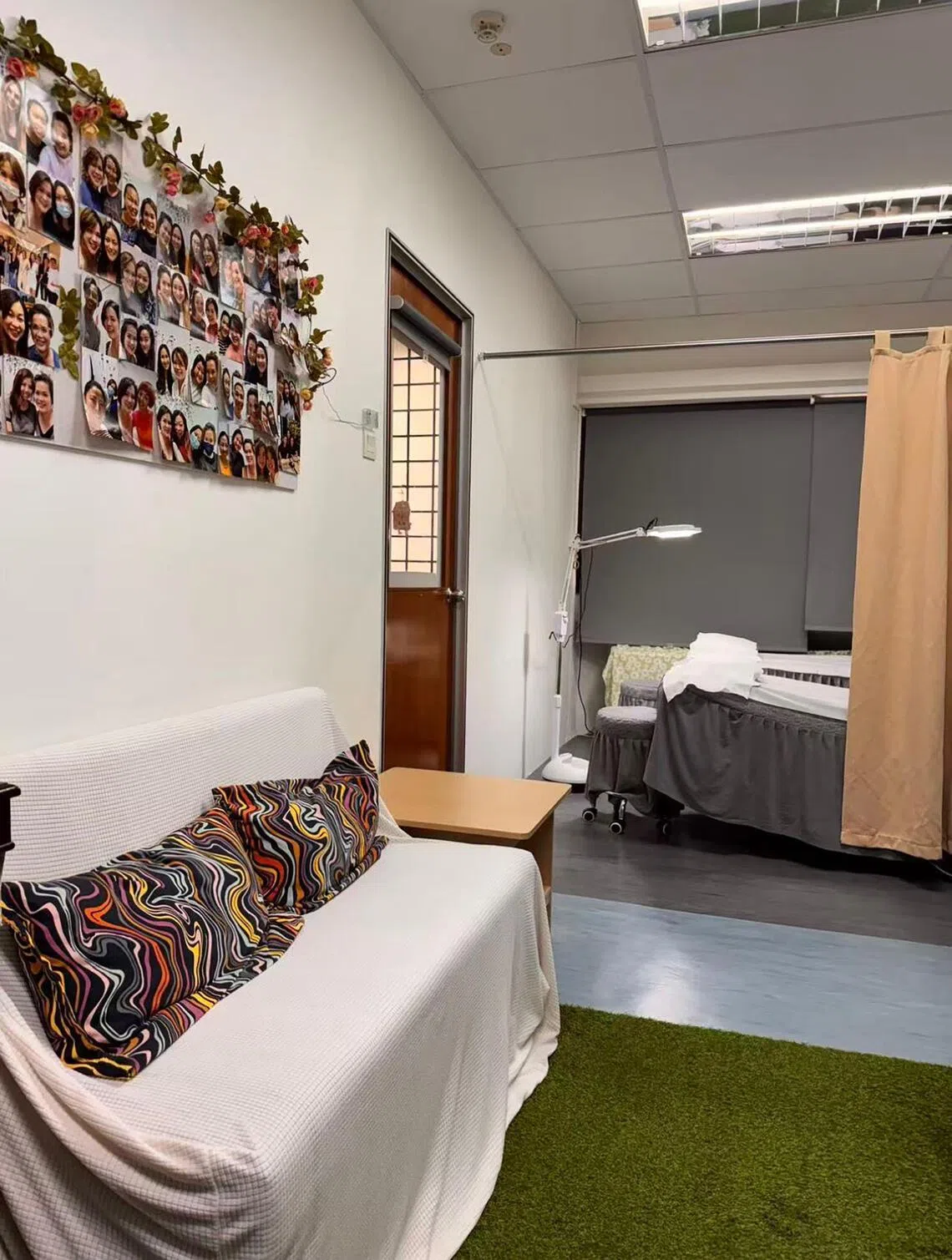
Bunny Lashes’ services include lash lifts, facials and body sculpting treatments.
PHOTO: DIANA LAI
In 2017, she began, quite simply, with lashes. The appeal was immediate: Lash extensions offered a quick transformation for clients who wanted to look polished even when they were exhausted.
When she started with $25,000 in her pocket, Ms Lai rented a small space in Lucky Plaza fitted with just a single treatment bed. In 2019, she moved to Kitchener Complex as a sub-tenant and occupied a 70 sq ft unit.
Her salon became known for its early opening hours – 8.30am on weekdays – to cater to mothers with corporate lives.
Clients could slip in before a school run, a shift at work or the start of a busy day, lie down for a treatment and leave looking more refreshed than when they arrived.
Over time, Ms Lai’s customer base grew into the group she understands best today: women in their 30s and older, including stay-home mothers, busy executives and healthcare workers finishing graveyard shifts.
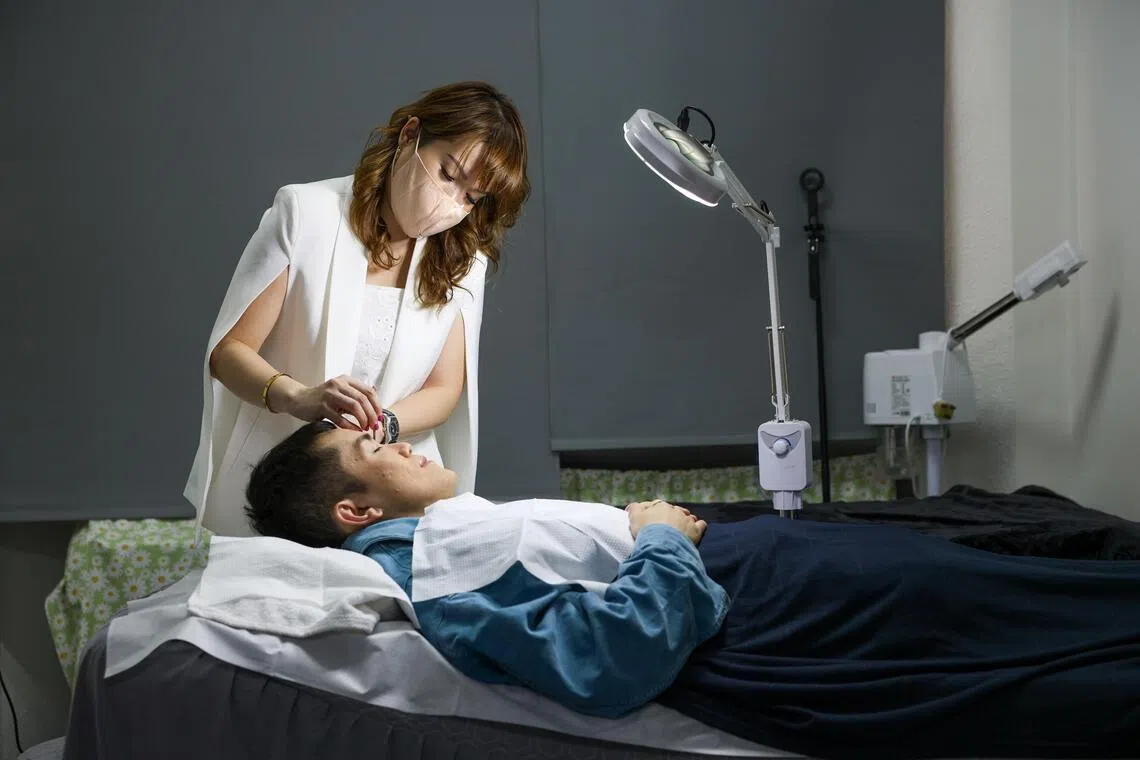
Ms Diana Lai performing a brow treatment – one of several beauty services she offers at her studio.
ST PHOTO: JASEL POH
But building the business required patience.
In the beginning, even after completing lash courses, she continued doing part-time bookkeeping, spending about six hours a week on accounting work while practising lash techniques in the evenings and taking customers on weekends at trial prices.
It took about six months of continuous practice before she felt she had truly mastered the skill.
“There are different eye shapes, different sensitivities, different expectations,” she says. “Constant practice is very important.”
She also gave herself a clear deadline.
“I told myself I would try for two years,” she says. “If the business couldn’t sustain itself, then I would go back to corporate life.”
But when the Covid-19 pandemic hit, like many salons, Bunny Lashes was forced to pause in-person services. For a moment, it seemed as though the timeline she had carefully planned might collapse.
Instead, Ms Lai treated the disruption as a prompt to experiment again.
Rather than wait for restrictions to lift, she moved online. During the pandemic, she began creating digital content about lash care and skincare, educating customers from home while looking for a product that could supplement services people could no longer come in for.
With the help of a fellow entrepreneur, she began developing a lash and brow growth serum, marketing it through Facebook Live and regular online updates showing her own results.
The serum took off.
She estimates that 500 bottles were sold, attracting distributors from Malaysia and the Philippines. The product went on to win recognition from Singapore beauty and lifestyle publications such as Daily Vanity, Expat Living and Beauty Insider – accolades that helped build credibility for her brand.
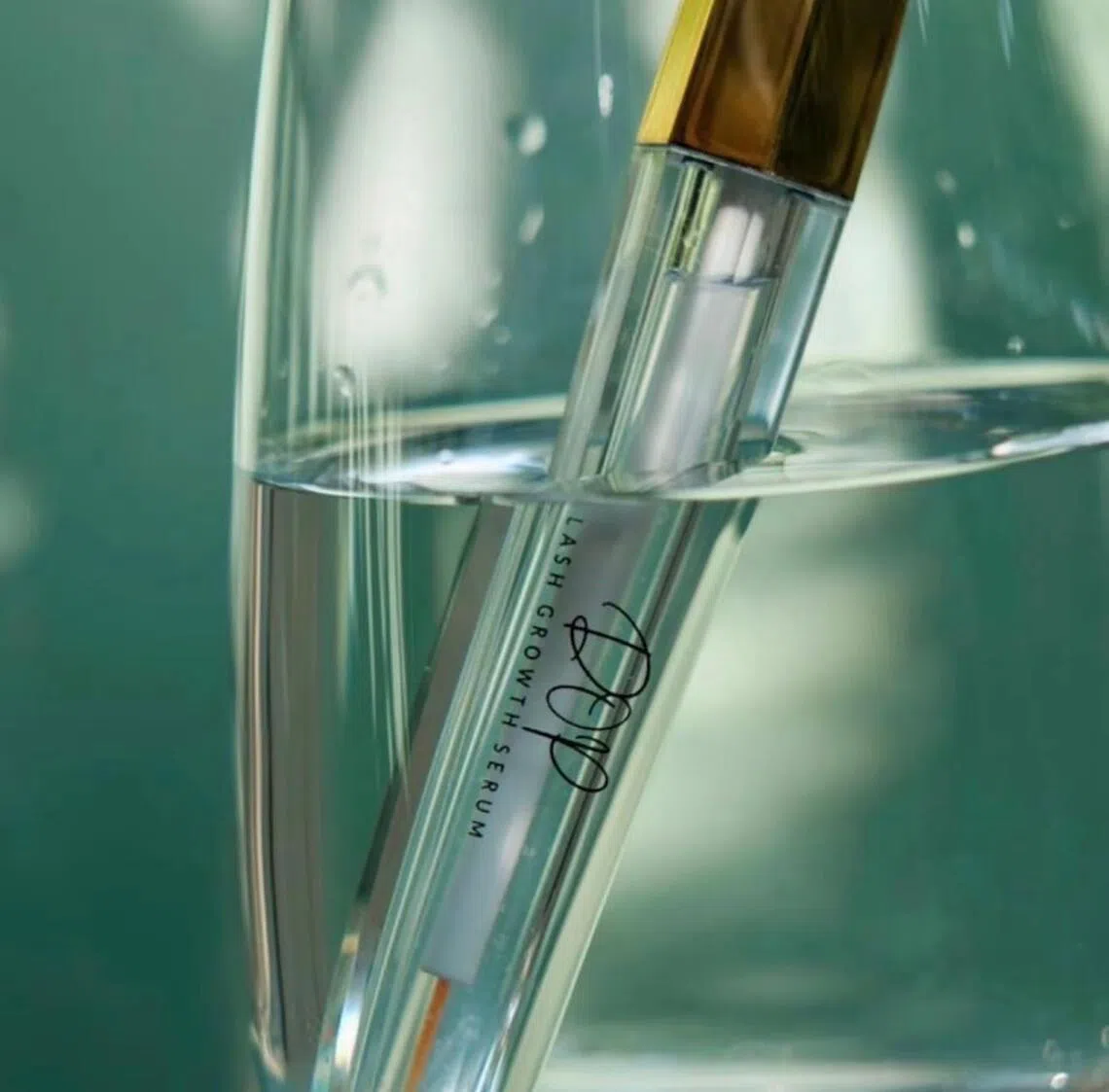
The award-winning D.O.P lash and brow growth serum.
PHOTO: BUNNY LASHES
After restrictions were lifted, Ms Lai’s online visibility and product sales helped introduce new customers to Bunny Lashes’ services – many of whom later booked treatments at the studio.
This experience sharpened her understanding of what social media could do for a small beauty business.
Today, she describes it as “a very big part” of Bunny Lashes’ marketing. On Instagram and TikTok, she posts treatment explainers, behind-the-scenes clips and content responding directly to questions from customers in her DMs.
What began as a lash business gradually widened after clients told her that one service was not enough.
She responded by earning a diploma in beauty therapy from the Confederation of International Beauty Therapy And Cosmetology in 2019. She has since continued upgrading her skills in treatments such as gua sha and bo jin – a traditional Chinese meridian therapy – through various institutions, most recently at Toni International College.
She later expanded into facial and body treatments, and in 2025, introduced colour analysis – which she learnt during a trip to South Korea after seeing how widely used the service was there.
Over time, Bunny Lashes has become, in her words, “an academy, a community and also a studio”.
It now generates a six-figure annual revenue and is run by Ms Lai and two part-time staff. While she declined to compare her earnings directly with that of her previous salary, she says the rewards of running her own business go beyond financial stability.
“In corporate life, you have a guaranteed pay cheque,” she says. “But when customers come back because they trust your work, that feeling is very different.”
And if there is one lesson Ms Lai has taken from the past decade, it is that progress often comes from being open to change.
“If you stay fixed on one thing, the business cannot grow. You have to keep evolving.”
Info: 02-06 Kitchener Complex, Block 808 French Road; 8.30am to 6.30pm (weekdays) and 10.30am to 6.30pm (Saturdays). For more information, go to @bunlash on Instagram
