
7 big challenges for the next CDC director
Public health experts watching the leadership void at the Centers for Disease Control and Prevention have been predicting for a while that finding someone to head the agency would be a Herculean task.
In the first 15 months of the second Trump administration, the agency has had a Senate-confirmed director for a mere four weeks — Susan Monarez, who was fired last August in a clash over vaccination policy with health secretary Robert F. Kennedy Jr.
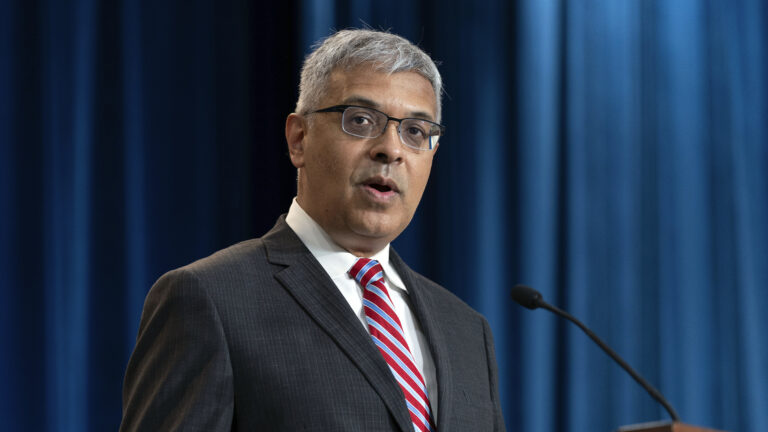
The administration had signaled it hoped to put forward a new nominee last week, but that didn’t happen. The director of the National Institutes of Health, Jay Bhattacharya, is now running his own nearly $49 billion operation and serving as part-time head of the CDC, hundreds of miles away.
If and when a new CDC director nominee is named, and if that individual manages to win confirmation from a Senate that is showing itself increasingly willing to dig in its heels on presidential appointments, the hard work will just be starting.
Whoever takes over the Atlanta-based CDC will face immediate and enormous challenges. Here are a few:
Winning over an angry, distrusting staff
There was a key moment in an all-hands meeting Bhattacharya called last week. Agency staff crowded a meeting room on the Roybal campus at the CDC headquarters in Atlanta; others watched online from their offices.
Following Bhattacharya’s opening remarks, the Q&A included this pointed question: “There’s been a lot of conversation about rebuilding the public trust in us, but I would like to know what you’re planning to do to rebuild our trust in all of you?” one woman asked, to loud cheers and thunderous applause.
Bhattacharya’s reply focused on the need to “de-escalate disagreement.”
Trust has been lost for numerous reasons, staffers say. Many are deeply resentful, among other things, that President Trump never mentioned a gunman’s attack on the CDC campus, while Kennedy’s first public comments were slow in coming. (He commented the day after the attack, and then only after posting pictures of himself salmon fishing in Alaska on social media.)
The attack was traumatizing, and the windows cracked by the barrage of bullets the gunman leveled at the agency have still not been replaced.
Fiona Havers was a medical epidemiologist in the CDC’s coronavirus division who quit last year because she didn’t want to be associated with the vaccine policies Kennedy was implementing, which staff believe will undermine public health. Kennedy’s key role in selecting the new CDC leader will make that individual instantly suspect to agency staff, she said.
“The very fact that they’re appointed by this administration is going to be a credibility issue for them,” said Havers, who is now an adjunct associate professor of infectious diseases at Emory University.
Abby Tighe, a former CDC employee who was fired in February 2025 in the first round of job cuts to hit the agency, agreed.
“The biggest challenge any director at this point has and that even the acting director has is there’s no trust between the workers at CDC and leadership. And so they need to make the case for why anybody should trust them, both [workers] at the CDC and the American people,” said Tighe, who is one of the founders of what’s now known as the National Public Health Coalition. (It was previously known as Fired But Fighting.)
Taking a stand on vaccines, or not
The administration’s political polling suggests the public largely supports vaccines, and does not approve of Kennedy’s efforts to undermine long-held vaccination policies. Kennedy has reportedly been told to focus on other health issues in the lead-up to November’s midterm elections.
But given Kennedy’s role in selecting the next CDC director — and the reason why he fired Monarez — a new director is going to have to make clear to staff quickly where he or she stands on vaccines. And there’s only one answer that will work here.
“The only point of reference staff have at this point under this administration is what happened with Dr. Monarez. And that’s that she stood up for vaccine integrity and she was fired,” Tighe said.
The administration has insisted Kennedy is not opposed to vaccines, though when he has shown some level of support it has generally been qualified in some way. There is clearly awareness of that inside the CDC. During his meeting with staff last week, Bhattacharya said that “it is vital that every kid in this country get the measles vaccine,” before adding: “Bobby’s fine with me saying that.”
Convincing staff he or she is actually calling the shots
For decades, the only political appointee at the CDC was the director. It used to be that even directors could weather changes in Washington, though in the past quarter-century or so, a new administration has typically led to a new CDC head. Even still, these were never political people. CDC directors haven’t historically spoken to the Conservative Political Action Conference (CPAC). (Though Bhattacharya did.)
But this administration has been stacking the CDC — specifically the Office of the Director — with political appointees, around 18 or so at this point. Most have no medical credentials or public health experience. Many worked for Republican campaigns or were previously unsuccessful Republican political candidates. Among the appointees is Sam Beyda, a recent university graduate who previously worked for Elon Musk’s U.S. DOGE Service and who appears to be playing an outsized role in running the CDC.
In most cases, their roles are undefined, though a number are clearly there to deliver on Kennedy’s efforts to rewrite vaccination policy in ways that downplay the importance of and sow distrust in these key public health tools.
In an oral history of what has happened to the CDC in The New York Times, former chief medical officer Debra Houry noted that Monarez was told she could not make major decisions without first running them by her chief of staff — who she had not selected — or Department of Health and Human Services legal counsel.
“Certainly if the CDC director has to have staffing and policy decisions signed off on by an aviation attorney … or 24-year-old Sam or somebody else now, that will really hamper a CDC director. Then you could put anybody there,” Houry, who quit in protest of Monarez’s firing, told STAT.
The size of the contingent of political appointees and the autonomy — at least from the CDC — with which it functions sends staff a clear message, said Daniel Jernigan, former director of the National Center for Emerging and Zoonotic Infectious Diseases, who resigned with Houry.
“It demonstrates that the secretary is the one that’s been calling all the shots, and it doesn’t really matter who the director will be,” he said.
Repairing the agency’s tattered credibility
The CDC has long been the world’s pre-eminent public health agency. Agencies around the globe have been modeled after it; many use the acronym CDC in their names, even if the letters don’t have the same meaning in the local language.
The agency’s website used to be a repository of public health information and science. Now it is a resource that even former staffers say should be approached with caution, understanding that while some pages remain valid, others have been rewritten. Many of these updates have been driven not by new research findings but rather by Kennedy’s mistrust of vaccines; in other cases, the administration has sought to scrub all references to health equity and transgender people from government websites, or has opted to revert to using the term monkeypox for a disease the rest of the world now calls mpox.
Richard Besser, CEO of the Robert Wood Johnson Foundation, spent years at the CDC, even serving as acting director at the start of the H1N1 flu pandemic in 2009. He no longer recommends that people consult the CDC’s website.
“It only works as a site if the public can trust that every single page is the most relevant, evidence-based information that there is. And that’s no longer the case,” Besser said.
Kennedy’s multiple attempts to revise vaccine recommendations have prompted public health experts to advise people to use the websites of professional societies such as the American Academy of Pediatrics or the American College of Obstetricians and Gynecologists if they want to see which vaccines should be administered and when.
Houry noted that a number of state health departments have unlinked their websites from the CDC’s.
Reestablishing public trust in the agency will be crucial, but it will not be easily achieved.
Getting back to the job of combatting chronic diseases
Over the past year the CDC has been subjected to several waves of job cuts. Chronic disease programs, in particular, have been savaged, whether those programs have been focused on oral health or tobacco control, to name a few. The administration argued the CDC had become too large and sprawling, responsible for too many issues that were far afield from its original mission of infectious diseases control — even though it had been tasked with each of those additional functions by Congress.
Kennedy announced a plan to move many of CDC’s chronic disease efforts into a new agency, which he proposed to call the Administration for a Healthy America. AHA is but an aspiration at this point, however.
Meanwhile, many CDC chronic disease programs remain fully funded by Congress, but are not functioning because they have no staff, said Tighe, who used to work in overdose prevention.
“There are people who have been totally fired and those programs are still funded. And there are people who have been on administrative leave for over a year who could go back and do their jobs, but are not able to,” she said.
Restore sightlines on what’s happening globally
Infectious diseases don’t give a hoot about borders — a lesson the world should have learned by now, after the massive West African Ebola outbreak in 2014-2016 or the Covid pandemic, or the global spread of mpox.
Knowing what’s happening elsewhere — learning about problems as they emerge, before they become catastrophes — is a key job for a national public health agency, especially for the CDC. Historically this has been the agency that has puzzled out the causes of new diseases. Other countries often seek its guidance and send it samples for validation of what their own laboratories think they are seeing. Or they used to.
But the Trump administration has withdrawn the United States from the World Health Organization, severing a multitude of scientific links in the process. It destroyed the U.S. Agency for International Development, which helped many countries run their own disease control programs but also gave the U.S. sightlines on what was happening in far corners of the earth.
The administration has said bilateral agreements with other countries could serve as the foundation for key information-sharing.
But Havers, Houry, and Jernigan, among others, are very worried that the U.S. withdrawal from the WHO and from international aid is limiting the country’s capacity to keep on top of disease threats. “I think that’s a huge concern,” said Havers, who spent substantial time in China during the start of the H7N9 bird flu outbreak. “There’s always a threat of novel pathogens emerging, and with the withdrawal from the WHO, I think CDC has reduced visibility in that space.”
Stopping the hemorrhaging of talent
The agency was traditionally the type of place where people who cared about public health would go and work for years, often the entirety of their careers.
But an estimated 20% of CDC staff have lost their jobs in the past year. Many of the centers and major programs are being run by interim heads. “Twenty-one of 25 centers, institutes, and offices lost their leaders since President Trump took office. That is gross instability,” Houry said.
Since being named interim leader at CDC, Bhattacharya has filled a few of those positions and issued job postings for a few more. He told staff at the all-hands meeting he knew of no plans to make further cuts at the agency, but pledged to oppose the idea if it is raised.
Jernigan said the next CDC director will have to figure out how to staunch the bleeding.
“If you talk with the staff, they’re all looking,” he said. “So the best thing that the incoming director can do is to give the staff something to stay for.”
