Hurricane Trump threatens to blow China off course
IF CHINA’S RULING elites could decide the duration of President Donald Trump’s war on Iran, two months would be a popular choice. A short war would not hurt America enough, is the icy verdict of a policy adviser in Beijing. His calculus reflects a consensus in national-security circles: that Mr Trump’s Middle Eastern campaign is at once a daunting display of firepower and a historic act of self-harm. Against that, experts agree, a longer conflict would damage China too much. As the biggest importer of energy and largest exporter of goods, China would suffer if high oil and gas prices or closed shipping routes were to trigger a global recession.
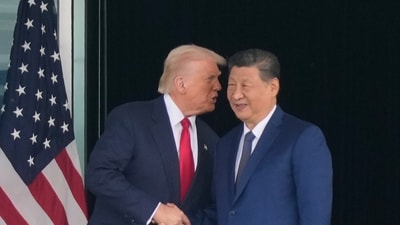
President Donald Trump and Chinese President Xi Jinping shake hands after their US-China summit meeting at Gimhae International Airport in Busan, South Korea on October 30, 2025. (AP)
Those same elites concur on one more point: probably, China will do little to shape how or when the Iran war actually ends. If that stance sounds oddly passive, given all that the country has at stake, this columnist can only agree. The Telegram just spent 12 days in Beijing and Shanghai, meeting serving and retired officials and military officers, government advisers, scholars of America and of the Middle East, and foreign-policy commentators with millions of followers on social media. When such experts discuss America’s president and his growing appetite for risk and disruption, they often sound strangely fatalistic, like sailors discussing a dangerous but unavoidable storm.
Mr Trump’s demands that China help him open the Strait of Hormuz, given that Chinese ships are heavy users of that passage, provoke scorn. China will not be an accomplice to a war it condemns, says a scholar. For good measure, an insider recalls a high-level policy debate in Beijing, a decade ago, after America asked China to do more to protect high-risk global energy routes. The country’s response was to enlarge its domestic oil-storage capacity, so that it now has reserves lasting many months. That is how China thinks, the insider proudly concludes. The tale offers a neat example of how senior Chinese talk to foreigners behind closed doors. Rather than hide China’s self-interested worldview, they embrace their country’s opportunistic ways and unblushing materialism. In a cynical world, it is implied, China can be relied on precisely because it is all about business. Explicit contrasts are drawn with America. That superpower is called an unpredictable bully that once invaded countries in democracy’s name but now—in Mr Trump’s second presidency—bombs them to take their oil.
Chinese analysts express puzzlement over Trumpian moves that seem to lack logic. One cites Mr Trump’s apparent tolerance when Israel killed Ali Larijani, a relative pragmatist in Iran’s leadership, even as he loudly declares his interest in finding an Iranian negotiating partner. Rather often, Chinese analysts solve such puzzles by blaming Israel. They accuse its prime minister, Binyamin Netanyahu, of plotting to reduce Iran to a state of helpless anarchy. There is much talk of Mr Netanyahu tricking Mr Trump into doing his bidding, with the help of a Jewish lobby in America.
In official responses to the Iran conflict, China chides America and Israel for flouting the UN Charter and international law. It has also jointly issued a boilerplate call for peace with Pakistan. The country’s tightly controlled news outlets emphasise the war’s human toll. Many ordinary Chinese are indignant. On a brief side-trip to the sleepy eastern city of Qufu, the temple-filled birthplace of Confucius, locals demanded to know whether this columnist is American. A man showed smartphone videos of bombs falling on Iran, and asked why the poorest and humblest are always the first victims of the “warmonger Trump”. Though Chinese outlets censored news of Iranian protesters being murdered by security forces in January, anger towards America and Israel is unfeigned.
Chinese elites draw different lessons from raids on Venezuela and Iran. They express alarm at the sight of American forces using advanced AI tools for targeting and for high-tech command and control. Comparisons are drawn to China’s shock as American precision weapons destroyed Iraq’s armies in the first Gulf war. Some fear that China may need years to catch up.
Very probably, the Iran war will leave Arab monarchies more reliant on America for security, it is said in Beijing. China’s best hope is to offer the Middle East opportunities to rebuild or modernise war-battered countries. Globally, China expects soaring demand for its greentech, as countries diversify away from oil.
The end of Chinese freeriding on America
Well-connected Chinese scoff at the notion that Mr Trump’s campaigns in Venezuela and Iran reveal a grand strategy to contain their country. For one thing, China focuses on countries’ abiding interests, not the regimes that hold power, they say. China has quite good relations with Delcy Rodríguez, the pliant Venezuelan leader who took power thanks to Mr Trump, adds an analyst: and when Venezuelan oil exports resume, China will be one of its best markets. For another, China has chokeholds to use in retaliation, including its control of rare-earth minerals. If America breaks the rare-earth vice, China has other dependencies in reserve. That intimidates Mr Trump, who is already seen in Chinese policy circles as usefully uninterested in ideological contests, and mostly interested in deals that suit his own interests. In a sign of the cynical mood in Beijing and Shanghai, a veteran America-watcher suggests a new worry for China: that an Iranian debacle will so weaken Mr Trump that China hawks in his administration and Congress will regain the influence they enjoyed in his first presidency.
Some Chinese analysis tips into smugness. It accuses Mr Trump of destroying his presidency (and the American-led international order) in Iran. This chaos is a vindication of China’s efforts to be self-reliant in key technologies. Shrewder voices note how China profits from globalisation, open sea lanes and other goods that America used happily to defend. China is unready for a world without rules. Riding out the storm will not be enough.