
India commissions 3rd nuclear submarine ‘Aridaman’, boosts second
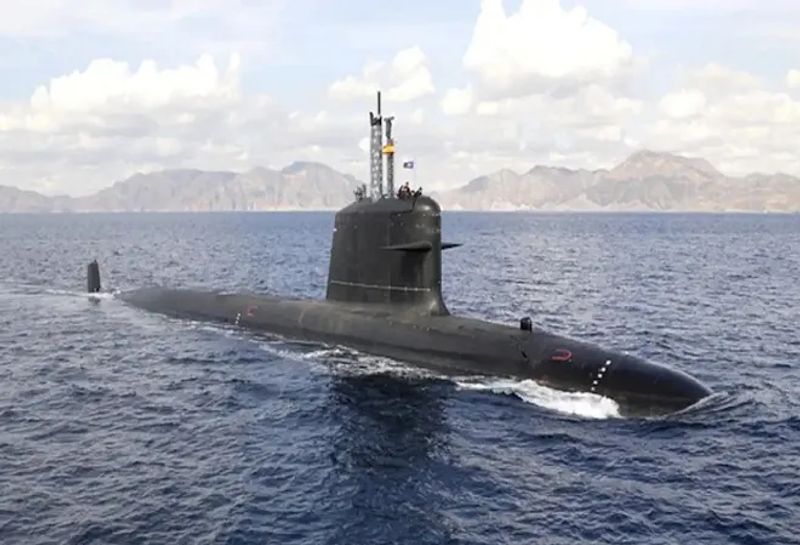
India is set to commission, on Friday, it’s third indigenous nuclear powered and ballistic missile carrying submarine, named ‘Aridaman’.
In Naval parlance such submarines are called ‘ship submersible ballistic nuclear’ (SSNB). India has already inducted two such submarines named INS Arihant and INS Arighaat, commissioned in 2016 and 2024, respectively. And the series is known as the Arihant class.
The ‘Aridaman’ is set to join the fleet today, sources confirmed.
Earlier on Friday morning the Defence Minister Rajnath Singh, who is in Vishakhapatnam for the commissioning of warship Taragiri, posted a one liner in Hindi language on social media platform X which when translated in English means: ‘It’s not a word, It’s a power — ‘Aridaman”.
Sources said the nuclear submarine is to be commissioned alongside the warship Taragiri. Since nuclear subs remain hidden, there is not expected to be a public ceremony like the one to be conducted for the Taragiri.
The Aridaman and its sister subs – INS Arihant and INS Arighat –are nuclear powered submarines and can remain submerged under water for weeks. India’s nuclear doctrine rules out a ‘first strike’, however, to carry out a retaliatory strike, an SSBN, submerged under water is considered the best option to strike.
It is expected to carry 750-km range K-15 and also a K-4 intermediate range (some 3500 kms) ballistic missiles- both can also carry a nuclear warhead.
The three submarines are part of under India’s secretive Advanced Technology Vessel (ATV) project and form a critical component of India’s nuclear triad – the ability to fire a nuclear weapon from air, land and sea.
The Aridaman – being longer in length than its sister vessels– has eight launch tubes instead of four, thus doubling of the vertical launch system (VLS) capacity to fire missiles.
The submarine’s hull has been fabricated by L&T and built at Visakhapatnam. The Arihant-class submarines are powered by an indigenous 83 MW pressurized light-water reactor (CLWR) developed by the Bhabha Atomic Research Centre (BARC).
The boat features improved sonar suites and indigenous communication systems, alongside more refined hydrodynamics to reduce its acoustic signature (noise level), making it harder to detect during deep-sea patrols.
India is part of a tiny group of nations that builds and sails these complex underwater nuclear weapons platforms. The others are the US, UK, Russia, France and China.
Separate from the SSBN, India is also looking to secure a nuclear-powered attack submarine from Russia. This is nuclear powered but does not carry nuclear missiles. Sources said it is expected to be arriving in India by 2027.
