
Will AI destroy jobs? Here are the questions no one is asking
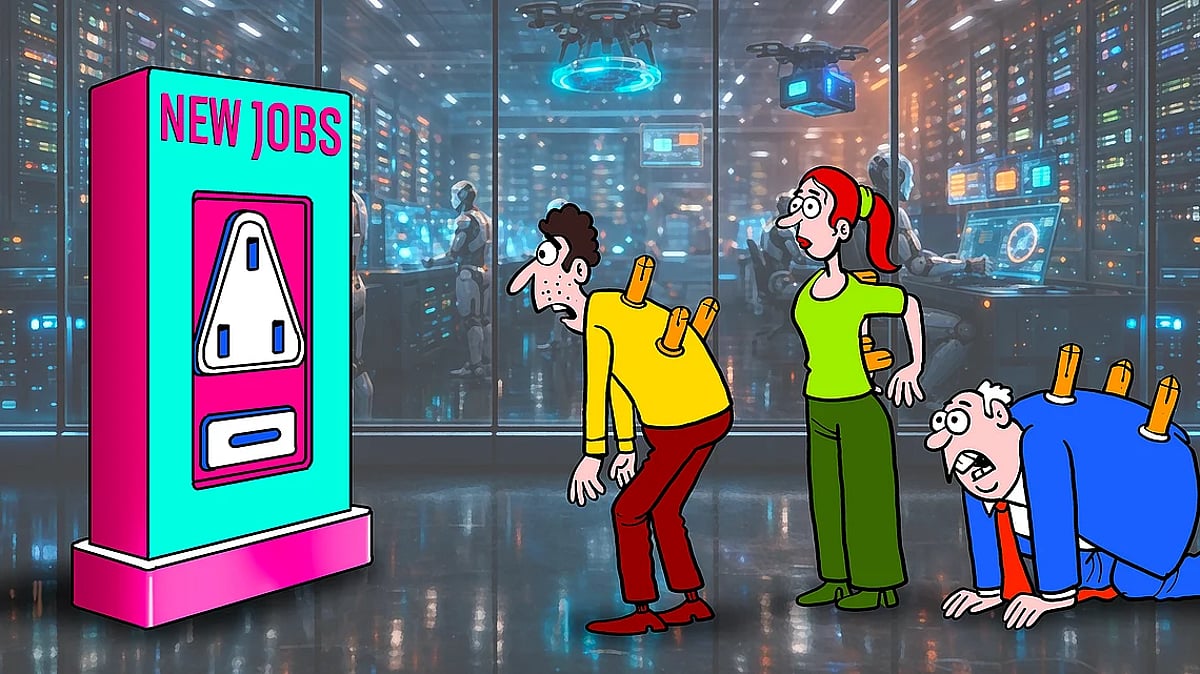
Given all this, it is worth asking whether workers around the world might eventually protest as AI begins to replace human labour – much as they did during the early years of the Industrial Revolution.
In 1811, a group of disgruntled textile workers in the United Kingdom, secretly organised and wrote to factory owners using the name “Ned Ludd,” a possibly mythical figure. In their letters, they warned that they would destroy mechanical knitting machines if their use continued. Their message resonated widely, and thousands of workers rallied behind the cause.
In 1811 and 1812, bands of textile workers began smashing machines that they believed threatened their livelihoods. These protesters came to be known as the Luddites.
As Banerjee and Duflo write: “Luddites destroyed machines to protest mechanization of weaving, which was threatening their livelihoods as skilled artisans. The term Luddite is now mostly used pejoratively to describe someone who blindly refuses progress.”
Now, will the rise of the AI lead to new Ned Ludds cropping up across different parts of the world?
Further, when the entry-level rungs of the career ladder are sawed off, do we really expect the youth to quietly “reskill” for jobs that haven’t been invented yet? Or will they simply lose faith in a system that views their first five years of professional growth as a “redundant cost”? Will they then become fodder for populist politicians as those in the western world who have lost out because of globalisation?
Will governments get involved in deciding the direction that AI takes? Or will they let companies keep taking AI where-ever they want to? At least that’s what the current evidence suggests, given that the biggest technology companies have been allowed to become monopolies in their respective areas.
Will the governments in the western world overlook the social and economic impacts of AI? Will governments allow “an unbalanced technology portfolio prioritizing automation and ignoring the creation of new tasks for workers” to continue? Will technology companies become feudalists?
Will we continue to let those who benefit most from the success of AI to set the agenda around it? Or as Susskind writes: “We need to rise above the homespun philosophizing that is popular in the tech community. Platitude is not principle.” But is that going to happen?
Indeed, as Adam Becker writes in More Everything Forever – AI Overlords, Space Empires, and Silicon Valley’s Crusade to Control the Fate of Humanity: “Setting the terms of such conversations about the future carries power in the present. If we don’t want tech billionaires setting those terms, we need to understand their ideas about the future.” Is that happening or will we continue to be mesmerised by tech billionaires and their agenda? Will they be the ones who decide if AI is working for the benefit of the people? Will they be the ones deciding on the morality of their creations?
If jobs are destroyed, and if enough new jobs are not created parallelly, what happens to consumption in the economy, especially in rich countries, which are largely consumption societies now? What happens to economic growth?
What happens to the psychological benefits of working? What about jobs giving a sense of purpose to the lived life?
What happens to taxes that governments collect? How does a state fund a welfare system when its primary tax-paying demographic is being replaced by lines of code?
Will inequality throughout the world increase as the two-tier society spreads further? If AI fails to lift all boats can we “take the broad acceptance of technological change for granted”?
Will, as Christopher Summerfield writes in These Strange New Minds “people whose jobs are automated… be left depending on the largesse of the state?”
These are important questions that aren’t really being asked, given that we seem to live in a world carried away by the hype around AI built up by tech bros.
So, where does all this leave us?
AI is often presented as an unstoppable force that will quickly transform the world of work. But the history of technology suggests a far more complicated reality. New technologies are usually surrounded by enormous hype in their early years. Nonetheless, adoption turns out to be slower and more uneven than the early predictions suggest.
This has been true of every technological revolution before this one – from the steam engine and railways to personal computers and the internet. Each of them eventually reshaped the economy, but the process took a while.
Indeed, AI is likely to follow a similar path. In the short run, its impact may be more gradual than the grand claims suggest. But over a longer period, its effects could turn out to be quite profound.
History offers a warning that we are not ready to hear. The early decades of the Industrial Revolution were marked by falling wages, longer working hours and severe hardship for most workers.
Prosperity arrived much later, and only after governments, institutions and businesses adjusted to the new economic reality – and only after a healthy fear of Karl Marx persuaded them that sharing the gains was preferable to revolution. Today, we have no equivalent fear.
The experience of the last few decades tells a similar story. Automation, computers and the internet dramatically improved productivity, but the gains were not evenly distributed. Routine middle-income jobs have been disappearing. High-skilled workers benefited disproportionately. Wages for many others stagnated. The result has been rising inequality and growing anxiety. AI could amplify all of these trends – and it is arriving at precisely the moment when the model of shared prosperity has already broken down.
Schumpeter was honest about what this means. Creative destruction, he wrote, requires the unemployed of today to “completely forget his personal fate”. In today’s mahaul, that forgetting is outsourced to a LinkedIn post about embracing change and a six-week online course in prompt engineering.
The questions that actually matter – what happens to consumption if the middle class continues to shrink, or what happens to tax revenues if white-collar work continues to be automated, or how a government can fund a welfare state if its primary taxpaying demographic gets replaced by lines of code – are nowhere on the agenda.
These questions are not being asked at the AI summits. They are not in the keynote speeches. They are not in the consultant reports. That is why the real debate about AI should not only be about technological possibilities. It should also be about who gains, who loses and how societies choose to manage the transition.
Some jobs will disappear, others will change, and new roles may eventually emerge. But there is no guarantee that the transition will be smooth or that the benefits will be widely shared.
As Morrissey sings: All make-up is a lie. When the make-up eventually comes off AI, we will discover that the future was not evenly distributed and that much of the hype may turn out to be just that. Nonetheless, as Emily M. Bender and Alex Hanna write in The AI Con – How to Fight Big Tech’s Hype and Create the Future We Want write: “Unfortunately, the perniciousness of hype is that it doesn’t need to be true to have huge impacts.”
At the end of the decades, we might live and we might just learn.
Vivek Kaul is an economic commentator and a writer.
This article has been republished from Newslaundry. You can read the original article here.
