
The Trump administration tried to influence an election in Hungary. It backfired
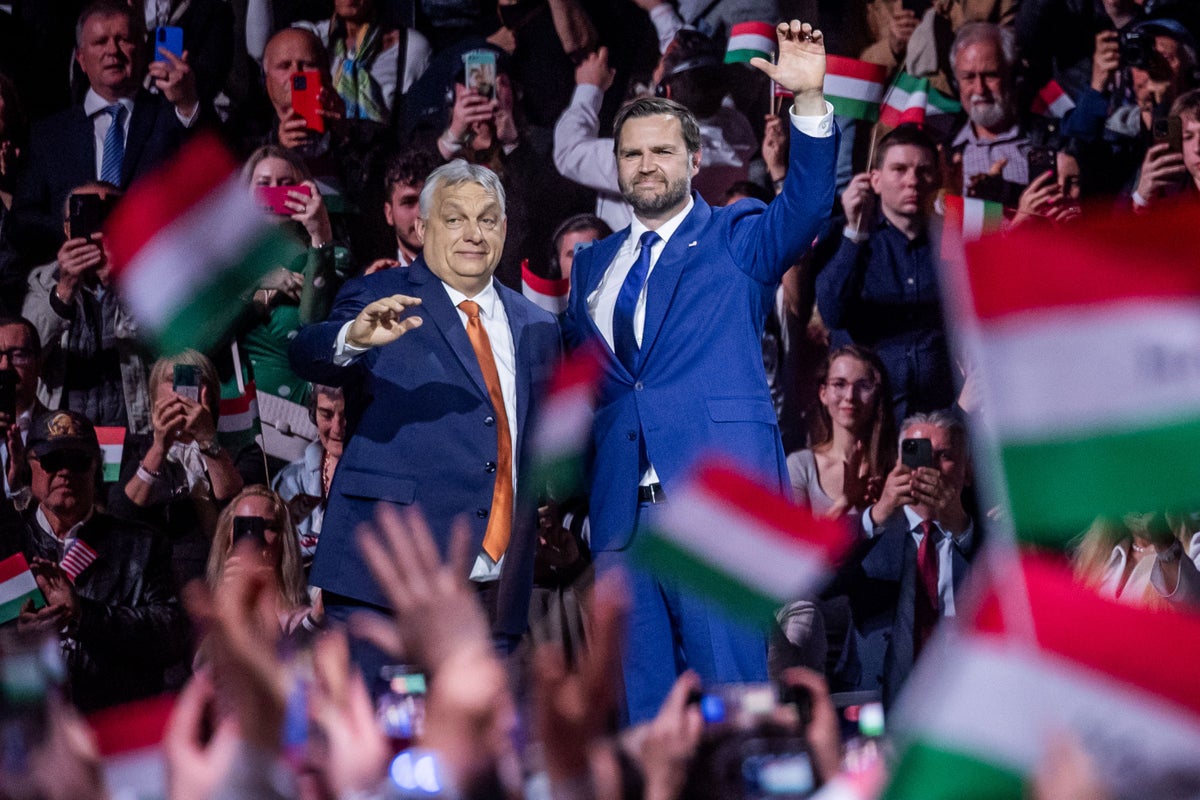
It began on a mild day in April, five days before the election. JD Vance stood onstage in a blue suit, American flag on his lapel, and asked a gathered audience in Budapest whether they would “stand against the bureaucrats in Brussels,” “stand for western civilization,” and “stand for freedom, truth and the God of our fathers.”
He put his arm around Viktor Orban, the man who had already been in power for over 16 years in Hungary, and then encouraged everyone to go to the polls and vote for him. Go to the polls they did — and voted against Vance’s man in staggering numbers.
Orban and his far-right party, Fidesz, lost in an unprecedented landslide. The autocrat who had proudly turned Hungary into an “illiberal democracy”, weakening the legal system, dismantling democratic guardrails, and running far-right scare campaigns against immigration and gender equality, had finally been ousted by the centrist Peter Magyar.
It was an embarrassing defeat. Over two-thirds of Hungarians voted against Orban, giving Magyar a “supermajority” that will allow him to undo much of his predecessor’s meddling. The fact that independent organizations had already declared Hungary’s voting system under Orban “free but not fair” — plagued with accusations of vote-buying and corruption that included giving Hungarian citizenship and voting rights to foreigners — made Magyar’s victory even more staggering.
As The Free Press put it immediately after Orban’s concession: “What kind of autocrat loses an election?” But it wasn’t just embarrassing for Orban.
JD Vance made a mockery of ‘America First’ by turning up to campaign alongside the far-right strongman. Vance surely knew that he would face accusations of meddling in another country’s elections, and of abandoning his country while gas prices soared and an unpopular war with Iran developed into a collapsing ceasefire. And even by the time the US vice president set off for Budapest, the numbers didn’t look great for Orban and his party.
Onstage at the event for supporters of Fidesz, Vance attempted to call Donald Trump. He held his phone up to the microphone and promised that the gathered audience would soon hear an encouraging live message from the president of the United States. The room fell silent. He dialed the number, the call connected — and then a robotic voice proclaimed: “I’m sorry. This number has a voicemail box that hasn’t been set up yet.”
If this was foreshadowing, it was of the most toe-curling kind.
“Well, honestly, after making a Pope die and botching Israel peace talks, wherever he goes, everything collapses. So I was really hopeful,” jokes Hanna, a Florida mother who immigrated to the U.S. from Hungary over a decade ago and spoke anonymously because of her family’s prominence in Hungarian politics.
“My sister just sent me a tweet from someone that said: ‘JD Vance deserves the Nobel Peace Prize because he alone managed to topple Orban’s authoritarian regime.’”
Bianka Stuit, who settled in Virginia in 2022 with her American husband, says, “I’m very intrigued to see how the US-Hungary relationship turns out, because I do not think it was a good move on the American administration’s part to so strongly support a candidate.
“But as for JD Vance, I mean, I am starting to believe in that curse of his where, like, whatever he touches turns to poopies.”
Lujza Nehrebeczky, a translator and ESL teacher who immigrated to the States in 2001 as a college student and now lives in Kentucky with her wife and daughter, bursts out laughing when I ask her about the Vance moment.
“I’m sorry. I’m sorry for cackling,” she says. “It’s just, so many of us thought: This is the kiss of death. It was embarrassing, frankly… It was, as the kids like to say, cringe.”
The anti-intellectual and the brain drain
Back at the Budapest rally, Vance’s call did connect with the U.S. president on the second try. Visibly relieved, he then held up his phone to the podium’s mic while Trump declared that he was a “big fan” of “Viktor,” and “with him all the way.”
He wasn’t lying. The Trump administration had an unusually close friendship with Hungary during Orban’s regime, putting the small country of around nine million people in the international spotlight for the first time in over 100 years. CPAC held five conferences in Budapest. High-profile US figures — including Tucker Carlson — visited Hungary while the Fidesz party was in power, praising Orban as a model for using state power to “curb” liberal institutions, from universities to the free press.
Orban was an expert in weakening opposition not by banning it, but by starving it of funding, access and visibility, while maintaining the formal shell of democratic legitimacy. Cities where fewer Fidesz votes were cast got less money; protesters against the government’s policies would have their names printed in right-wing magazines or written onto mysterious lists by police. A 2022 New Yorker investigation suggested that far-right American politicians were travelling to and from Hungary to learn about such tactics and asked whether the country might “offer a glimpse of our authoritarian future”.
Three days after he won the election, Peter Magyar claimed that he’d discovered Orban was giving Hungarian taxpayer money to CPAC. Describing the clandestine payments as a “crime,” Magyar added that he would stop the transfer of funds immediately. CPAC, he said, was still welcome to hold events in Budapest if it so desired — but it would not be taking money from Hungarians. Asked about Magyar’s claim by The Independent, a CPAC spokesperson said: “CPAC has never received funding from the Hungarian government… This movement is based on donations from a wide array of sources. We are thankful to our supporters and we don’t comment on who they are because lawfare also intends to close their checkbooks. That being said, any decisions on the use of government money in Hungary will have zero impact on our organization as it has never received any of these funds.”
Inside Hungary, 52-year-old Dora — who asked that I only use her first name, for fear of potential repercussions — says by phone, “People are very excited.” Young people have been openly celebrating on the streets and the populace is hopeful that there will be rapid and positive change. Dora, on the other hand, is only cautiously optimistic. She voted for Peter Magyar, but she’s cynical after so many years of Orban’s rule.
The country has very high inflation and is in a lot of debt, especially to China. EU funds have been frozen after concerns about misuse. Dora watched her country change from afar under Orban — for 19 years, she lived in Connecticut in the US, and she only recently moved back to her small, southern Hungarian city — and she remembers that he, too, was once seen as a positive change during struggling times.
A few years ago, Dora’s father died from medical neglect on an intensive care ward staffed by just two nurses for 40 patients. And a few weeks ago, she herself had to have a small inpatient procedure. For lunch while she recovered, she was given half a slice of bread spread thinly with pâté. It was a far cry from her experiences in the privatized American healthcare system, where every patient is a client.
The Hungarian public healthcare system hasn’t always been this way: it was once upheld as one of the best-run state systems on the continent by its European neighbors. Medical degrees in Hungary are still considered to be academically robust and desirable, their universities remain competitive in global rankings, and Hungarian universities attract healthy amounts of international students to their medical schools each year (international students at Semmelweis University, a prestigious medical school in Budapest, make up a huge 35 percent of the student body.)
Unfortunately, a complete failure to update in-country infrastructure over the past 20 years has meant that hospitals have fallen into disrepair. The colleges that launch medical careers across Europe and Asia — many of which teach in English and German so as to cater to their cosmopolitan population — still educate Hungarians, but those Hungarians now take their degrees and move abroad to become doctors, nurses and medical researchers in other countries.
“My mom is a true boomer, like born straight after World War II,” says Lujza Nehrebeczky, “and every single one of her friends has children living in western countries. [Emigrating] is so prevalent that it’s every single one.” This is partially because Hungary’s healthcare system has gone so far downhill — as Dora puts it, Orban and the rest of his Fidesz cabinet “had the luxury of Versailles… but the hospital doesn’t have toilet tissue” — even as pro-government politicians and businessmen close to Orban vastly increased their wealth over the past decade.
But it’s also because of Orban’s fondness for anti-intellectualism. Rhetoric against universities, people with college degrees, and education in general has led to thousands of educated Hungarians moving abroad to pursue their careers in friendlier, more tolerant societies where they don’t have to fear interference or repression.
The vast majority of those leaving are under 40 years old, and they tend to settle, and have families, in nearby countries like Germany. The brain drain and its effects — rampant understaffing, empty hospitals, a struggling economy — became so severe by 2024 that Orban’s government began spending huge amounts of money on ad campaigns to try and tempt its young people back; Lujza Nehrebeczky says she was targeted by one on social media that featured nostalgic, soft-focus videos of children playing in the Hungarian countryside in the eighties. She wasn’t tempted.
Perhaps the most severe consequence of Hungary’s brain drain came about when the Central European University — home to some of Europe’s most brilliant researchers and academics — announced in 2018 that it was moving from Budapest to Vienna, Austria. By 2019, 90% of its operations had departed. The pressure from Orban’s government had simply become too great for the university to sustain; the right-wing fervor about tearing apart anything that could be perceived as liberal meant that most academics could no longer do their jobs without fear or obstruction.
The loss was huge: prominent speakers and thinkers and cutting-edge scientists gone from the country in a sudden flush, unlikely ever to return.
JD Vance, while still a senator in Ohio, mentioned the situation in 2024 after returning from yet another visit to Hungary. “The closest conservatives have ever gotten to successfully dealing with the left-wing domination of universities is Viktor Orban’s approach in Hungary,” he said, adding, “I think his way has to be the model for us.”
Needless to say, there are strong signs that a brain drain is already happening in Trump’s America.
‘I do not believe in fairy tales’
Dora says that after returning from her 19 years in the U.S., she’s still somewhat culturally American: she takes time to smile and tell people good morning, and to tell nurses and servers that she appreciates their work. Such chattiness is unexpected in Hungary, and she laughs when she says that she thinks some people are taken aback. But she’s come to realize how valuable it is to keep people on side, to make connections with them and to foster positive community.
In other ways, however, she’s entirely culturally Hungarian. Like every other Hungarian I spoke to for this article, she told me that she doesn’t think of herself as left-wing or right-wing; she considers the policies of each candidate and has no party loyalty.
Nobody who I interviewed thought that it was much of a problem that Magyar used to be in Orban’s Fidesz party (“Some people… say: Well, Peter Magyar, he used to be in Fidesz. So he’s he’s just Orban-lite. There’s not going to be a real regime change,” says Lujza Nehrebeczky. “Especially Americans who are very used to very polarized American politics. ‘There’s only Republicans and Democrats. There’s only left and right.’ And I dare say they’ve been the victims of this mentality [during the last election]… of letting the perfect be the enemy of the good.”)
Most Hungarians also told me that they expect some level of corruption from politicians — that after a long, exhausting history of ceding two-thirds of its territory after World War One, then being under the thumb of Nazi Germany, then being dominated by communist rule, before the birth of their shaky democracy in 1989, they didn’t expect much — but that Orban had become complacent and ostentatious.
“Listen, I am over 50. I do not believe in fairy tales,” says Dora. “I don’t believe in a politician who is completely clean. I don’t believe it. Because sooner or later, they’re going to have a crossroads with their own interests or private interests or anything. But if you steal a little bit — OK, not steal, but let’s say gain — if you gain a little bit in your position because you’re a prime minister, that’s fine with me… But that kind of money [that Fidesz spent on government-affiliated people and programs, while schools and hospitals lay in disrepair]? That’s insane.”
Another thing that most Hungarians agree upon: they want to stay out of Russia’s war with Ukraine. Although their sympathies lie with the Ukrainian population, they also fear repercussions from Russia (“This is their war, their problem,” says Dora. “Let them work it out,” while noting that Russia could cut Hungary’s gas pipelines if they were provoked.)
Although the EU is hopeful that Hungary will provide funds to Ukraine with the rest of its member countries now Orban is out of power, that’s not exactly likely to happen: one thing Magyar seemed to agree with Orban over during his election campaign was the idea of staying out of the conflict. In his first speech after winning the election, he said that he’d like to see an end to the war, but focused mainly on Hungary rebuilding relations with European leaders and not on propping up the embattled country across the border.
Szilvia Schwezner, a 48-year-old single mother of five living in Colorado, was encouraged when she saw Vance campaigning alongside Orban.
“Hungary never got this attention before,” she says, adding that it felt to her for years like her country always got “the stick of the lollipop”.
In Szilvia’s view, Orban put Hungary on the map and brought the country much-needed respect and international recognition. Wiping new tears away, she tells me she’s been crying all weekend because she believes Hungary made the wrong choice in voting Orban out. She had a recent phone conversation with her brother — who still lives in Hungary, and voted for Magyar — that devolved into a screaming row. Her grief is both ideological and practical: She’d told herself that if Orban won this election, she’d move back home. Those plans are now in tatters.
Two years ago, just a few months after Szilvia got her American citizenship, she cast her vote for Trump. She says that, like Orban, Trump spoke to her about the need for immigration control and Christian values. When Charlie Kirk died, she says, her sixteen-year-old daughter cried for two weeks. Szilvia says she didn’t personally agree with everything Kirk said — she certainly didn’t agree with him about abortion, for instance — but she found his MAGA-adjacent platform broadly appealing.
“Deep in my heart, I hope [Orban and Magyar] are together because they’ve been working together” in the past, she adds. “I mean, he [Orban] was clapping his hands. I was like: Maybe they just created two Fideszes!”
The way in which Orban conceded — with some light applause for his opponent and a short speech acknowledging Magyar’s win — has been a source of relief to many Hungarians and interest to many Americans.
“A lot of us, I think, were worried that there might be violence, that there might be a January 6th,” says Lujza. Instead, she says, she’s been “really proud” of the Hungarian response. She notes that Hungary has a long history of nonviolence; that the country avoided the violence of its neighbors, for instance, during the fall of communism.
Nevertheless, she says, a lot of her American friends have been confused about how Orban could be comparatively gracious. They keep saying: “Wait, I thought he was a dictator. He conceded. He congratulated his opponent. What?”
‘This is exactly how we were in 1989’
Lujza went to elementary school in Budapest under the communist regime. She remembers that the class’s history books — sent direct from Russia — had to be changed out every semester “because there were so many lies in them” and the lies needed to be amended with different, more governmentally amenable lies.
She was 10 years old when the USSR fell, and she saw “kids burning their Russian textbooks, like literally burning them in the schoolyard” in the days immediately afterward. The atmosphere, she remembers, was euphoric. The days after Orban’s ousting have been “eerie and very hopeful” because they remind her so much of that period, she says: “That was the most positive time. I’ve spent half my life in Hungary and half my life in the US, and that was — during my time in Hungary — that was definitely the most hopeful time.”
In the days before this year’s election, she took to browsing Tumblr to see what Hungarian teens and tweens inside the country were saying. She reads a post out to me, a Gen Z-flavored reaction to Orban’s loss: “OK, but I low-key genuinely don’t know how to act right now. I’ve never had a different government in my life. Like, I actually cannot process that someone else is going to be leaving the country. That’s a thing that can happen? A new prime minister, a whole new party? It’s not something I can wrap my head around. Wow.”
“This is exactly how we were in 1989,” Lujza says. “It’s something we couldn’t wrap our heads around because until then, we were only allowed to vote for one party… It’s so eerie to see this kind of full-circle moment.”
For Lujza, all of this is bittersweet. She wishes she could be in her home country to witness this enormous change, but she’s functionally stuck inside the US. She has a green card and intended to naturalize under Biden, but one thing led to another and she never got around to it. Now, her immigration lawyer has warned her that crossing the border — and the possibility of being detained when she tries to re-enter the US — is such a high risk that she shouldn’t consider doing so unless it’s a literal life-or-death situation.
It’s painful: Lujza’s mother, who has a fear of flying, has never met her nine-year-old daughter; when her little girl wanted to go to a local No Kings protest a few weeks ago, Lujza had to sit her down and explain to her how to identify an ICE agent. Her whole life is here and she doesn’t want to risk deportation, doesn’t want to risk the ire of the government by turning up to the wrong protest — but she also doesn’t want to have to live in fear. In some ways, it’s starting to feel like Orban’s Hungary.
Bianka Stuit says she understands why many Hungarian Americans might have hoped for an Orban win, even if she herself didn’t. She’s not ideological; she says she’s equally suspicious of the Democrats and the Republicans in the US (as for the Trump administration, “whatever sympathy I might have had for them evaporated after the Iran war,” she adds.)
“My entire adult life, it was Orban,” Bianka says. “I’ve never seen anything else. So it’s kind of crazy. And I am just looking at everything Magyar is saying and doing now with just a lot of curiosity… I’m taking notes and I’m like: OK, this is going to be super interesting to see how this pans out.”
Bianka’s main concern is that Magyar built a coalition out of everyone, from progressives and leftists to conservatives and centrists. It was a “negative unity,” she notes, adding that most of the people who voted for him simply wanted to get rid of Orban. Inevitably, a lot of these people are going to be disappointed, because he can’t bring in policies that please them all. What then?
A lot of Hungarians in America are worried about the loss of Orban because of the “bromance” between him and Trump, Bianka adds. The visa and ESTA situations for Hungarians entering the United States were up and down under Trump and Biden, and when Trump got in for his second term, he made it much easier for Hungarians to travel seamlessly.
“Now I’m like: What’s going to happen? Are we going to have more restrictions? Is it going to be harder for my family to get a visa? Is it going to be harder for my family to get the ESTA?” she says, adding that “it was, I guess, beneficial for us to have our two leaders be friends with each other.”
Bianka Stuit remains skeptical about Magyar’s history in the same party as Orban: “He is a product of what he just defeated. So he came from the inner circles of Orban, and he came from all of those kind of nasty tricks. That’s where he learned, that’s where he socialized, that’s where he became familiar with how politics is being done. And I am just not entirely sure that this is going to be good because on one hand, this could have been just a good learning experience for him where he figured out what the weaknesses are of that system and that’s why he managed to beat the system. But on the other hand, it’s very possible that maybe he learned all these tricks and now he’s just going to be the same thing, but in a different color.”
Dora puts it more succinctly: “I remember Orban when he was younger. He promised a lot of things, too.”
‘Project 2025 was basically written on the Orban script’
Before Bianka Stuit moved to the US, she worked for the European Parliament. Her experience killed all her starry-eyed, hopeful ideals about the EU.
“I was deep inside the EU institutions… and basically, part of my job was to monitor US-EU relations,” she says. Although it was an interesting job, “it turned my deep support and enthusiasm for the EU institutions into just disillusionment.” The reason she left, she says, is because, “I felt like we were doing a whole lot of talking, a whole lot of writing and planning and just saying big things and thinking big thoughts and then nothing ever turns into action… It made me sad.”
Stuit says she saw firsthand that EU funds were wasted on members of parliament with “enormous salaries” who would “pick up the pay-check and take the credit” after lower-paid assistants did their work for them, “so that’s another thing why I’m a little bit skeptical of Magyar’s position. I know he’s very like: we need to get back into the EU’s good graces. And yes, it is cool to be able to count on the support of the EU institutions and to be able to to get those financial instruments that they offer. But at the same time, is this going to give Hungary the kind of support that Hungary needs right now? Is this going to give us security from the war that’s literally nextdoor?”
Hanna, in Florida, who lives “down the road from Mar-a-Lago,” has other concerns. She grew up in the Old Jewish Quarter of Budapest, and she had a very cosmopolitan upbringing: her father was a TV personality and her mother worked in Hungarian politics. She was friends with a lot of upwardly mobile people — when she was younger, she partied with people who ended up in Orban’s cabinet and in Orban-adjacent organizations in recent years — and she watched a lot of them slowly compromise their values for Fidesz. She realized that if she also wanted to have a good career in Hungary herself, she’d have to do the same — so she left.
In Hanna’s view, the Trump administration “copied things” they learned from the Orban government.
“Project 2025 was basically written based on the Orban script,” she adds. Specifically, she says, Orban had a habit of refusing to fund opposition mayors in Hungary, and letting their cities fall into disrepair.
“We see that here, right?” she adds. “They’re taking away funds from — and they’re sending ICE into — the states where the politics are not desirable.” Hanna, who is Jewish, also notes that despite his frequent antisemitic dog-whistles, Orban had an uncomfortably cozy relationship with Netanyahu and Israel, hosting the Israeli prime minister, supporting Israel’s war in Gaza, and often speaking with Israeli advisers (in the wake of Hungary’s recent election results, The Jerusalem Post referred to Orban as “Israel’s most reliable ally inside the EU”.)
Florida is a “test state” for some of the worst auspices of the Trump administration, in Hanna’s view. When she moved to the U.S. under Obama, she couldn’t have imagined what was coming: “At that time, everyone was just laughing about Trump wanting to become president,” she says. Even after Trump’s first administration, she wasn’t too worried.
But then his second term began, and she felt like she was suddenly seeing flashing red warning signs. “I was really worried, and the people around me didn’t understand why. Only the Hungarians did, who already knew what was coming because we saw this [before],” she says.
Hanna has noticed that “the weirdest laws” will pop up in Florida — things like prohibiting loud music from cars, a law that went into effect in 2025. Over the past two years, she’s felt the atmosphere change: her husband, who is Black, has been pulled over multiple times while driving. She works in construction, with a lot of Latino employees, and “a lot of our crews have been disappearing,” she says. “They’re either deported or they’re scared to come to work.”
For people like Hanna, who came to the US seeking a more tolerant and open society, these changes are both scary and infuriating. But she doesn’t intend to move back to Hungary: she already carries a lot of guilt for leaving in the first place. Although she did a lot of activism in the early days of Orban’s rule, she still felt that she was “running away” when she eventually moved to the US. This time, she intends to stay and resist.
“I love this country in the sense that it’s beautiful,” she says. “It has so much potential; so many people are nice. And I just hate what’s happening here. I hate what they’re doing.”
Lujza moved for similar reasons to Hanna. “I was a 20-year-old lesbian who had to make a choice about: Do I stay and never get to be out, never get to have a family, a marriage? Or do I go and have a chance at an open and normal life?” she says. Even in Kentucky — a deep-red state, despite pockets of blue like her city of Lexington — “we have never had one second of trouble being a two-mom family. Not in the hospital, not at preschool or school, and we’ve always been respected as a family. It would not be like that in Hungary.”
Nevertheless, they do have in the back of their minds the idea of moving back as a “lifeboat” in case things go very wrong in America. Lujza’s daughter has asked her multiple times why the family doesn’t just up and move to Hungary until Trump’s out, she says with a rueful laugh. But of course the logistics are more complicated than a nine-year-old can comprehend. For one thing, her marriage wouldn’t be recognized inside Hungary, where same-sex marriage remains illegal: Lujza would be seen as a single mother and her wife would have no rights to their daughter at all, nor any rights to Hungarian citizenship. Despite that, Lujza’s wife would be eligible for permanent residency of the EU, meaning that she could functionally live and work in Hungary as if she were a citizen. But is that enough, practically, morally, emotionally?
It’s a difficult and complex situation. Nobody has a crystal ball; all anyone has is hope and fear. In each country, Lujza finds herself wondering: which one is going to change most rapidly, and in which direction? Whose rhetoric is meaningless and whose is dangerous? Like most other Hungarians in the US, she now feels like she’s in limbo. It’s difficult to know which way to turn when both of your home countries feel close to a precipice: one, many fear, sliding rapidly into anti-democratic, illiberal rule; another only just beginning to claw its way back up.
