
What do Chinese make of Su-57, RELOS & India-Russia defence ties? Marriage of necessity
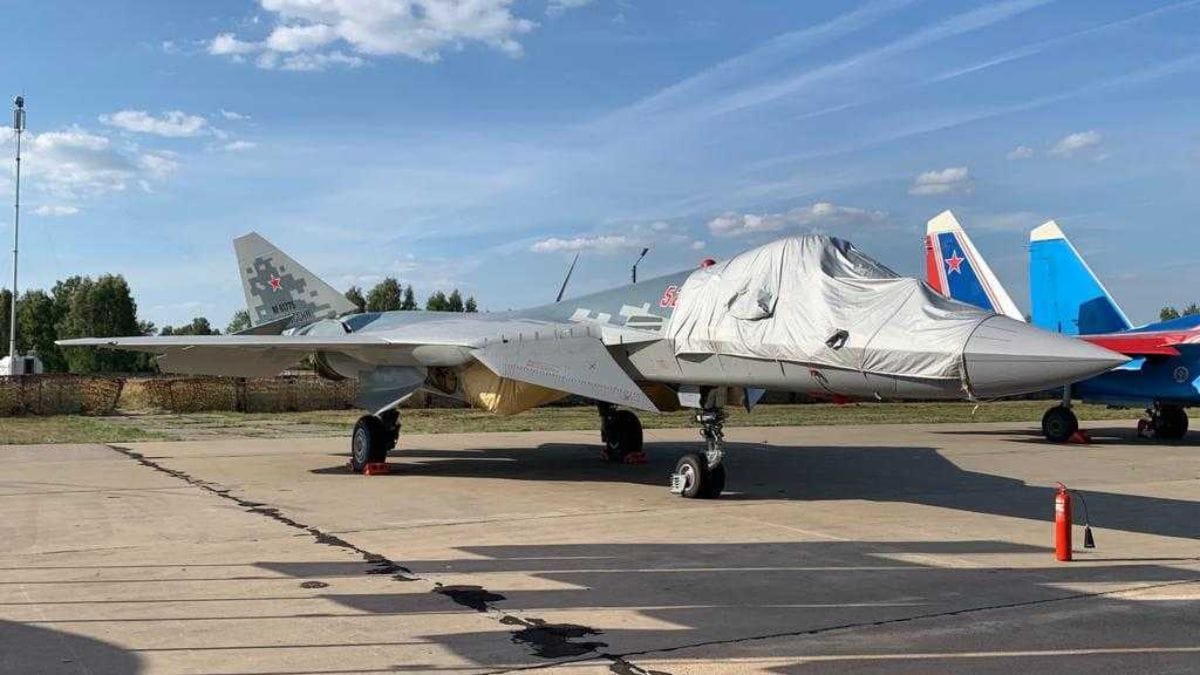
Chinese commentary on India-Russia defence cooperation has recently intensified, particularly around discussions on Su-57 co-production and the Reciprocal Logistics Exchange Agreement, or RELOS. These debates are framed in China as part of a wider strategic configuration, shaped by sanctions pressure, defence-industrial constraints, and evolving patterns of multi-alignment.
Following Russian President Vladimir Putin’s visit to China, early narratives on Chinese social media suggested Indian unease over the trajectory of Russia-China relations. One headline read: “After Putin’s visit to China ended, the most anxious country was neither the United States nor Japan, but India, which has long considered itself a world power.”
This framing shifted last week after Russia’s Federal Service for Military-Technical Cooperation confirmed ongoing negotiations on potential Su-57 co-production in India. In Chinese commentary, this is read as part of Russia’s broader effort to manage industrial constraints and sustain its defence export ecosystem under Western sanctions.
Also Read: From Kolkata to Quad, Marco Rubio’s India visit sparks anxiety and mockery in China
Su-57 in Chinese commentary
The prospect of India acquiring the Su-57 drew sceptical reactions on Chinese social media.
“France’s Rafale fighter jets have been shot down by Pakistan. India has now decided to purchase Su-57s to enhance its defence capabilities,” read one Weibo post.
Within Chinese discourse, the Su-57 is placed alongside China’s J-20 and J-35, as well as US platforms such as the F-22 and F-35, as part of a small group of fifth-generation fighters in service. However, discussions tend to focus on capability maturity, production scale, and operational reliability.
References to the Ukraine conflict are used as an interpretive benchmark. Claims about the Su-57’s roles in precision strikes, air combat, and suppression of enemy air defences are treated as limited battlefield validation rather than decisive operational proof. In this reading, potential production in India is seen as both technology transfer and industrial extension: a means of sustaining output, diversifying production risk, and addressing constrained domestic capacity under sanctions.
Across Chinese commentary, three analytical strands recur.
First, a capability diffusion argument holds that imported platforms do not automatically translate into decisive operational advantage. Their effectiveness is understood as dependent on systems integration rather than platform ownership, reflecting a broader shift towards networked warfare.
Second, Russia’s defence-industrial constraints are emphasised. Shortages of key components and production bottlenecks are seen as limiting output. Within this context, potential Su-57 production in India is interpreted as a way to ease capacity pressures and sustain exports under sanctions. At the same time, Russia is portrayed as balancing between China and India to retain room for manoeuvre.
Third, asymmetry in Russia’s Asian defence partnerships is a recurring theme. India is perceived as receiving broader defence and technological access to Russian systems than China, which is subject to tighter technological restrictions. This asymmetry is interpreted as reflecting shifting dependencies as China’s domestic defence industry has matured.
RELOS and the logic of managed interoperability
Zhang Chenyi, a PhD in International Relations at Moscow University, argues that, against the backdrop of the Russia–Ukraine conflict, US sanctions, India’s strategic autonomy, and Indo-Pacific competition, the Reciprocal Logistics Exchange Agreement (RELOS) goes beyond logistics. It allows India and Russia to access each other’s military facilities and deploy troops, ships, and aircraft for five years, including up to 3,000 personnel, five warships, and ten aircraft.
Zhang also describes RELOS as historically notable as the first instance of India institutionalising the potential entry of foreign military forces on its territory under predefined conditions. He notes that this level of access has not been granted even to the US despite its comprehensive strategic partnership with India.
Within this framing, RELOS is seen as an updated version of non-alignment centred on managed interoperability. It expands practical access and operational flexibility for both sides where India gains greater reach, energy security options, and strategic leverage across regions, while Russia secures opportunities to maintain influence, preserve markets, and ease logistical pressures under sanctions.
Also Read: Chinese say Beijing-Islamabad submarine deal will shake Indian Ocean. ‘Modi unable to sleep’
How China sees India-Russia defence ties
Chinese military analyst Du Jinwu argues that India’s experience with Russian defence cooperation — marked by delays, cost overruns, and dependence on external support — has reinforced concerns over reliability and technology transfer.
Despite renewed Russian proposals for Su-57 co-production, New Delhi has shown little interest, and is instead prioritising the indigenous Advanced Medium Combat Aircraft (AMCA) programme and greater defence self-reliance.
Against this backdrop, Chinese discourse portrays India-Russia defence cooperation as shaped more by structural constraints than strategic convergence. Sanctions pressures, industrial limitations, and shifting regional balances are seen as the main drivers of cooperation. India’s engagement with Russian platforms such as the Su-57, alongside mechanisms like RELOS, is interpreted as part of a broader pattern in which capability, production, and logistics are increasingly distributed across partners rather than embedded within a single strategic alignment.
Within this framing, the relationship is understood as one of managed interdependence where India pursues diversification and strategic autonomy, while Russia seeks industrial continuity and export resilience under constraints. The dominant view in Chinese discourse is one of necessity-driven cooperation rather than durable strategic convergence.
Sana Hashmi, PhD, is a fellow at the Taiwan-Asia Exchange Foundation. She tweets @sanahashmi1. Views are personal.
(Edited by Asavari Singh)
