

Why a speech by Pursuit Of Jade’s Zhang Linghe has divided Taiwan
TAIPEI – For Chinese actor Zhang Linghe, all it took was a greeting of “tak ke ho” – “hello” in the Taiwanese Minnan dialect – to spark rapturous applause from an audience that included many Taiwanese.
But his speech that followed, which saw the 28-year-old heart-throb calling for deeper cross-strait cultural and people-to-people exchanges, drew mixed reviews.
Fans were delighted to see his surprise appearance at the 18th Straits Forum in the Chinese city of Xiamen on June 13, but there was also scrutiny from Taiwanese critics and officials who labelled the move as political propaganda.
“Originally, Zhang Linghe was simply an artiste, but after being manipulated and used by (China’s) Taiwan Affairs Office, he has been tainted with political overtones,” said Liang Wen-chieh, deputy minister of Taiwan’s Mainland Affairs Council.
Zhang rose to fame in Taiwan after starring in the mega-hit Chinese period drama Pursuit of Jade that was aired in March, playing a fallen general.
He was invited to give a speech at the Straits Forum, hosted annually by the Chinese government in Xiamen, a city that is geographically closest to the self-governing Taiwan, to promote cross-strait civil, cultural and economic exchanges. China sees Taiwan as its territory to be “reunified”, by force if necessary.
The event – attended by businesspeople and youth from both sides, as well as Taiwanese opposition politicians and Chinese government officials – is viewed with deep skepticism by Taipei, which sees it as a tool to cultivate Taiwanese society to align with Beijing’s interests. Around 6,000 Taiwanese attended the event.
Key speakers included China’s Wang Huning, a Communist Party Politburo standing committee member in charge of dealing with Taiwan, who said that both sides of the strait belong to one China and share a common destiny.
Taiwan’s Chang Jung-kung, vice-chair of the Beijing-friendly opposition party Kuomintang (KMT), said in his speech that people on both sides of the strait belong to the Chinese nation, share the same origin and roots, and are bound by blood ties.
Zhang is believed to be the first Chinese actor invited to speak during the forum’s main plenary session, a stage typically reserved for high-profile businesspeople and sports legends.
In Zhang’s six-minute speech, he invited people in Taiwan to cross the Taiwan Strait, the body of water that separates Taiwan from the Chinese mainland, and visit China to see for themselves the “vitality and dynamism” of the mainland.
Many Taiwanese do go to China for work, study and holiday; according to official census data from China, around 157,000 Taiwanese residents are registered living there.
Noting that he has personally received many invitations from “friends in Taiwan”, he said he looked forward to deeper exchanges between the two sides of the strait in the fields of film, music and culture, and to more opportunities for young people from both sides to exchange ideas, interact and integrate.
“The power of culture can always transcend mountains and seas, connecting the hearts of compatriots on both sides of the strait,” he said.
While audiences in Taiwan enthusiastically consume Zhang’s work, experts told The Straits Times that this popularity does not necessarily translate into political support for China.
“Taiwanese can admire him as an actor, but that would be the same as them admiring actors from South Korean or Japanese dramas,” said Chen Shih-min, a political science analyst at National Taiwan University.
“Would this one person change how they feel about their identity and make Taiwanese people want to be governed by China? It’s very unlikely,” he said.
According to a long-running poll by National Chengchi University in Taipei, an overwhelming 87.8 per cent of people in Taiwan said that they want to maintain the cross-strait status quo of de facto independence.
Still, James Yifan Chen, a cross-strait relations expert at Taiwan’s Tamkang University, said that Zhang’s speech helped to generate cultural resonance and secure media attention.
“His speech won’t make Taiwanese view China as favourable overnight, but it could make China appear slightly less hostile,” he said.
On social media, Taiwanese fans were divided in their views. While some said that they hoped Taipei would address Zhang’s call for more cross-strait exchanges, others felt that he had exploited his Taiwanese fandom for political purposes.
“I really like him, but I still have a clear head,” read a comment on the microblogging platform Threads.
According to Tamkang’s Chen, Beijing’s choice of Zhang at the Straits Forum was highly strategic.
“He is an actor that is currently very popular, so many Taiwanese, especially younger people, would be more inclined to hear what he has to say, compared with a lesser known figure,” he said.
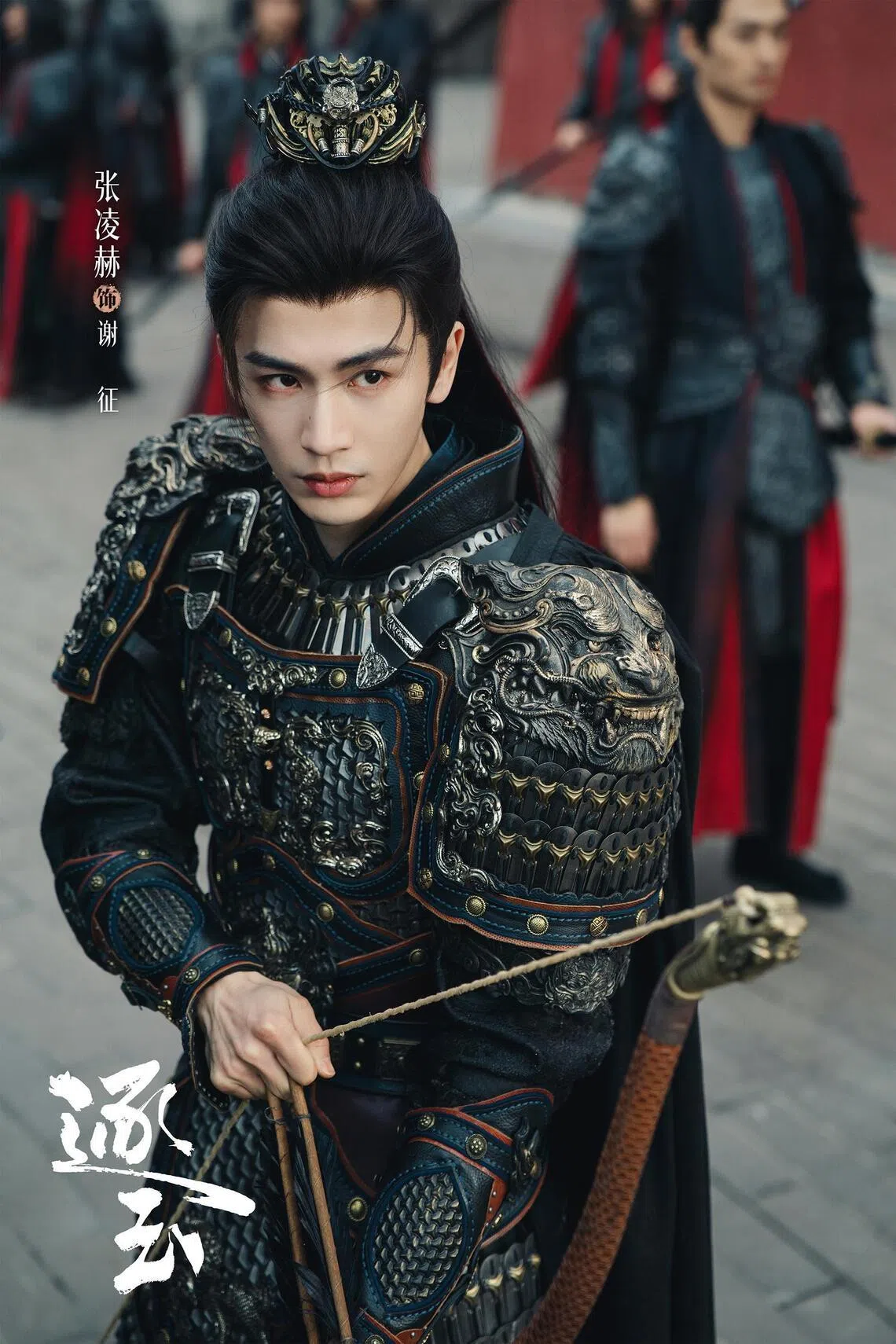
Zhang rose to fame in Taiwan after playing a fallen general in the mega-hit Chinese period drama Pursuit of Jade that aired in March.
PHOTO: PURSUIT OF JADE/WEIBO
Celebrities from both sides have long played a prominent role in cross-strait exchanges, serving as cultural bridges but sometimes becoming focal points of political tension.
In June 2024, popular Chinese actor Hu Ge paid a surprise visit to Taiwan, where he held a dialogue session with young Taiwanese film-makers.
Although the star of the hit Chinese period drama Nirvana In Fire (2015) kept his comments focused on his body of work, local media noted that he had flown in on the same flight as a delegation from the Shanghai Taiwan Affairs Office and questioned if his trip was politically motivated.
Taiwanese celebrities working in China also often face pressure to make political statements aligned with Chinese interests, such as sharing pro-unification posts online.
In 2024, dozens of Taiwanese celebrities, including singers Rainie Yang and Angela Chang, reshared on their social media accounts a post by Chinese state television channel CCTV that described Taiwan independence as a “dead end”, and said that reunification with China is “unstoppable”.
Taiwan’s Mainland Affairs Council has since warned that celebrities who echo or distribute Communist Party of China (CPC) propaganda could be fined up to NT$500,000 (S$20,500).
Earlier in April, Cheng Li-wun, chair of the KMT, had said that young Taiwanese who travelled with her to China had joked: “Why have you adults made cross-strait relations so complicated? You just need to invite Zhang Linghe to Taiwan.”
Given the amount of attention that has been generated by Zhang’s speech so far, Beijing will likely make more use of some popular celebrities to promote cross-strait interactions, including possible visits to Taiwan, said Tamkang’s Chen.
“This is a relatively low-risk, non-sensitive, approach, because even if you criticise these celebrities for doing ‘united front’ work, they can just say that they are participating in cultural exchanges,” he said.
China’s “united front” is a strategic political strategy and network used by the CPC to co-opt and influence individuals, organisations, and communities to achieve the party’s goals.
At a regular Taiwan Affairs Office press conference in Beijing on June 17, spokesman Chen Binhua said that China would be happy to see well-known mainland actors and singers visit Taiwan for exchanges. He emphasised that cultural exchanges can effectively connect people on the two sides.
Chen then asked if anyone would like Zhang to visit Taiwan.
“I hope Dilraba will go,” said a Taiwanese reporter, referring to Chinese actress Dilraba Dilmurat, who is Uighur by ethnicity and star of the hit drama You Are My Glory.
Chen said: “We will do our best to satisfy you.”
