
Donald Trump’s 100-day rampage has upended all expectations of the beginning of a presidency
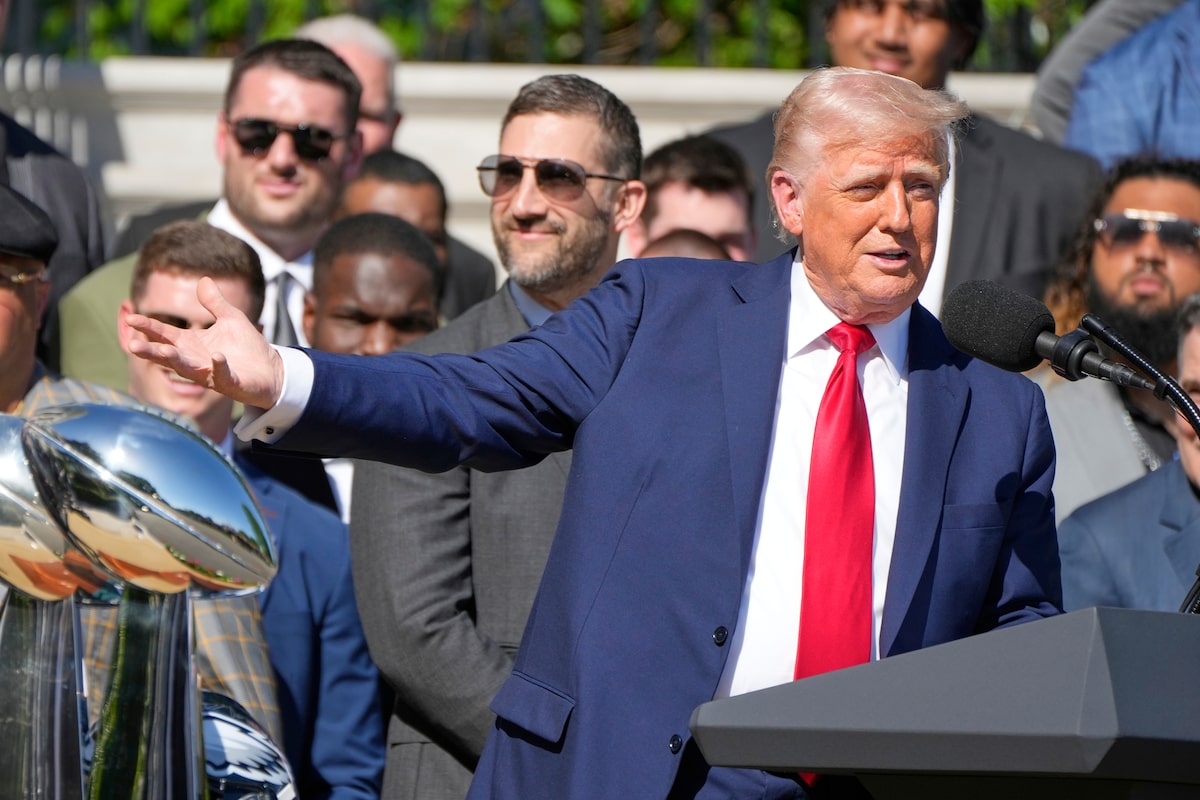
U.S. President Donald Trump speaks as he welcomes the Super Bowl champion Philadelphia Eagles to the South Lawn of the White House, in Washington, on April 28.Mark Schiefelbein/The Canadian Press
A national bank holiday. Programs to mobilize the unemployed to work in massive conservation and public-works programs. New regulations on the trading of stocks and bonds. Incentives to boost farm commodity prices by reducing agricultural cultivation. First steps toward ending Prohibition. In all, 15 major pieces of legislation that changed the character of the country, the capital and capitalism even as the presidency itself was dramatically redefined.
For 92 years – through 15 American presidents – Franklin Delano Roosevelt’s 1933 record of accomplishment in his first hundred days in office was the standard against which all succeeding chief executives were measured.
No longer.
Donald Trump’s dizzying hundred days, which end Wednesday, have upended all expectations of the beginning of a presidency.
They have established new standards for the depth and breadth of White House-driven change, raised fresh questions about the range of executive power, and minimized the importance of the judicial and legislative branches.
They have reshaped the country’s political and cultural life, upended the conventional byways of American political life, defied court orders, jeopardized longstanding diplomatic relations and undermined once-independent agencies, including – until Mr. Trump backed down last week in the face of wild shifts in the financial markets – the Federal Reserve Bank.
And in so doing, they have transformed reliable allies such as Canada, the European countries, Japan and South Korea into trade rivals – and left them shocked at how swiftly and how profoundly the defining colouration of their international profiles, and their decades-long assumptions about their national defence, have been wiped away.
U.S. president Franklin Delano Roosevelt is pictured at his desk in 1936.Keystone Features/Getty Images
“The Trump hundred-day approach is unprecedented in modern times in terms of the breadth of its policies and the degree to which things are happening through unilateral executive action,” said Andrew Ballard, a Florida State University political scientist. “The big change is how presidential administrations make change. We know presidents try to enact a part of their agenda right out of the gate, but the difference here is what is being done by the executive branch alone.”
Though courts have paused or stopped more than 100 Trump initiatives, overall his actions are taming, if not destroying, the regulatory state, which was the legacy of a Republican president (Theodore Roosevelt, 1901-09) and a Democratic president (Franklin Roosevelt, 1933-45). A sprawling, aggressive central government has been an element of American life that has survived efforts, by presidents dating to William Howard Taft in 1910, to pare back the federal government. Four of the past seven presidents have attempted to make the government more efficient, but none with the swiftness and indiscriminate cuts that characterize the Elon Musk effort.
Other presidents – perhaps lacking Mr. Trump’s intensity and ego, perhaps more sensitive to the constitutional limits of the presidency, perhaps not willing to associate their time in office with the perilous circumstances that gripped the country during FDR’s administration at the depths of the Great Depression – tamped down hundred-day expectations, looking instead to the long game.
“All this,” John F. Kennedy said of his vision in his famous 1961 inaugural address, “will not be finished in the first one hundred days,” adding, “Nor will it be finished in the first one thousand days, nor in the life of this administration, nor even perhaps in our lifetime on this planet. But let us begin.”
U.S. president John F. Kennedy delivers his inaugural address on Jan. 20, 1961, after taking the oath of office on Capitol Hill in Washington.Uncredited/The Associated Press
Five days after Mr. Kennedy was assassinated in 1963, his successor, Lyndon B. Johnson, picked up the theme, saying to a joint session of Congress, “Let us continue.” But Mr. Trump seems determined to leave nothing to chance, or to his successors. He made it clear in his first hundred days that he was determined to take that period – chosen and named as a tribute to the Hundred Days between Napoleon’s escape from his Elba exile and his defeat at Waterloo – to finish his initial agenda, and to finish off his opponents and the irritating constraints that stymied his predecessors.
The British, reacting to their disastrous experience in Afghanistan in the middle of the 19th century, applied a notion first expressed by the 18th century poet William Cowper. That concept of “masterly inactivity” is the very opposite of the Trump doctrine in Washington, which the President considers a hostile enemy capital and whose denizens – their comfort, ease and customs disrupted – regard his administration as a belligerent occupying army.
Instead, at age 78, Mr. Trump has pursued masterful, almost frantic, activity, while displaying an astonishing capacity for work at all hours. He is an old man in a hurry, replicating if not exceeding the undisciplined late-night work habits of Bill Clinton, who was 32 years younger at the time of his first hundred days.
Andrew Coyne: A tale of two elections: Trump vs change made for an uncertain mandate
Gary Mason: Donald Trump is the cautionary tale Canada needs to heed
Last week, Mr. Trump sent out social-media attacks on a federal judge, public radio and television, and Canada, between 1 a.m. and 2 a.m. in the morning. Dwight Eisenhower went to bed in the White House on Election Night 1960 at 10:30 p.m., nearly 14 hours before the results were clear.
FDR’s flurry of activity and achievement was largely confined to the United States. By contrast, Mr. Trump is supranational, meaning that his policies have vast implications that go well beyond the boundaries of the United States. These policies have, for example, prompted turmoil in global markets and, a matter of first importance in North America, disrupted decades of congenial and familial relations, along with established trade patterns, between Americans and Canadians.
For two centuries, American politics has been marked by controversies over the reach of presidential powers. Campaigning for president in 1840, William Harrison, the eventual winner, said, in a reference to his two predecessors (Andrew Jackson and Martin Van Buren), that considering one person “the source from which all the measures of government should emanate is degrading to the republic, and of the most dangerous tendency.”
About 84 years later, Mr. Trump has signed more executive orders in his first hundred days than any other president in that period. The more than 130 such orders is more than double his first-term average for an entire year. His initiatives have undermined the role of Congress and, as Jack Goldsmith, who led the White House Office of Legal Counsel under president George W. Bush, put it in a New York Times video conversation, “The executive branch has basically been attacking Congress’s appropriation power, its core power.”
Mr. Trump signs an executive order establishing the Energy Dominance Council led by Secretary of the Interior Doug Burgum in the Oval Office at the White House, in Washington, on Feb. 14.Andrew Harnik/Getty Images
On six critical issues, majorities of voters believe Mr. Trump has gone too far, according to a New York Times/Siena College poll released over the weekend. The public skepticism about the President’s policies and the weariness of administration chaos have eroded the President’s standing more swiftly than in his first term. The latest Reuters/Ipsos poll put approval of Mr. Trump’s handling of the economy at 37 per cent, his lowest rating in either of his terms.
For that and other reasons, Mr. Trump’s critics believe that comparing the 32nd president (who extended a defence umbrella with Canada before the Second World War) with the 47th president (who has taunted Canadians with tariffs and talk of taking over the country) is inappropriate.
“FDR used all of his energy and talent of his brain trust to create and build up and help people,” said Susan Dunn, a Roosevelt expert at Williams College in Massachusetts. “Trump is maliciously, mendaciously, and nefariously setting out to destroy – universities, law firms, other institutions, sometimes with their own collusion. The two presidents and their first hundred days couldn’t be more different.”
A telling measure of the effect of Mr. Trump’s beginning days comes from a Northeastern University undergraduate course that is examining this period.
“This hundred days has moved with incredible velocity,” said Jonathan Kaufman, one of the professors of the course and the director of the university’s School of Journalism. “When we got to 93 days I thought we had gone through eight years. But unlike eight years ago, there was a sense among students of outrage and going to the barricades. This year they are more reflective. They’re trying to figure out what it means rather than automatically go into opposition.”
Figuring out what Mr. Trump means in the broad arc of American history will take more than a hundred days. It will be the preoccupation of scholars for decades.


