
Letters to the editor, May 13: ‘Wrong to claim that the decisions of unelected judges are undemocratic’
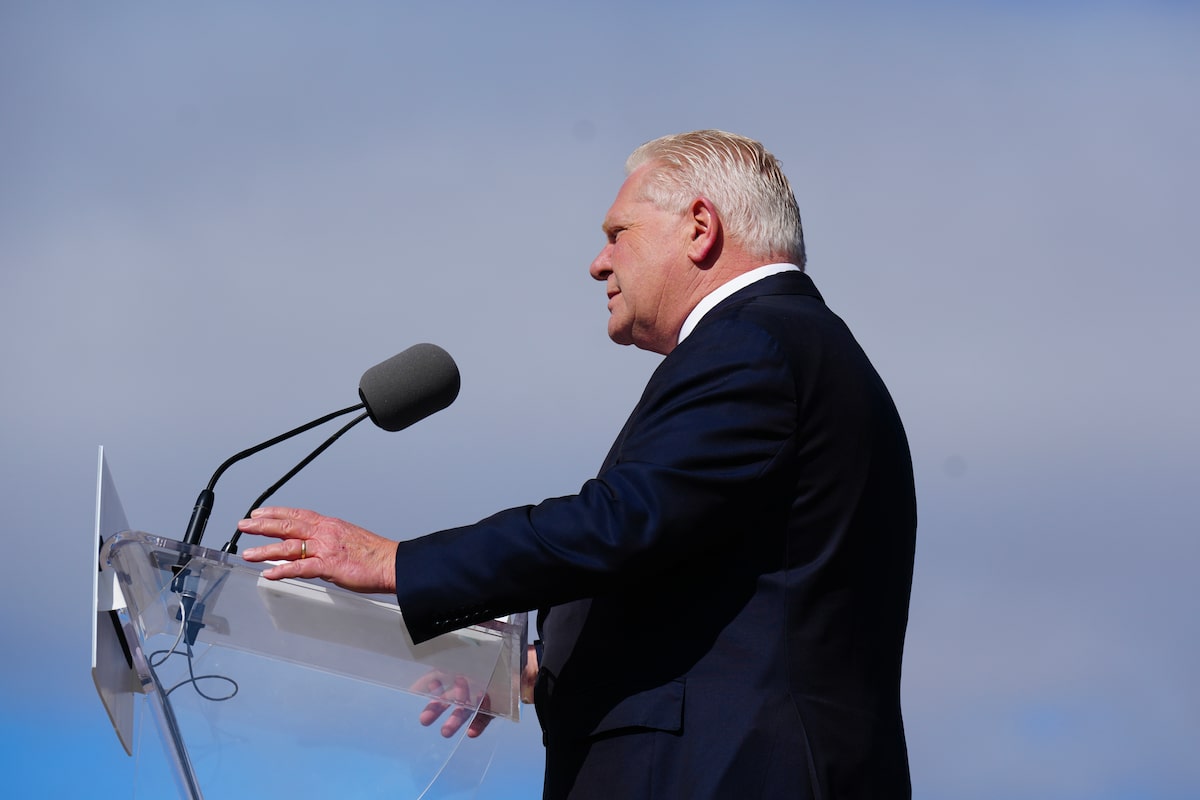
Ontario Premier Doug Ford speaks to journalists during an availability in Mississauga, on April 30.Chris Young/The Canadian Press
Back and forth
Re “U.S., China agree to pause most tariffs after trade talks” (Online, May 12): Have I got this right? This “deal” seems to be nothing more than a Trump turnaround on tariffs imposed on China, and China’s withdrawal of its retaliatory response.
Aren’t these largely the same circumstances that underpin the yet-to-be fleshed out “deal” between the United States and Britain? I am perplexed why coverage emphasizes dealmaking rather than backtracking.
Pat Evans Toronto
Re “Trump announces U.S. trade deal with Britain, says ‘final details’ still to come” (May 9): In the cold light of day, the new U.S.-Britain trade agreement will likely be understood to be an economic “nothingburger” – no beef, no bun, no condiments, not a hint of gluten.
Ron Freedman Toronto
Judge of that
Re “Doug Ford’s unjustified contempt for courts” (Editorial, May 8): If the courts are prepared to usurp the role of our duly elected politicians and rule on detailed policy decisions, they should expect the same degree of criticism that our politicians attract.
I am not fooled by the claim that the courts are merely “interpreting” Section 7 of the Charter.
Hubert Hogle Greater Napanee, Ont.
I’m extremely concerned when I see a politician (a premier, no less) who doesn’t understand the system in which he operates. Canada is not just a democracy, it’s a liberal democracy.
Democracy is a form of government in which political power vests with the people. That’s why elected officials are supreme when it comes to creating laws.
Liberalism is a political philosophy that prioritizes individual rights. That’s why if a law breaches an individual right, it should not be allowed to stand.
In Canada, unelected judges decide whether a law breaches an individual right. This is because they are considered most able to make objective decisions.
It is therefore wrong to claim that the decisions of unelected judges are undemocratic. They limit government overreach, thus balancing the work politicians do in maintaining our liberal democracy.
Liz Tinker Toronto
On the other hand
Re “Right fit” (Letters, May 9): I respectfully, and totally, disagree with a letter-writer who believes that “only a proportional representation system would guarantee a true and fair representation of what voters want.”
In representative government, we vote to select our representative. This person is delegated to attend Parliament to represent the community that exists in their riding.
Elections are not intended as referendums on a particular leader or even a particular party. That idea does not exist in the Constitution, but is rather a figment of the horse-race mentality and power-hungry desires of backstairs string-pullers. Proportional representation would deliver the election of representatives to backroom politicos.
The sooner we get back to representative governments, the better. Knowing we have a representative that we picked should soothe our community psyches.
Bring on transferable votes, which would help build consensus at the community level.
Alan Ball New Westminster, B.C.
In a proportional representation system, negative campaigning is often less effective because attacking one party doesn’t guarantee gains for another, diluting the impact of antipathy.
In contrast, first-past-the-post can foster two-party dominance, where hostility toward one side directly benefits the other, thereby incentivizing divisive, adversarial politics.
Between foreign bots on social media distorting reality and the growing hostility in politics, it’s time to remedy this issue.
Pete Reinecke Ottawa
Purchasing power
Re “Ontario’s Darlington SMR project to cost nearly $21-billion, significantly higher than expected” (Report on Business, May 9): Ontario electricity ratepayers and taxpayers may wish to recall that Ontario Power Generation’s small modular reactor project has never been subject to meaningful external economic or environmental review.
Other jurisdictions that have considered small modular reactors are now pulling back in the face of rising cost estimates and questions about technological viability. Alone in trying to proceed regardless of these risks, Ontario seems to be setting itself as a test case for others to see just how badly the SMR experiment can go wrong.
Mark Winfield, Co-chair, Sustainable Energy Initiative, faculty of environmental and urban change, York University; Toronto
Channel changer
Re “Trump’s film tariff threat resurrects row over treatment of U.S. platforms in Online Streaming Act” (May 8): Further to personal commentary I provided in this article, I am writing to provide additional context at a critical time in the Canada-U.S. trade and investment relationship.
My comments – which were mine alone and not reflective of any clients I represent – come as the Trump administration advances an aggressive “America First” agenda.
As Mark Carney looks to make life more affordable and defend Canadian interests, I see no compelling reason to continue implementing the Online Streaming Act. This Trudeau-era policy is now firmly in Washington’s sights and risks deepening the affordability crisis here at home.
Scrapping it would send a strong early signal that this is a new government charting a different course.
Adam Taylor, former senior trade adviser, Global Affairs Canada; Ottawa
Talk, talk
Re “Ontario reports 200 new measles cases as province struggles to contain outbreak” (May 9): Ontario Chief Medical Officer of Health Kieran Moore says “the more he speaks, the more fear can be created.” In that case, he should be speaking 24/7.
The only reason for getting vaccinated is fear of disease. How many children need to be in intensive care before parents need to be afraid? How many, God forbid, need to die?
If Dr. Moore cannot understand this, he should be replaced immediately.
Ira Greenblatt Ottawa
Risk communication is a critical component of risk management. Unfortunately, trust in the credibility of public health was compromised during the pandemic, resulting in missed childhood vaccinations and increased negativity toward immunizations.
Perhaps applying research-proven best practices in risk communication, as taught by renowned experts in the field such as Vincent Covello, director of the Center for Risk Communication, is needed to increase effectiveness.
The challenge now is to find the right words.
Joanne Malvern BScN (public health), Toronto
One of the most contagious diseases in the world that was effectively eliminated now re-emerges due to ignorance and false narratives. With all due respect, it is time for fear.
Bernadette Lonergan Toronto
Re “Easy as…” (Letters, May 9): A letter-writer thinks “surely we can do better.” We did do better.
I was born in 1958 and was vaccinated in school along with my classmates and every other student in Ontario. No permission slips required.
Janice Couch Kingston
Letters to the Editor should be exclusive to The Globe and Mail. Include your name, address and daytime phone number. Keep letters to 150 words or fewer. Letters may be edited for length and clarity. To submit a letter by e-mail, click here: [email protected]

